
|
One of the most important trees in India is Neem tree. It is very famous for medicine. The bark, leaves, flowers, seeds and fruit pulp are used to treat a wide range of deseases. It is also use in tooth paste, skin problem and ulcers. Most of Indian people use the branch of tree for cleaning the teeth in the morning and also eating the new born leaf. Really this tree is boon for us. |
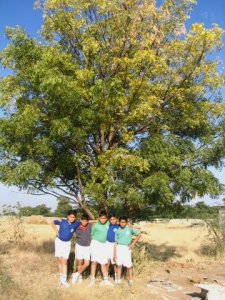 |
Neem tree is use in timber. Besides being hard and fast growing, its chemical resistence to termites makes neem a useful construction material.Neem is a fast growing tree that can reach a height of 15-20 m, rarely to 35-40 m. It is evergreen but under severe drought it may shed most or nearly all of its leaves. The branches are wide spread. The fairly dense crown is roundish or oval and may reach the diameter of 15-20 m in old, free-standing specimens. The trunk is relatively short, straight and may reach a diameter of 1.2 m. The bark is hard, fissured or scaly, and whitish-grey to reddish-brown. The sapwood is greyish-white and the heartwood reddish when first exposed to the air becoming reddish-brown after exposure. The root system consists of a strong taproot and well developed lateral roots. |
The alternate, pinnate leaves are 20-40 cm long, with 20-31 medium to dark green leaflets about 3-8 cm long. The terminal leaflet is often missing. The petioles are short. Very young leaves are reddish to purplish in colour. The shape of mature leaflets is more or less asymmetric and their margins are dentate with the exception of the base of their basiscopal half, which is normally very strongly reduced and cuneate. |
 |
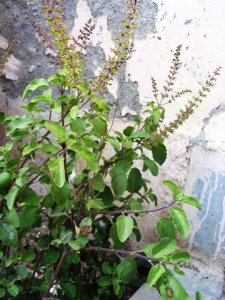 |
Tulsi plant is famous in India. It is often seen at numerous Hindu temples because it is sacred for us. Anyone find these plants in Hindu family. In the morning time all Hindu people pray to tulsi. It is also use in tea and medicine. During the cough in cold season Indian people make the tea of tulsi then get the relief. The name 'Tulsi' connotes "the incomparable one". This sacred Basil, Ocimum Sanctum, is a fragrant, medicinal plant that also keeps away mosquitoes and flies. It offers a herbal remedy for serious ailments like inflammation, heart disease, various forms of poisoning, malaria, diabetes, hepatitis and psychosomatic stress disorders because of its anti-bacterial, anti-fungal and anti-viral properties. |
The Ashoka tree is a flowering tree considered sacred throughout India and where it is found. It is prized for its beautiful foliage and flowers. The Lord Buddha was born under this tree. The Hindus regard it as sacred. The tree gets a mention in the Ramayana. One of its varieties is a very handsome, small, erect evergreen tree, with deep green foliage. Its flowers are very fragrant and are bright orange-yellow in color and later turn red. |
 |
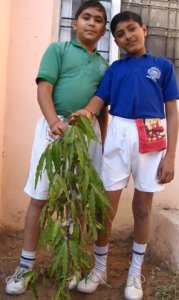 |
Ashoka is a Sanskrit word meaning without grief or that which gives no grief. Of course, the tree has many other names in local languages as well. One such name means the tree of love blossoms. The Hindus regard it as sacred, being dedicated to Kama Deva, God of Love. The tree is a symbol of love. Its beautiful, delicately perfumed flowers are used in temple decoration. There are also festivals associated with this flower. It is planted in Buddhist monasteries. |
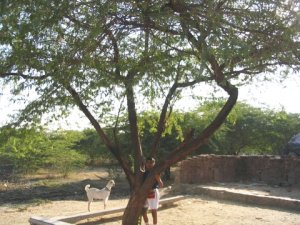
Acacia properly known as babul, is a large tree up to 14 meters high, with thorns on its branches. It has darkish grey bark and yellow flowers in the spherical heads. Babul tree is indigenous to Sind in Pakistan. It occurs wild in India and tropical Africa. The bark, the leaves and fruits of the tree contain tannin and gallic acid. The various parts of babul tree are useful in medicine. |
 |
 |
Date tree. Dates have a high tannin content and are used medicinally as a detersive and astringent. As an infusion, decoction, syrup, or paste, dates may be administered for sore throat, colds, bronchial catarrh, and taken to relieve fever and number of other complaints. One traditional belief is that it can counteract alcohol intoxication. The seed powder is also used in some traditional medicines. A gum that exudes from the wounded trunk is employed in India for treating diarrhea. The roots are used against toothache. |
Thank you to Anurudh Kumar and students from the Sangam School of Excellence in India. |
| Go back to the map |  |