
|
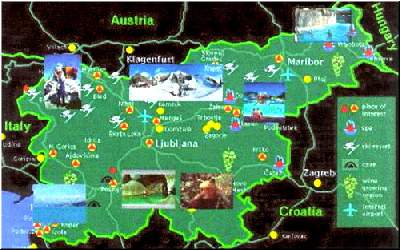
Slovenia is just a small country, but it is very beautiful.
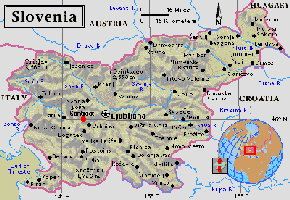
On the map it has a shape of a hen. It borders on Italy in the west,
Austria in the north, Hungary in the east and Croatia in the south.
In the south-west we have some beautiful sea - it is a part of the Adriatic
Sea.
|
 |
|
The population of Slovenia is about two million. It is in the middle of Europe. There are many forests here (about 55 % of the territory), as well as mountains, plains, valleys, rivers, waterfalls and lakes. We have good wines and food. We can't name them in English - because they are not English - we call them struklji, jota, potica and prekmurska gibanica …these are only a few of them. In summer we have a great time at the sea. In winter we go skiing in the mountains. Or you can go skiing in the morning and swimming in the spas in the afternoon… |
 |
The most famous Slovenian sights
are The Postojna Cave, The Skocjan Cave and Karst in general (this type
of landscape was named after our Karst - or Kras as we call it), the
Cerknica Lake, Lake Bled, Lipica (with Lipizzaners), and many others.
Slovenia is a very interesting country to visit. A lot of tourists visit Slovenia and return again. We hope you join them one day! |
|
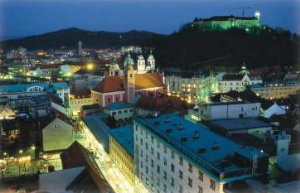
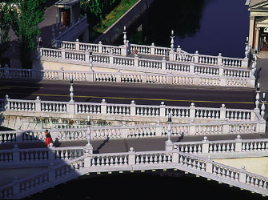
Ljubljana is our capital city. In Ljubljana there
is a castle and a river called Ljubljanica. There is the tromostovje
(Three bridges), rovtož (Town Hall) and the NUK(narodna univerzitetna
knjižnica - National University Library) In ljubljana there is
the biggest shopping center BTC and the very famous cinema called the
Kolosej (Colosseum). If you are hungry, you can go to many restaurants.
The mayor of Ljubljana is Danica Simšic .
|
 |
 |
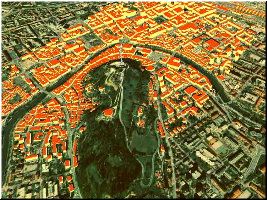 |
Ljubljana is in the center of
Slovenia . People lived there four thousand years ago and we have some
archaelogical foundings about it.
They lived in the barje of Ljubljana - a kind of swamp. |
|
About two thousand years ago it was a Roman forth. In that time the town was called Emona. The city isn't big. It has a population of about three hundred thousand. It has a lot of old buildings. The old buildings were made after the earthquake in 1958. There are many schools and a university. |
|
Lake Bled with its Island
|
 |
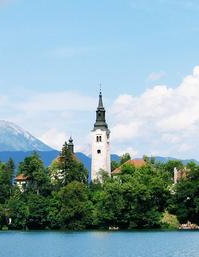 |
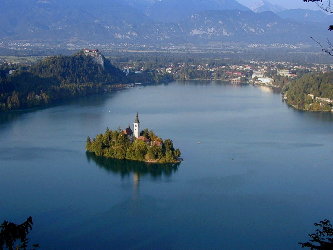
There's is an island in the middle of the lake with a church on it and people believe that their secret wishes will come true if they make the bells in the church ring. In summer Bled is very popular for swimming in the lake and mountaineering. In winter the lake freezes and you can skate on it or - which is even more interesting - walk on ice all the way to the island and make your wishes come true. |
|
The Oldest
Vine in the World
Slovenia is a wine growing country, producing red and white wines of high quality. Maribor, a city in north-east Slovenia, was the centre of lively wine trade in the Middle Ages. In the old city centre the visitor to Maribor can see an amazing ancient vine. |
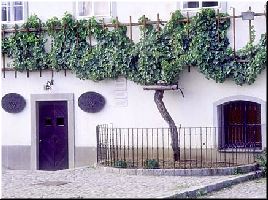 |
It grows next to an old town house,
near its main entrance. The vine is 400 years old and it is the oldest
vine in the world. This record is in the Guiness Book of Records. Many
people believe that it is the oldest vine in the world, too, but this
is difficult to prove.
|
|
Every year the vine produces 35
- 55 kg of grapes, which gives up to 100 bottles of wine. The grape
harvesting is a traditional event and many people come to Maribor to
see how the wine is produced. The wine is called »MODRA KAVCINA«
Specially designed bottles of »modra kavcina« are used mainly
for protocol. Pope John Paul IInd and the USA president Bill Clinton
got a bottle of this wine as a present when they visited Slovenia.
|
|
Predjama Castle
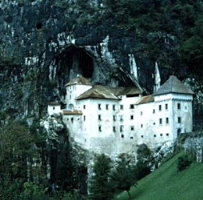
Near Postojna there is the famous Predjama Castle. It was built in 1201. It is special because a a big part of the castle was built in a cave. There is an interesting legend about this castle and the kinght who lived there- Erazem. People say that Erazem Predjamski ("Erasmus from Predjama") once insulted a very important Austrian colonel, Pappenheim. The dispute led to a duel where Erazem fought bravely and killed Pappenheim. Soon after that an army was sent to Predjama castle to kill Erazem. |
 |
|
When the castle was attacked, the enemies
threatened Erazem and his people from outside the castle because they
thought that they will sooner or later die of hunger. But the legend
says that there was a secret passage between the castle and the Vipava
valley, about 30 km away. The Vipava Valley is situted in a warm part
of Slovenia where people grow a lot of vegetables, fruit and cereals.
The passage is believed to end behind the castle.Erazem got all the
food from the Vipava valley through the secret passage and didn't die
of hunger. He was hiding in his castle for a long time but unfortunately
one of his servants betrayed him. He let his enemies know which part
of the castle Erazem was in at a certain moment. Erazem was then killed
by a shot from his enemies' cannon while he was sitting on the toilet.
|
 |
Planica
|
|
Planica is where ski-flights were born and where the
first man was carried beyond the magic 100-metre mark - and recently
also over 200 metres.
|
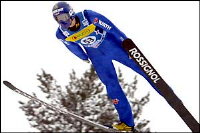 |
The current world record is held by Matti Hautämaki
of Finland- 231 m from Planica in 2003.
|
|
The Partisan
Hospital Franja
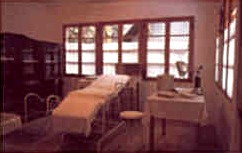
The Franja Partisan Hospital, named after the physician Dr. Franja Bojc Bidovec,operated in the period from 1934-45 in Dolenje Novake near Cerkno. The hospital was established for the treatment of wounded soldiers and severly ill persons from the operating territory of the 9th Corpus of the Slovene Partisan Army, which fought against the Germans in the Primorsko (Littoral) and part of the Gorenjska regions towards the end of 1943. |
 |
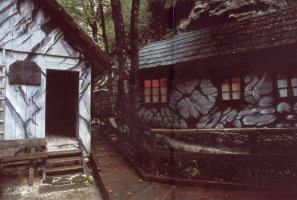 |
In November, the partisan units
and their wounded soldiers retreated to the Primorska region, when the
idea of building a hidden partisan hospital began to take root. At the
end of 1943, the first cabin was built in the almost inaccessible Pasica
gorge and on 23 December it accepted the first wounded soldiers.
Altogether some 1000 patients were treated in all the departments. It is surprising that the hospital had many facilities, such as an X-ray cabin and a power plant. |
|
The most difficult moments in
the "Franja" hospital were in March 1945 when the Germans
came very close to the hospital and the gorge was under heavy enemy
fire. But the hospital survived the attack thanks to its secret location
and the help of local people.
Today, the Franja Hospital is on the UNESCO's list of world cultural heritage and visitors from all continents come to Slovenia to visit this place. |
|
Wine and Prosciutto
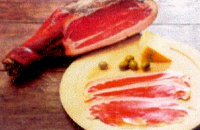
The most known slovenian wine is so called Teran. It's produced from grapes of wine called refošk, but only on Karst, where is red soil. And from this type of soil the wine has its colour and taste. |
 |
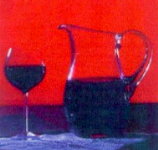 |
Because of its characteristics it goes haud to haud with prosciutto, wich is also a speciality of Karst. This is ham with bone dried in wind. Its very healthy and recomended in slimming cures. Red wines are known by their flavonoids, which are so good for our cells. And this combination: Teran and prosciutto is ideal for aenemic people -what else can you wish? »mmmmmmm«! |
|
We also have Ice Wine, because
the grapes are picked only when the frost has been in the vineyards
for several days.
We hope we've brought you some taste of Slovenia and made you curious enough to come to our country. |
|
Vintage
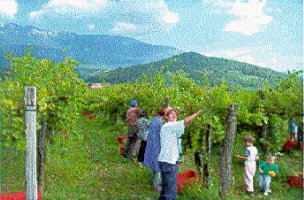
In Slovenia we have a lot of wine. The most popular wines are: cvicek,teran,… We have a lot of vineyards. They are very big. In our region are a lot of farms with vineyards. In autumn we have vintage. Our friends come to help us. After the vintage we have a party. |
 |
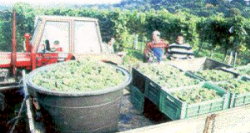 |
The 11th of November is called St. Martin's
Day (Martinovo). On that day the must turns into wine. On the first
Saturday after that day we invite the people who helped us with the
vintage to celebrate it with us.
|
|
Potica
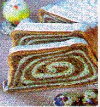
Potica is Slovenian food. It can be made from different things like flour, eggs, milk, sugar, butter, yeast, salt, lemon zest, crumbs of bread, honey, cinnamon, rum, raisins and walnuts. The people like it very much and we only have it for birthdays, Easter, Christmas and other special days. It is very good. It is very difficult to make. My grandmother has a special recipe for it. |
 |
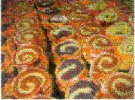 |
She makes it on Christmas. All
the family visit her and enjoy it. We have a lot of different kinds of potica: ~ coconut potica ~ chocolate potica ~ walnut potica ~ chestnut potica ~ poppy seed potica … and others. In Slovenia we have a lot of traditional food! All this food is very good. We are very proud of it!!! |
|
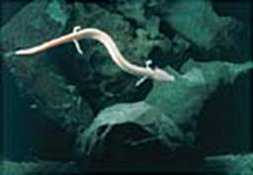
Proteus Anginus One of the Slovenian interesting things is a small fish. Its name is proteus anguinus. It only lives in Karst caves. It is the colour of human skin - the slovene names for it means human fish. It is obout 20-30cms long. It's one of the longest animals in European caves. Two kinds of human fish live in Slovenia. |
 |
 |
Lipizzaners
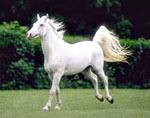
Founded in 1580, the Stud-farm of Lipica is one of the most attractive cultural and historical sites of the Republic of Slovenia, situated close to the border with Italy. Here, the tradition of breeding and selection of pure Lipizzan Horses has been alive for over than four hundred years. |
|
The Lipizzaner Horse's ancestors
can be traced back to 800A.D. they were Berber horses were then crossed
with Karst horses.
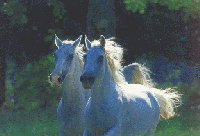
Stud-farm Lipica has 400 years old tradition of breeding the famous white horse. This is the original home of Lipizzaners rase. |
 |
 |
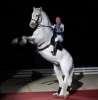
After the second World War, Lipica succeeded
to develop its own Classical Riding School, and presented it in the
equestrian events and presentations all over the world.
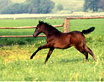
An interesting fact is that the Lipizzaners aren't white when they are born, but brown or even black. |
|
The intact nature, riding courses with
beautiful Lipizzan horses, a nice trip in a carriage and pair through
the parks of Lipica, ponies for children, a tour to the oldest stud-farm
of Lipizzan horses in the world and look at the majestic gaits of the
white horses dancing to music in the show of the classical riding art
the dresage.
Those guests who desire to spend a holiday or least a weekend in Lipica can stay in one of the two hotels, Maestoso or Klub Hotel Lipica. |
 |
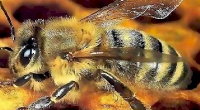 |
Carniolan Honeybee In Slovenia we have 550 different kinds of bees. The best known is Carniolan bee. It is a honeybee. Honeybees make honey, but they also pollinate flowering plants. Honeybees are social insect. |
|
That means that they live in colonies,
where each of them has a role. Workers , are the smallest, are all females.
They feed the others, guard the hive entrance, collect nectar to make
honey and produce wax comb. Each colony has only one queen. The queen
produces eggs. Honeybees are friendly insects but you must be careful
with them.
|
|
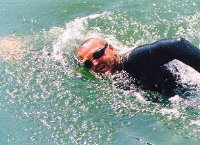
Our Athletes Martin Strel. He was born on 1st October, 1954. He was educated to be a musician - a guitarist, but since 1978 he has been the professional marathon swimmer. At first he competed in The World Cup, but now he swims solo. He has two children, daughter Nina and son Borut. |
 |
|
In 2000 Strel swam the length
of the Danube, a major European waterway. Swimming three extra stages
meant that he covered a total of 1867 miles on the river. This was his
first achievement to get him a mention in the Guinness Book of Records.In
2001 Strel managed to break yet another world record on the Danube.
This was the record for non-stop swimming. By covering 313 miles in
84 hrs and 10 min, he set the new world record in long-distance swimming
in July 2001.
Strel's greatest achievement is from 2002 when he managed to swim the Mississippi (2360 miles in 68 days ). 2004 - Martin Strel swims Yangzi or Yangtze, also Chang Jiang, longest river of Asia, in China, about 6,300 km (3,900 mi) in length. |
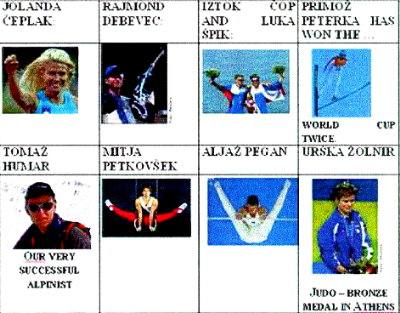 |
Some other Slovene
athletes. And there are many other excellent athletes we are proud of.
|
|
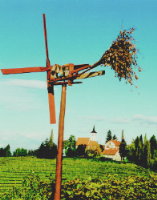
Klopotec - a bird-scaring rattle Klopotec - bird-scaring rattle. Klopotec - a wooden device for scaring birds away from vineyards. The klopotec that can still be found in the north-east of Slovenia is an original Slovene product.
|
 |
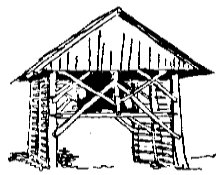 |
Kozolec - hayrack
The kozolec (hayrack) is a free standing, permanent, mainly wooden, vertical, open but roofed device for drying and storing the goods: hay and grain. Some thirty different types can be distinguished by their construction, most of them found only in Slovenia. The use of the hayrack: at first, it was used for storing grain (food for the people), and later, for storing fodder (for animals only). Today, due to the introduction of cheaper technology, it is only a remnant of former times is the only ethnical architecture I know: it exists exclusively in ethnical territory of Slovenian nation. |
|
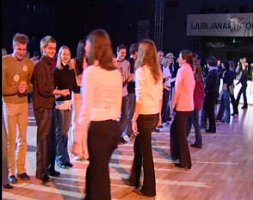
Quadrille - cetvorka May 23rd 2003 was the last day of the school lessons for students of the fourth class of the secondary school.In our capital town Ljubljana 4240 students gathered on the Slovenska ulica (one of the main streets in Ljubljana - our capital).They danced synchronous quadrille (or "cetvorka" in Slovene) by Strauss music together with the other students from 14 Slovenian towns. |
 |
|
The world record from the year
2002 in the synchronous dance was improved again- together 12.932 secondary
schoolgirls (orange T-shirts) and schoolboys (black T-shirts) danced
in the streets at the same time. The record entered The Guiness Book
of Records, too.
Students are going to dance in the streets in the next years, too. |
 |
We're sorry if this is too long - we could even write more …. but we've done our best to shorten the text - we'd like to tell you so much about our country and ourselves. Hope to meet you here one day! Best wishes from Dobravlje, Slovenia! |
 |
Go back |