
25 facts about Uzbekistan
|
Welcome to Uzbekistan
- an oasis of peace, a land where ancient history and liberal culture
converge. It's the oldest land in Central Asia having a twenty-five
centuries long history, the country with the arranged specific historical
and cultural community different from that of other regions.
|
 |
|
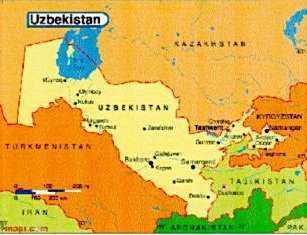
General information: The Republic of Uzbekistan is located in the middle of Central Asia and shares its borders with Kazakhstan, the Kyrgyz Republic, Tajikistan, Afghanistan and Turkmenistan. The area of Uzbekistan is part of the Aral Sea basin. Population: The population of Uzbekistan is more than 24 million people. Over 60% of the population live in rural areas and of these people, over 40% are under the age of 16. The Republic of Uzbekistan consists of 12 regions (oblast) and the Autonomous Republic of Karakalpakan. Geography: Deserts occupy 80 of the territiry of Uzbekistan, mountains - 15%. The main rivers running in the territory of Uzbekistan: - the Amu Darya and the Syr Darya.Climate: The climate of Uzbekistan is extremely continental with a great number of sunny days. Average monthly temperature in January is from 10 to +3ºC. Summer is hot and dry. Average monthly temperature in July is from +35 to +45ºC. Autumn is warm enough and is the season when delicious fruits and vegetables are in abundance in numerous bazaars (markets). Average annual temperature is 13ºC.Cities: Some of the world's most audacious and beautiful examples of Islamic religious buildings are to be found in Uzbekistan's Bukhara, Khiva and especially Samarkand. |
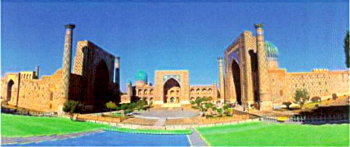 |
SAMARKAND is one of the oldest
cities in the world, established during the middle of the first century
under the name Marakanda, later it was Afrosiab. The city was conquered
by the troops of Alexander the Great, the Arab Caliphate and Gengis
Khan. It was the capital of the powerful state of Sogd, the center of
Amir Temur's great empire. Temur was the one who cared about the beauty
of the city and its strength as a major capital city in the region.
The numerous monuments of Samarkand and its suburbs impress tourists.
|
|
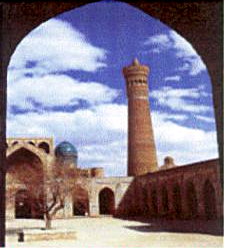
BUKHARA: More than 140 architectural
monuments can be found here, and of the major blue-domed minarets one
would have to start with the Kalyan Minaret constructed in 1127. This
unique construction rises into the sky for 47 meters. The most striking
feature of the minaret is its intricate ornamentation. The world-famous
archituctural ensemble Lyabi-Hauz, which includes the Kukeldash madrassa,
the Khanaka and the Nadira Divan-begi Madrassa is listed in the world
catalogue of significant historical buildings. The most unique one,
however, is the mausoleum of the Samanids for their ruler Ismail, his
father and his grandchild.
|
 |
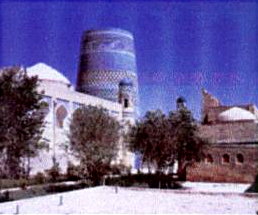 |
KHIVA, the city museum in the
open sky, is unique in its beauty known as 'The Pearl of the Khorezm
Oases". Important spiritual and cultural values came from the large
scientific centers of astronomy, mathematics and medicine that operated
in this area centuries ago. A valuable heritage of knowledge was left
here bi internationally famous scholars such as Beruni, Agakhi and Nadjmiddin.
One can stroll through the narrow streets of Khiva, peeking into the
small courtyards through the wooden carved doors.
|
|
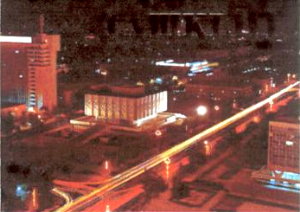
TASHKENT -is one of the most
biggest ancient city in Central Asia- the capital of the Republic of
Uzbekistan. In the inscriptions of 262 years B.C. of Pursian king Shapura
I on "Kaabe Zoroastra" the oasis of Tashkent was called Chach.
Chach was a crossroads on the way of gold export, precious stones, spices
and splendid horses to another towns and states. Today Tashkent, in
translation from uzbek standing for "Stone town" is a capital
of modern Republic, keeping the evidence of future, the memory of many
history events of Uzbekistan, - one of the biggest industrial center
of Central Asia, with the population of over 2 million people.
|
 |
|
Currency: The national currency of the Republic of Uzbekistan is SOUMS. Flora: Flora of Uzbekistan is represented by at least 4800 species of vascular plants which belong to 650 genera and 115 families. Cuisine: There are over one thousand dishes in Uzbek cuisine. Fruits and vegetables grown under the tender Oriental sun are terrific in taste. There are about 500 varieties of Uzbek pilaff only cooked in its own way in every region. Uzbek dishes differ in appearance, fragance and flavor in its use of rice, savoury seasonings, vegetables and legumes, yoghurt and grilled meat. Some of them are prepared on the everyday basis, others are sasonal, some are cooked more rarely, depending on the seasonal availability of ingredients or to celebrate certain special occasions. Uzbekistan meals often consists of pilaf, kebabs, noodles and pasta, stews, elaborate breads and pastries. Subtle seasonings and fancy sweets distinguih the cuisine of southern Uzbekistan. Tea is ubiquitous, usually served without milk. Calorie content and ecological cleanness of local foodstuffs is unique, Uzbek cuisine can not be described, it should be tasted. Uzbek bread: During the meal special round bread, called non, is served. There are many traditions connected to Uzbek bread. It never cut with knife. At the start of the meal, it is broken into pieces by hand and placed on the table near each place setting. Do not place bread upside down (with its flat side up), by placing it the right way up will earn you the respect of the host and those around you. Uzbek people consider bread to be holy and greatly respected. Clothing: For a long time originality
of Uzbek clothes has been defined according to climate, conditions of
life and tribal customs and traditions. In 19th century clothes still
kept the features of archaism: wide, long, whole cutting, hiding the
shapes of human body. Being uniformed the clothes for winter, summer,
male, female and children were very similar in forms and cutting. |
| Go back |
 |