Extracted from http://www.glenbrook.k12.il.us/gbssci/phys/THender/quizzes/
Unit 1 Quiz#1
Fill in the Blank:
1. A _________________ quantity is
completely described by its magnitude.2. A _________________ quantity has both
magnitude and direction.
3. The velocity of an object at any
given instant in time is known as the _________________ velocity.
4. The rate at which the velocity
changes is known as the __________________.
Multiple
Choice:
1. Which of the following
represents a speed?
a. 6 km
b. 4 min/km sec
c. 2 km/sec2
d. 8 m/sec
2. Which of the following
represents an acceleration?
a. 6 m2/sec2
b. 6 min/km sec
c. 10 km/hr
d. 2 m/sec2
For Questions (3) and (4), consider the following
sentence:
A boy walks 150 meters due east and then turns around
and walks 30 meters due west.
3. The boy walked a
distance of
a. 30 meters
b. 150 meters
c. 120 meters
d. 180 meters
4. The boy's displacement is
a. 30 meters
east
b. 150 meters
east
c. 120 meters
east
d. 180 meters
west
Problems and
Short-Answer:
1. Fernando Vázquez views
GBS football games from under the bleachers. He frequently paces back and forth
to get the best views. The diagram below shows several of
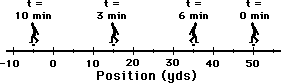
a. What is the distance walked by Vázquez
during the ten minutes? __________
b. What is Vázquez's displacement
during the ten minutes? __________
c. Calculate Vázquez's
average speed.
d. Calculate Vázquez's
average velocity.
2. Roi King is traveling down
3. Upon a recent visit to Mars, you run out of petrol
for your spacecraft. So you order 28 grams of petrol. A Martian informs you
that the unit system on Mars is different than on Earth. The Martian asks;
"How many zooms of petrol do you need?" Use the following information
to form conversion factors in order to calculate the amount of zooms of petrol
you should order. Clearly show all conversion factors.
|
5
zings = 4 grams |
2
warps = 3 zings |
9
zooms = 5 warps |
Unit 1 Quiz#2
1. Seymour Butz views GBS
football games from under the bleachers. He frequently paces back and forth to
get the best views. The diagram below shows several of
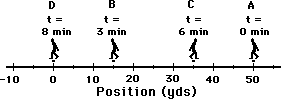
 a. What is the
distance walked by
a. What is the
distance walked by
b. What is
c. Calculate
d. Calculate
3. Upon a recent visit to Mars, you run out of petrol
for your spacecraft. So you order 18 grams of petrol. A Martian informs you
that the unit system on Mars is different than on Earth. The Martian asks;
"How many zooms of petrol do you need?" Use the following information
to form conversion factors in order to calculate the amount of zooms of petrol
you should order. Clearly show all conversion factors.
GIVEN: 5 zings = 2 grams; 4 warps = 3 zings; 3 zooms =
2 warps
4. Identify the three controls on an automobile which
can be used by the driver to cause an acceleration.
Discuss each control, explaining in what sense it controls the acceleration.
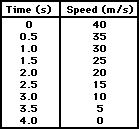 5. Sammy Sosa
(Chicago Cub's baseball player) hits a pop-up. It leaves his bat traveling upwards at a speed of 40.0 m/s. As the ball
travels upwards, its speed decreases in accord with the data at the right.
5. Sammy Sosa
(Chicago Cub's baseball player) hits a pop-up. It leaves his bat traveling upwards at a speed of 40.0 m/s. As the ball
travels upwards, its speed decreases in accord with the data at the right.
a. Use the data to determine the acceleration value
(singular, not plural) of the baseball. Be sure to include the correct units on
your answer.
b. If the baseball is moving upwards and slowing down,
then what is the direction (up or down) of the ...
i.
velocity vector?
ii.
acceleration
vector?
c. In the space at the far right, use bold dots to
depict the motion of the baseball during its upward flight. (The initial
position of the ball is given.)
Unit 1 Quiz#3
Interpretting Graphs:
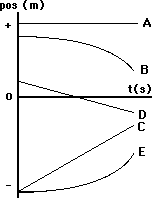
Consider the position vs. time graph below. The motion of five different people (A, B, C, D, and E) are
shown on the graph. Study the graph and answer the following questions. Some
questions may have more than or less than one answer.
Question:
|
|
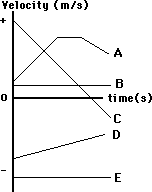
Consider the velocity vs. time graph below. The motion of five different people (A, B, C, D, and E) are
shown on the graph. Study the graph and answer the following questions. Some
questions may have more than or less than one answer.
Question:
|
|
Mathematical Analysis
of Graphs:
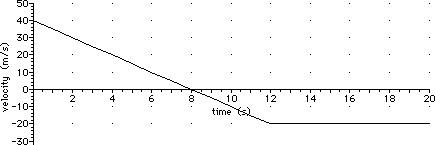
The graph below represents an object's
motion for twenty seconds. Use the graph to answer questions 1 - 5.
- Use the
graph to calculate the acceleration of the object at 6 seconds.
- Use the
graph to calculate the displacement of the car during the first 8 seconds.
- Use the
graph to calculate the displacement of the object from
- Use the
graph to calculate the displacement of the object during the entire 20
second interval.
- Use
complete sentences and the language of physics to describe the motion of
the object during the entire 20 seconds. (Do a "bang-up" job.)
Miscellaneous
Motion Problems:
- Interpret the information depicted by the
position-time graph to construct a velocity-time graph for the same
motion.
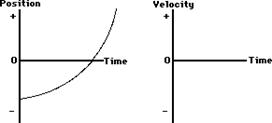
- Interpret the information depicted by the
velocity-time graph to construct a position-time graph for the same
motion.

- Noah Formula throws a ball upward with a velocity
of +30 m/s. If the ball accelerates at a rate of 10 m/s2 (downwards), what
is the velocity of the ball after 5 seconds?
- Claire de Aisles is racing her shopping cart down
the aisles of Jewel at +4 m/s for 3 seconds. Seeing a sale out of the
corner of her eye, she skids to stop at a constant rate of -1 m/s2. Sketch
a velocity-time graph for Claire's motion and calculate the distance which
Claire de Aisles skids before coming to a complete stop.
Unit 1 Quiz#4
Interpretting Graphs:
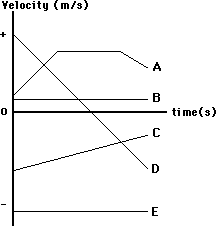
Consider the velocity vs. time graph below for
questions #1-5. The motion of five different people (A, B, C,
D, and E) are shown on the graph. Study the graph and answer the
following questions. Some questions may have more than or less than one answer.
Place your answers in the blank.
|
|
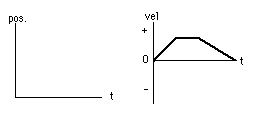
6. Convert the following velocity-time
plot to the corresponding position-time plot. Note there are three distinct
parts to the motion.
7. Construct the motion diagram (i.e.,the "oil drop
diagram") for the motion of the object depicted by the velocity-time graph
in question #6.
8. Renatta Oyle is driving rightward (+ direction) at 30 m/s when she
suddenly slows down at a constant rate of acceleration to a rest position in 5
seconds.
a. Identify the
direction of the acceleration of the car. ________________ Explain.
b. Construct a
motion diagram (i.e., an "oil drop diagram") of the car's motion
during this braking period.

c. Sketch plots
of position vs. time and velocity vs. time for the car's motion during this braking
period. If a plot should be a straight line, make it clearly straight; if it
should be curved, make it clearly curved; etc.
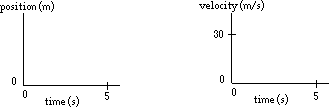
Use your velocity-time plot to determine the
displacement of the car during the 5 second braking period. Circle your answer.
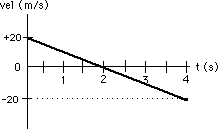 9. Rex Things throws his mother's glass vase straight upward into the air
with a velocity of 20 m/s, upward. The velocity-time plot is shown at the
right.
9. Rex Things throws his mother's glass vase straight upward into the air
with a velocity of 20 m/s, upward. The velocity-time plot is shown at the
right.
a. The vase
travels upwards, reaches its peak and then falls back downwards. At what time
does the vase reach the peak of its trajectory? t = ___________ s
b. As the vase is
moving upwards, it is slowing down. Therefore, its acceleration is _______________
(up or down).
c. As the vase is
moving downwards, it is speeding up. Therefore, its acceleration is
_______________ (up or down).
d. Use the
velocity-time plot to determine the acceleration of the vase.
Kinematic Equations Quiz
A Chevrolet Corsica (m = 1220 kg; length = 4.6 m; a =
-8.0 m/s2) is traveling 32.0 m/s. The
1. Use kinematic equations
to determine the distance that the BMW travels while braking
to a stop.
2. Use kinematic equations
to determine the distance that the
2.
Use kinematic equations to
determine the distance that the
3.
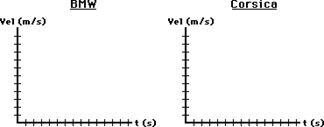
Sketch graphs of velocity vs. time for the two cars.
Using the graphs, calculate the total distance traveled
by the two cars. Clearly show your work.
5. Did a
collision occur? Clearly explain.
Kinematic Equations Quiz#5
To receive full of partial credit, please
show all your work. Write clearly and legibly. Show appropriate units on all
answers. The following equations may be useful.
Equations:

1. Solve either 1 of the following two
problems (A or B). Do not solve both. Cross out the problem which you do not
want to be graded. If you do not clearly indicate which problem you are
solving, then only Problem A will be graded. (5 pts. each)
Problem A: Miles Tugo is traveling along
Problem B: Two ants
race across the entire length of the top of a Wheaties
box at constant speed. The box is 34.0 cm long. One ant travels 4.6 cm/s and
the other ant travels 3.5 cm/s. The fastest ant will cross the finish line
first. How much time will pass between the time when
the first ant crosses the finish line and when the second ant crosses the finish
line?
2. Milton Yermouth
is hurrying to his workplace at Chocolates, INC when he observes a multi-car
pileup on the interstate.
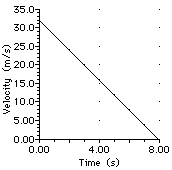
3. The velocity-time graph portrays the
motion of a 600-kg Yugo skidding to a stop. Use the
graph to determine the distance which the Yugo
travels while skidding. (3
pts)
|
4. Rex Things drops
his mother's vase from a window on the top floor of the John Hancock
building. Demonstrate your understanding of acceleration (g=10 m/s2,
down) by filling in the table at the right. (2 pts) |
Time (s) 0 1.0 2.0 3.0 4.0 |
Velocity (m/s) 0.0 _________ _________ _________ _________ |