THE PERIODIC TABLE
AND PERIODIC PROPERTIES
Information
collected from
http://gaia.floyd.edu/tutor/Periodicity.htm#Radii
http://antoine.frostburg.edu/chem/senese/101/periodic/index.shtml
http://chemed.chem.purdue.edu/genchem/topicreview/
Development of the Periodic Table
Mendeleev, a
Russian Chemist, was one of the first to be partially sucessful
in arranging the known elements in the 1870's into a chart that would allow the
prediction of properties. He arranged the elements known in those days
according to increasing atomic masses. The first Periodic Law proposed by him
stated:
"The properties of the elements are a periodic
function of their atomic masses"
When Mendeleev arranged the known elements using this principle
as a guide, he found that certain elements grouped themselves into vertical
groupings sometimes called families. If one measured a property of each of
the elements in the group, Mendeleev noted that the
value for that property would either be high or low depending upon the group
under observation. For example, measuring the atomic radius of the atoms of
elements which is the distance from the outermost valence region to the nucleus
of an atom, one would find that in the case of the first group of elements on
the left side of the chart all the elements seemed to have characteristically
high values where those elements grouped on the right side of the chart seemed
to have characteristically small radii values. All of the elements in group 1
had the highest radius value of any element in its respective period. A period
is a horizontal row of elements in the table. Likewise all the elements in
group 17 on the far right of the chart had the lowest radius value of any
element in its respective period. This is a manifestation of the periodicity
exhibited by the elements between their atomic weights and their property
measurements. One could conceivably show this periodicity using other
properties such as boiling points, melting points, etc.
You may access a
short biography of Demitri Mendeleev here.
There were some
inconsistencies in the arrangement of the elements according to his law,
however it wasn't until the early 1900's (1914) that a Prof Moseley, a British
Physicist, was able to determine the atomic numbers of all the known elements
using an experimental technique. Moseley then proceeded to rearrange the
elements according to increasing atomic numbers. Moseley's arrangement seemed
to clear up the contradictions and inconsistencies of Mendeleev's
arrangement, but Moseley based his arrangement on atomic numbers and not atomic
masses.
Moseley's periodic
law is now considered the current Periodic Law. It resulted in a slight
alteration of Mendeleev's arrangement, but the slight
difference was enough to correct the inconsistencies that existed in Mendeleev's arrangement.
The elements are
arranged in vertical columns known as Groups. The elements in each group
have consistently high or low values for certain properties. The horizontal
rows of elements are referred to as "periods".
Group 1 is also called the
alkali metal group. These are strong metals that are unusually soft and very
reactive toward Oxygen forming Oxides and water forming hydroxides of the
metal. These elements are so reactive toward Oxygen and water vapor that they are stored under an inert liquid to protect
them from Oxygen and water vapor.
Group 2 is called the
alkaline earth metals. These metals are not as soft as Group 1 metals. They
also react more mildly with Oxygen to produce oxides of the metals and only
react with water at temperatures where the water is steam.
Groups 3-12 are referred to as
the transition metal groups. These metals are not as predictable because of the
shielding effect of the inner electrons. As for the "shielding
effect" this refers to the inner electrons found in the transition state
elements and the inner transition (rare earth) elements. These electrons had a
tendency to block the electrical effect of the positive nucleus upon the outer
valence electrons of those atoms. This shielding effect helps to partially
explain the erratic placement of the electrons in the d and f orbitals relative to the s and p orbitals.
Groups 1-2 and 13-18
are referred to as the representative elements
Group 17 is referred to as
the halogen group
Group 18 is referred to as
the Noble gas group previously known as the inert gas group.
There are two special
series of elements that occur right after the transition metal element Actinium
(Actinides) and Lanthanum(Lathanides).
These special inner transition state metals were first rearranged by Dr. Glen Seaborg of
The metals which tend
to have their atoms losing electrons during a chemical change are roughly found
to the left Group 14
Non-metals which tend
to have their atoms gaining electrons during chemical change are roughly found
in Group16-17 with some elements in the lower parts of Groups 15.
Metalloids which tend
to have their atoms sometimes losing and sometimes gaining electrons during
chemical change are generally found in Groups 14-16
The Noble gases
really belong to their own category since their atoms tend neither
to lose or gain electrons. There are only a handful of compounds
involving the Noble Gases (mostly involving Xenon).
Periodic Table of
the Elements
|
|
|
|||||||||||||||||
|
1 |
|
|||||||||||||||||
|
2 |
|
|||||||||||||||||
|
3 |
||||||||||||||||||
|
4 |
||||||||||||||||||
|
5 |
||||||||||||||||||
|
6 |
||||||||||||||||||
|
7 |
||||||||||||||||||
|
|
lanthanides |
||||||||||||||
|
|
actinides |
PERIODIC PROPERTIES
►Quantum numbers and the
periodic table
- An element's location on the periodic
table reflects the quantum numbers of the last orbital filled
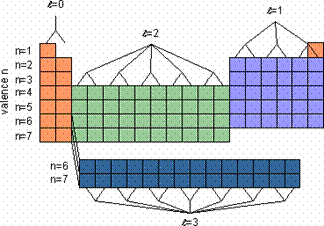
- The period
 indicates the value of principal quantum number for the valence shell
 - the lanthanides and actinides are in periods 6 and 7,
respectively.
- The block indicates value of azimuthal quantum number (
 ) for the last subshell that received electrons in
building up the electron configuration.
) for the last subshell that received electrons in
building up the electron configuration. - blocks are named for subshells
(s, p, d, f)
- Each block contains a number of columns
equal to the number of electrons that can occupy that subshell
§
The
s-block (in orange) has 2 columns, because a maximum of 2 electrons can occupy
the single orbital in an s-subshell.
§
The
p-block (in purple) has 6 columns, because a maximum of 6 electrons can occupy
the three orbitals in a p-subshell.
§
The
d-block (in green) has 10 columns, because a maximum of 10 electrons can occupy
the five orbitals in a d-subshell.
§
The
f-block (in dark blue) has 14 columns, because a maximum of 14 electrons can
occupy the seven orbitals in a
f-subshell.
- questions to ponder
- What would the periodic table look like
in a hypothetical universe where:
§
there were 3 possible values of ms,
instead of 2?
§
the angular momentum quantum number could take on
values from 1 to n-1 only?
§
values of m = 0 were not allowed?
§
the maximum value of n were 5?
►Factors affecting the valence shell
|
Factors affecting the valence
shell. Anything that influences the
valence electrons will affect the chemistry of the element. |
||
|
|
Factors |
Effect |
|
1. |
valence
principal quantum number n |
Larger n
means a larger valence shell (because n controls the size of orbitals) |
|
2. |
nuclear charge Z |
Larger Z
means a smaller valence shell (because higher positive charge on the nucleus
attracts the valence electrons, and pulls them inward) |
|
3. |
number of
core electrons |
More core
electrons means a larger valence shell (because highly penetrating core
electrons repel valence electrons, and push them farther from the nucleus) |
|
|
||
►Effective nuclear charge
Electrons
moving across the nucleus do not experience the same nuclear attraction; those
electrons closer to the nucleus experience a greater force than those that are
farther away. The nuclear charge actually "felt" by an electron is
called the effective nuclear charge, Zeff.
Zeff for a given electron is given by the true
nuclear charge, Z, less the amount by which electrons closer to the nucleus
screen it, S, Zeff = Z - S. Therefore, effective
nuclear charge increases from left to right in a period and from top in a group
on the periodic table.
Zeff 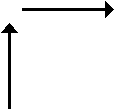
Li:
1s2 2s1
=> Zeff = +3 - 2 = 1
Cs
> Li > Cl > F
The
greater the effective nuclear charge, the greater the attractive force between
the nucleus and its electrons (F q q/d2)
►Atomic
Radii
 As the attractive force between a
nucleus and its electrons increases, the average distance between the nucleus
and its electrons decreases. The average distance between the nucleus and its
outermost electron is expressed as the atomic radius of the atom. It can be
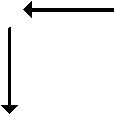
said that atomic radius decreases from left to right in a period and from
bottom to top in a group on the periodic table. The greater
the force of attraction, the smaller the radius.
As the attractive force between a
nucleus and its electrons increases, the average distance between the nucleus
and its electrons decreases. The average distance between the nucleus and its
outermost electron is expressed as the atomic radius of the atom. It can be
said that atomic radius decreases from left to right in a period and from
bottom to top in a group on the periodic table. The greater
the force of attraction, the smaller the radius.

|
trend |
valence |
Z |
# core |
net effect on atomic
radius |
|
going right across main group rows... |
no change |
increases |
no change |
the increase in Z causes a decrease in radius |
|
going right across transition
series... |
no change |
increases |
increases |
the increase in Z causes a decrease in radius, but the increase
in the number of core electrons causes an increase. The two competing effects
cause a small decrease, then small increase! |
|
going down groups... |
increases |
increases |
increases |
three competing effects; but n is strongest,
so radius increases. |
►Sizes of
Ions
Recall
that atoms increase in size going from right-to left on a period and
top-to-bottom in a group.
Cations are smaller than their parent
atom because the effective nuclear charge on the outermost electrons is greater
in the cation. The number of protons remains the same
but the number of screening electrons decreases. Li > Li+
Zli = 3 - 2 = 1
Zli+ = 3 - 0 = 3
Anions are larger than their parent atoms because the effective nuclear
charge on the outermost electrons in smaller in the anion. The number of
protons remains the same but the number of screening electrons increases.
For
ions of the same charge, size increases going down a group.
Isoelectronic series are groups of atoms
and ions which have the same electronic configuration. Within isoelectronic series, the more positive the charge, the
smaller the species and the more negative the charge, the larger the species.
1s2
2s2 p6
N3-
O2- F- Na+ Mg2+ Al3+
Isoelectronic - same number of electrons
►Ionization
Energy
- ionization energy is the minimum amount of
energy required to remove an electron from an atom or ion in the gas phase
- normally, ionization removes valence electrons
first
- valence electrons are farthest from
nucleus on average, so they feel the least attraction for the nucleus and
are easiest to remove
- end of valence electrons is marked by a
big jump in ionization energies
|
Na(g) |
|
first ionization energy |
|
Na+(g) |
|
second ionization energy |

 H
= +496
H
= +496 - core orbitals
have lower n, and are much more penetrating than valence orbitals
- proximity to nucleus makes core electrons
much more difficult to remove
- core noble gas configurations have high
stability
- factors
affecting ionization energy
- atomic
radius
- smaller atoms hang on to valence
electrons more tightly, and so have higher ionization energy
- charge
- the higher the positive charge becomes,
the harder it is to pull away additional electrons
- second ionization energy is always higher
than the first
- orbital penetration
- It's easier to remove electrons from p orbitals than from s orbitals
- electron
pairing
- within a subshell,
paired electrons are easier to remove than unpaired ones
- reason: repulsion between electrons in
the same orbital is higher than repulsion between electrons in different
orbitals
- example
On the basis of gross periodic trends, one might expect O to have a higher ionization energy than N. However, the ionization energy of N is 1402 kJ/mol and the ionization energy of O is only 1314 kJ/mol. Explain.
Taking away an electron from O is much easier, because the O contains a paired electron in its valence shell which is repelled by its partner.
There
are periodic trends in the ionization energies, also tied to the effective
nuclear charge. As the effective nuclear charge increases, it requires more
energy to remove the outermost electron from an atom. Consequently, ionization
energy is also related to the atomic radius, with ionization energy increasing
as atomic radius decreases. Therefore, the first ionization energy increases
from left to right in a period and from bottom to top in a group.
Na > Al > Mg > Si

Exceptions to the General Pattern of First
Ionization Energies
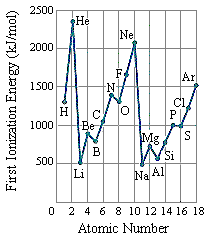
The
figure below shows the first ionization energies for elements in the second row
of the periodic table. Although there is a general trend toward an increase in
the first ionization energy as we go from left to right across this row, there
are two minor inversions in this pattern. The first ionization energy of boron
is smaller than beryllium, and the first ionization energy of oxygen is smaller
than nitrogen.
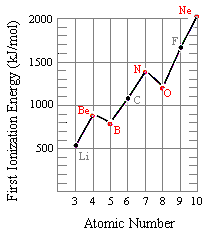
These
observations can be explained by looking at the electron configurations of
these elements. The electron removed when a beryllium atom is ionized comes
from the 2s orbital, but a 2p electron is removed when boron is
ionized.
Be:
[He] 2s2
B:
[He] 2s2 2p1
The
electrons removed when nitrogen and oxygen are ionized also come from 2p
orbitals.
N:
[He] 2s2 2p3
O:
[He] 2s2 2p4
But
there is an important difference in the way electrons are distributed in these
atoms. Hund's rules predict that the three electrons
in the 2p orbitals of a nitrogen atom all have
the same spin, but electrons are paired in one of the 2p orbitals on an oxygen atom.
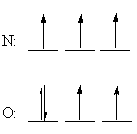
Hund's rules can be understood by assuming
that electrons try to stay as far apart as possible to minimize the force of repulsion
between these particles. The three electrons in the 2p orbitals on nitrogen therefore enter different orbitals with their spins aligned in the same direction. In
oxygen, two electrons must occupy one of the 2p orbitals.
The force of repulsion between these electrons is minimized to some extent by
pairing the electrons. There is still some residual repulsion between these
electrons, however, which makes it slightly easier to remove an electron from a
neutral oxygen atom than we would expect from the number of protons in the
nucleus of the atom.
Second, Third, Fourth, and Higher
Ionization Energies
By
now you know that sodium forms Na+ ions, magnesium forms Mg2+
ions, and aluminum forms Al3+ ions. But have
you ever wondered why sodium doesn't form Na2+ ions, or even Na3+
ions? The answer can be obtained from data for the second, third,
and higher ionization energies of the element.
The
first ionization energy of sodium, for example, is the energy it takes
to remove one electron from a neutral atom.
Na(g) + energy  Na+(g) + e-
The
second ionization energy is the energy it takes to remove another
electron to form an Na2+ ion in the gas
phase.
Na+(g) + energy Na2+(g)
+ e-
The
third ionization energy can be represented by the following equation.
Na2+(g) + energy Na3+(g)
+ e-
The
energy required to form a Na3+ ion in the gas phase is the sum of the
first, second, and third ionization energies of the element.
First, Second, Third, and Fourth Ionization Energies of Sodium,
Magnesium, and Aluminum (kJ/mol)
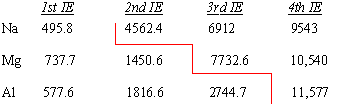
It
doesn't take much energy to remove one electron from a sodium atom to form an Na+ ion with a filled-shell electron
configuration. Once this is done, however, it takes almost 10
times as much energy to break into this filled-shell configuration to
remove a second electron. Because it takes more energy to remove the second
electron than is given off in any chemical reaction, sodium can react with
other elements to form compounds that contain Na+ ions but not Na2+
or Na3+ ions.
A
similar pattern is observed when the ionization energies of magnesium are
analyzed. The first ionization energy of magnesium is larger than sodium
because magnesium has one more proton in its nucleus to hold on to the
electrons in the 3s orbital.
Mg:
[Ne] 3s2
The
second ionization energy of Mg is larger than the first because it always takes
more energy to remove an electron from a positively charged ion than from a
neutral atom. The third ionization energy of magnesium is enormous, however,
because the Mg2+ ion has a filled-shell electron configuration.
The same pattern can be seen in the ionization
energies of aluminum. The first ionization energy of aluminum is smaller than magnesium. The second ionization
energy of aluminum is larger than the first, and the
third ionization energy is even larger. Although it takes a considerable amount
of energy to remove three electrons from an aluminum
atom to form an Al3+ ion, the energy needed to break into the
filled-shell configuration of the Al3+ ion is astronomical. Thus, it
would be a mistake to look for an Al4+ ion as the product of a
chemical reaction.
►Electron
Affinities
The electron
affinity of an element is the energy given off when a neutral atom in
the gas phase gains an extra electron to form a negatively charged ion: M(g) + e M(g)-.
These reactions tend to be exothermic and so the values of E are generally
negative.
 In general, electron affinity tends to decrease
(become more negative) from left to right in a period. Going down a group,
there is little change in the electron affinities. Negative electron affinity
means that the atom gains electrons easily. Cl >
Na > N > Be
In general, electron affinity tends to decrease
(become more negative) from left to right in a period. Going down a group,
there is little change in the electron affinities. Negative electron affinity
means that the atom gains electrons easily. Cl >
Na > N > Be
Several
patterns can be found in these data.
- Electron affinities generally become
smaller as we go down a column of the periodic table for two reasons.
First, the electron being added to the atom is placed in larger orbitals, where it spends less time near the nucleus
of the atom. Second, the number of electrons on an atom increases as we go
down a column, so the force of repulsion between the electron being added
and the electrons already present on a neutral atom becomes larger.
- Electron affinity data are
complicated by the fact that the repulsion between the electron being added
to the atom and the electrons already present on the atom depends on the
volume of the atom. Among the nonmetals in
Groups VIA and VIIA, this force of repulsion is largest for the very
smallest atoms in these columns: oxygen and fluorine. As a result, these
elements have a smaller electron affinity than the elements below them in
these columns as shown in the figure below. From that point on, however,
the electron affinities decrease as we continue down these columns.
At
first glance, there appears to be no pattern in electron affinity across a row
of the periodic table, as shown in the figure below.
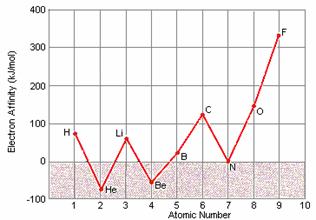
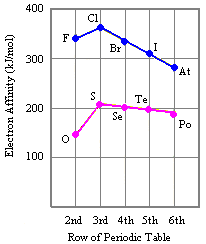
When
these data are listed along with the electron configurations of these elements,
however, they make sense. These data can be explained by noting that electron
affinities are much smaller than ionization energies. As a result, elements
such as helium, beryllium, nitrogen, and neon, which have unusually stable
electron configurations, have such small affinities for extra electrons that no
energy is given off when a neutral atom of these elements picks up an electron.
These configurations are so stable that it actually takes energy to force one
of these elements to pick up an extra electron to form a negative ion.
►Electronegativity
Relative
tendency of an atom to attract electrons to itself when chemically combined
with another atom.
The
relative ability of an atom to draw electrons in a bond toward itself is called
the electronegativity of the atom. Atoms with large electronegativities (such as F and O) attract the electrons
in a bond better than those that have small electronegativities
(such as Na and Mg). The electronegativities of the
main group elements are given in the figure below.

When
the magnitude of the electronegativities of the main
group elements is added to the periodic table as a third axis, we get the
results shown in the figure below.
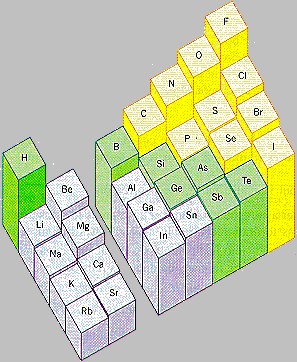
There
are several clear patterns in the data in the above two figures.
- Electronegativity increases in a regular fashion
from left to right across a row of the periodic table.
- Electronegativity decreases down a column of the
periodic table.
►Why metals are metals
- the ionization energy of metallic elements
is very low
- valence electrons are easily lost, and
shared among all atoms in the metal
- this 'sea' of valence electrons binds
together the metal cations and gives metals
their characteristic properties
- mobility of electrons in the sea explains
metal's ability to conduct electricity and heat
- metals are workable because cations can slide past each other but still be bound
by the electron sea
- comparing metals
- more valence electrons means stronger
metal
- higher positive charge on cations, higher negative charge on sea = stronger
bonding
Explaining
elemental properties: the s block elements
|
The properties of the
alkali metals ultimately result from their ns1 valence
configuration. |
|
|
property
of alkali metals |
explanation |
|
metallic |
very low ionization
energy; the electron sea model works well for alkali metals |
|
soft |
ns1 valence configuration contributes
just 1 electron to the electron sea. The sea is weak. Metal cations aren't tightly bound and it's easy to slide them
past each other. |
|
low densities |
Alkali metals have the largest radii and lowest atomic weight in each period. Low mass in high volume = low density. |
|
highly reactive |
very low ionization energies make
alkali metals good electron donors in redox
reactions. |
http://gaia.floyd.edu/tutor/Periodicity.htm#Radii
http://antoine.frostburg.edu/chem/senese/101/periodic/index.shtml
http://chemed.chem.purdue.edu/genchem/topicreview/