SCIENCE
AND SCIENTIFIC METHOD
TEXT.1: READ THE TEXT AND FIND THE
KEY WORDS.
http://home.earthlink.net/~dmocarski/chapters/chapter1/main.htm
Science is a method of explaining and predicting events in the observable
(measurable) universe.
If a person is asked to draw a picture of a
they will almost always draw a person using some sort of lab
equipment. Try it. Ask someone to draw a picture that is instantly recognizable
as a picture of .
Usually they will draw a person using the tools of such as telescopes,
microscopes, beakers, and test tubes. Many pictures will include math (especially E=mc2).
The picture will almost always show some act of or observation with a
clipboard or notebook to record the observations. This intuitive depiction is
really a quite accurate definition of what is.
The reason that people include the tools
of in their pictures is
that they know, at least at some basic level of understanding, that are interested in
finding out about the things around us that can be measured and put into
numbers. That's exactly right. do things and most
of what they do involves a measurement or observation of some kind.
The fact that science uses and observation as
the basis for its explanations and discoveries is the source of both the
strength and weakness of scientific knowledge. Its strength lies in that
findings can be verified by repeating
and observations. The weakness lies in that scientists have
to limit themselves to studying those things that can be . That is the definition of
physical, that which can be observed and .
Because scientists can only do science in the
physical universe they cannot use science to answer many important theological,
ethical, and aesthetic questions. Supernatural and philosophical experience is
beyond the reach of scientific study. This does not mean that a scientist
cannot be interested in these areas. It only means that it is impossible to
deal with them in a scientific way.
Although science is limited to what
can be observed and measured it has been a very successful and fruitful endeavor. We live in a technological paradise. We are
healthy and comfortable largely because our scientific knowledge and techniques
allow us to understand and manipulate the world around us so that it meets our
needs. The food we eat, the medicines we take, the toys we play with, are all
excellent and plentiful because we understand how things work. Unfortunately
the scientific techniques that enable us to shape our physical environment
cannot be applied to defects in our society and culture. Maybe someday we will
be able to measure human behavior in a way that lets
us use the precision of science to solve our problems. This idea was explored
by the great science and science fiction writer Issac
Asimov in his "Foundation" series of novels. It is great reading and
I highly recommend them. They are fiction however and will remain so for the
foreseeable future.
TEXT 2.
http://home.earthlink.net/~dmocarski/chapters/chapter1/main.htm
Pure and Applied Science
Another way of categorizing science is to
determine whether or not the area of study is intended to discover new facts
and laws or is trying to apply existing scientific knowledge to solve
technological problems. Good examples of the latter are engineering and most forms of medicine.
An engineer for instance is generally attempting to design some tool or machine
such as a bridge, or spacecraft, or a new computer chip by using facts and laws
that have already been discovered. That's what applied science is. The application of scientific knowledge.
Pure sciences on the other hand delve into the
unknown trying to discover new and different aspects of our universe. This can
lead to tests of our present explanations and laws and sometimes results in new
and better theories of how things work.
Cosmology, not cosmetology, is the study of
the structure and evolution of the universe. The answers to cosmological
questions give us an idea of how stars, galaxies, and space and time itself
began and changed over time. Particle
Physicists smash atoms together to see what they are made of, and paleontologists
try to understand the nature of creatures not seen on our planet for millions
of years. None of these endeavors directly produces a
new machine or medicine. They all are attempting
to gather new information. That's what pure
Science is .
Sometimes people hear about studies that don't
seem to have any practical value and wonder why time and money is being spent
on them. It is important to remember that new discoveries can eventually lead
to the solution of some unforeseen problem or be applied in some way that has
not yet been perceived. A good example of this occurred in the mid 1800's when
the great mathematician and physicist James Clerk Maxwell was investigating how
electricity and magnetism were related. He discovered some equations that
predicted that electricity and magnetism would travel through space at the
speed of light. In his time the work was purely theoretical. It was a discovery
that had no application. Today we use that knowledge as the basis for all of
our electronics and communications industries. That means your cellular phone,
computer, and yes your beloved television were derived from work that was done
in the pursuit of knowledge.
TEXT 3.
http://home.earthlink.net/~dmocarski/chapters/chapter1/main.htm
The notion of a testable hypothesis is crucial
to differentiating good science from crackpot pseudo-scientific theories like
the Roswell UFO crash and paranormal X-file type explanations of events. The
crackpot theory usually relies on an approach called negative proof. Negative
proof is non testable. Negative proof
is an "it's true because you can't
prove it's not true" approach. It requires only belief and you can
believe anything you want. Science on the other hand requires positive proof.
That is a "you can see that this happens under these circumstances"
approach. It does not require belief but observation.
The problem with negative proof is that there
is no way to test it. A typical scenario of pseudo-science (theories that
sound scientific but do not really use scientific methods to verify them)
goes something like this. A bright light in sky is seen in some out of the way
place and is witnessed by several people that cannot immediately identify its
cause. An hypothesis develops that it was an alien
spacecraft in the process of crashing to earth. This is OK so far but where the
hypothesis falls apart is that there is no verifiable evidence. Invariably
there are no bits of the spacecraft or clear non-faked photographs. The only
proof is of the "you can't prove it's not true" type. The lack of
evidence is usually attributed to a government cover-up. But here again there
is never any clear evidence of the cover-up.
Here is another example of how meaningless a
"proof" without measurable evidence can be.
Suppose I tell you that there is a tiny man
that lives in the pipes running throughout your house. He is the gremlin that
causes all the household plumbing problems that can crop up from time to time.
You know, like leaky faucets, running toilets and the like. The reason that you
have never seen him is that he and his race of beings have the power to make themselves virtually undetectable. By the way, the
government is aware of the existence of these creatures but since they have not
been able to do anything about them they don't want to frighten us and all that
is known about these creatures is kept hidden in a secret army base in a cavern
under the
You might say that this is ridiculous and that you
don't believe it. My response to you might be that it is true and that you
can't prove that it is not. This is exactly the "proofs" of many
pseudo-scientific ideas. They might be great fun but they certainly offer
nothing in the way of a real understanding of how things work.
All this doesn't mean that
speculation and imagination do not have a role in science. They do. New and
radical ideas spur the advancement of science into new and exciting directions.
To be useful and productive however ideas must produce testable hypotheses.
That's what science is all about. Science fiction and ghost stories are very
entertaining but they are not science. They may even predict what will someday
occur. They may even be true. But they aren't science until they produce
measurable data and verifiable hypotheses.
DIMENSIONAL
ANALYSIS
1. What are the dimensions of
: a) force, b) moment, c) work, d) pressure?
2. Which one of the following has different
dimensions from the others)
a)
stress*strain b)
stress/strain
c)
pressure d)
potential energy per unit volume
e)
torque
3. Which of the following units could be used
for capacitance (capacitance = Q/V)?
a)
kg m2 s-1 C b) kg m2 s-2
C2 c) kg-1
m-1 C2
d) kg-1 m-2
s2 C2 e)
kg-1 m-2 s3 C
4. What are the dimensions of
: a) density; b) cubit feet per minute; c) area; d) power.
5. What are the dimensions of: a)
distance/velocity; b) force*time; c) angle moved through per second?
6. The surface tension of a liquid is measured
in N m-1 .
What are the dimesions of surface tension?
7. It is suggested that pressure P at depth h in a liquid of density d
is P= d*h*g.
Show that this equation is dimensionally correct.
8. A liquid having small depth but large volume
is forced by an applid pressure P above it to escape with velocity v through a small hole below.
v is
given by: v= Pxdy. Where d is the liquid´s density and x
and y are dimensionless constants.
Determine x and y.
9. The SI unit of power ,
the watt, expressed in terms of the base units of kg, m, s is:
a)
kg m2 s-2; b) kg m2 s-3;
c) kg m s-2; d) kg m s-3; e) kg m2 s-1
10. Kepler discovered
that the orbital periods T of the planet about the Sun are related to their
distances r from the Sun. From Newton´s laws, the
following relationship may be derived: T2 = [4p2/GM]r3, where M is the mass of the
Sun.
Use the equation to find units for G in terms
of base units.
KINEMATICS (I)
1. CONCEPTUAL PROBLEMS
1.1.
Which of the position-versus-time curves in the figure best shows the motion of
an object with constant positive acceleration?

1.2.
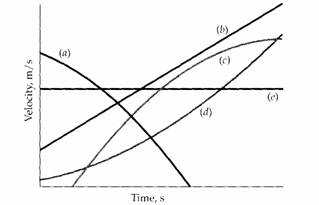
Which of the veloctity-versus-time curves in the
figure, best describes the motion of an object with constant positive
acceleration:
1.3.
What is the average velocity over the “round trip” of an object that is
launched straight up from the ground and falls straight back to the ground?
1.4.
True/fase; explain
(a)
If the acceleration remains zero, the body cannot be moving.
(b)
If the acceleration remains zero, the x-versus-t curve must be a straight line.
(c)
The equation Dx=v0t+(1/2)at2 is valid for all particle motion in one
dimension
(d)
If the velocity at a given instant is zero, the acceleration at that instant
must also be zero.
(e)
The equation Dx=vavDt
holds for all particle motion in one dimension.
1.5.
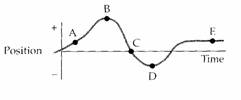
An object moves along a line as shown in the figure. At which point or points
is its speed at a minimum?
1.6.
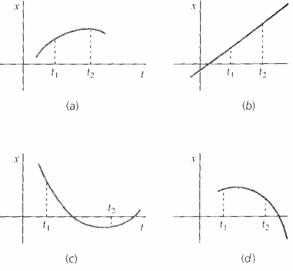
For each of the four graphs of x
versus t, answer the following questions:
(a)
Is the velocity at time t2 greater than, less than or equal to the
velocity at time t1?
(b)
Is the speed at time t2 greater than, less than or equal to the
speed at time t1?
1.7.
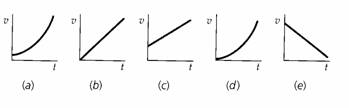
Assume that a Porsche accelerates uniformly from 80.5 km/h (50 mi/h) at t=0 to 113 km/h (70 mi/h)
at t=9. Which graph best describes the motion of the car?
2. NUMERICAL PROBLEMS
2.1.
A ball is thrown upward with an initial velocity of 20 m/s.
(a)
How long is the ball in the air? (Neglect the height of the release point).
(b)
What is the greatest height reached by the ball?
(c)
How long after release is the ball 15 m above the release point?
2.2.
A centrifuge spins at a rate of 15000 rev/min.
(a)
Calculate the centripetal acceleration of a test-tube sample held in the
centrifuge arm 15 cm from the rotation axis.
(b)
It takes 1 min,15 s for the centrifuge to spin up to
its maximum rate of revolution from rest. Calculate the magnitude of the
tangential acceleration of the centrifuge while it is spinning up, assuming
that the tangential acceleration is constant.
2.3.
A ball thrown into the air lands 40 m away 2.44 s later. Find the direction and
magnitude of the initial velocity.
2.4. A stone thrown
horizontally from the top of a 24 m tower hits the ground at a point 18 m from
the base of the tower.
(a)
Find the speed with which the stone was thrown.
(b)
Find the speed of the stone just before it hits the ground.
KINEMATICS
1. CONCEPTUAL PROBLEMS
1.1.
A golfer drives the ball from the tee down the fairway in a high arcing shot.
When the ball is at the highest point of its flight,
(a) its velocity and acceleration are both zero,
(b) its velocity is zero but its acceleration is non zero,
(c) its velocity is non zero but its acceleration is zero,
(d) its velocity and acceleration are both non zero,
(e) insufficient information is given to answer correctly.
1.2.
How is it possible for a particle moving at constant speed to be accelerating?. Can a particle with constant velocity be accelerating at
the same time?
1.3.
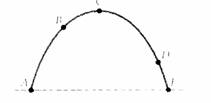
The figure represents the parabolic trajectory of a ball going from A to E.
What is the direction of the acceleration at point B?
(a)
Up and to the right
(b)
Down and to the left
(c)
Straight up
(d)
Straight down
(e)
The acceleration of the ball is zero
1.4.
Referring to the motion described in Problem 1.3.
(a)
At which point(s) is the speed the greatest?
(b)
At which point(s) is the speed the lowest?
(c)
At which two points is the speed the same?. Is the
velocity the same at those points?
2. NUMERICAL PROBLEMS
2.1.
A boy whirls a ball on a string in a horizontal circle of radius 0.8 m. How
many revolutions per minute does the ball make if the magnitude of its
centripetal acceleration is g?
2.2.
A cargo plane is flying horizontally at an altitude of 12 km with a speed of
900 km/h when a large crate falls out of the rear loading ramp.
(a)
How long does it take the crate to hit the ground?
(b)
How far horizontally is the crate from the point where it fell off when it hits
the ground?
(c)
How far is the crate from the aircraft when the crate hits the ground, assuming
that the plane continues to fly with constant velocity?
2.3.A projectile is fired into the air from the top of a 200 m
cliff above a valley. Its initial velocity is 60 m/s at 60º above the
horizontal. Where does the projectile land?
2.4.
A flowerpot falls from the ledge of an apartment building. A person in an
apartment below, coincidentally holding a stopwatch, notices that it takes 0.2
s for the pot to fall past his window, which is 4 m high. How far above the top
of the window is the ledge from which the pot fell?
KINEMATICS
1. A
pulley wheel
rotates at 300 rev/min. Calculate (a) its angular velocity in rad/s, (b) the linear speed of a point on the rim if the pulley
has a radius of 150 mm, (c) the time for one revolution.
SOL. (a) 31.4 rad/s;
(b) 4.71 m/s, (c) 0.200 s
2.
The turntable on a record player rotates at 45 rev/min. Calculate (a) its
angular velocity in rad/s, (b) the linear speed of a
point 14 cm from the centre, (c) the time for one revolution.
SOL. (a) 4.7 rad/s;
(b) 0.66 m/s, (c) 1.3 s
3. A
car moves round a circular track of radius 1.0 km at a constant speed of 120
km/s. Calculate its angular velocity in rad/s.
SOL.
0.033 rad/s
 4. A man stands at the earth´s equator. Find
(a) his angular velocity, (b) his linear speed, (c) his acceleration due to the
rotation of the earth´s axis.
4. A man stands at the earth´s equator. Find
(a) his angular velocity, (b) his linear speed, (c) his acceleration due to the
rotation of the earth´s axis.
(Radius
of the earth= 6.4 * 106 m)
SOL. (a) 7.3*10-5 rad/s; (b) 0.47
km/s, (c) 0.034 m/s2
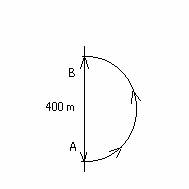
5. A
car takes 80 s to travel at constant speed in a semicircle from A to B as show
in the figure. Calculate:
(a)
Its speed. (b) Its average velocity. (c)The change in
velocity from A to B.
SOL. (a) 2.5p m/s;
(b) 5.0 m/s North, (c) 5.0 p m/s to the left.
6. A
ball is dropped from a cliff top and takes 3.0 s to reach the beach below.
Calculate (a) the height of the cliff, (b) the velocity acquired by the ball.
SOL. (a) 45 m, (b) 30 m/s.
7. A
man stands on
the edge of a cliff and throws a stone vertically upwards as 15 m/s. After what time will the stone hit
the ground 20 m below?
SOL. 4 s.
8. A
shell is fired at 400 m/s at an angle of 30º to the horizontal. If the shell
stays in the air for 40 s, calculate how far it lands from its original
position. Assume that the ground is horizontal and that air resistance may be
neglected.
SOL. 14 km.
9. A
stone is projected horizontally with velocity 3.0 m/s from the top of a
vertical cliff 200 m high. Calculate (a) how long it takes to reach the ground,
(b) its distance from the foot of the cliff, (c) its vertical and horizontal
components when it hits the ground. Neglect air resistance.
SOL. (a) 6.3 s, (b) 19 m, (c) 63 m/s, 3.0 m/s.
10.
A motorcycle stunt-rider moving horizontally takes off from a point 1.25 m
above the ground, landing 0 m away as shown in the figure. What was the speed
at take off?
SOL. 20 m/s
11.
An aircraft is travelling horizontally at 250 m/s at a height of 4500 m when a
part of the fuselage becomes detached. Find.
(a) the time taken for the detached part to reach the ground.
(b) the horizontal distance travelled from the point of
detachment to striking the ground.
(c) the velocity of striking the ground
SOL.
(a) 30 s, (b) 7500 m, (c) 391 m/s
12.
A lunar landing module is descending to the moon´s
surface at a steady velocity of 10 m/s. At a height of 120 m a small object
falls from its landing gear. Taking the moon´s
gravitational acceleration as 1.6 m/s2, at what speed, in m/s, does
the object strike the moon?.
Sol. 22 m/s
13. A
bus travelling steadily at 30 m/s along a straight road passes a stationary car
which, 5 s later, begins to move with a uniform acceleration of 2 m/s2
in the same direction of the bus.
(a)
How long does it take the car to acquire the same speed as the bus?
(b)
How far has the car travelled when it is level with the bus?
SOL.(a)15 s, (b)1.2 km
14.
A shot-putter show throws the shot forward with a velocity of 12 m/s with
respect to his hand, in a direction 54º to the horizontal. At the same time,
the shot-putter´s body is moving forward
horizontally, with a velocity of 3.0 m/s.
Draw
a vector diagram to show the addition of the two velocities of the shot at the
moment of release. Hence, or otherwise, show that the vector sum of the two
velocities has a magnitude of approximately 14 m/s.
15.
Water emerges horizontally from a hose pipe with velocity of 4.0 m/s as shown
in the figure. The pipe is pointed at P on a vertical surface 2.0 m from the
pipe. If the water strikes at S, calculate PS.
SOL. 1.25 m
DYNAMICS
1. CONCEPTUAL PROBLEMS
1.1. A particle is travelling in a vertical circle at constant speed.
One can conclude that the .......................is constant.
(a) velocity, (b) acceleration, (c) net force,
(d) apparent weight, (e) none of the properties listed.
1.2. A sky diver of weight w is descending near the surface of the earth. What is the magnitude of
the force exerted by her body on the earth?
(a) w.(b) greater than w.(c) less than w.(d)9.8 w. (e)0,
(f) It depends on the air resistance
2. NUMERICAL PROBLEMS
2.1. Suppose that a frictionless surface is inclined at an angle of 30º
to the horizontal. The 270-g block is attached to a 75-g hanging weight using a
pulley.
(a) Draw the free-body diagrams, one for the block and the other for the
hanging weight.
(b) Find the tension in the string and the acceleration of the block.
(c) The block is released from rest. How long does it take for it to
slide a distance of 1.00 m down the surface?
2.2. The string of a conical pendulum is 50 cm long and the mass of the
bob is 0.25 kg. Find the angle between the string and the horizontal when the
tension in the string is six times the weight of the bob. Under those
conditions, what is the period of the pendulum?
2.3. You swing a pail of water in a vertical circle of radius r. If its
speed is vt at the top of
the circle, find:
(a) the force exerted on the water by the pail
at the top of the circle.
(b) the minimum value of vt
for the water to remain in the pail.
(c) What is the force exerted by the pail on the water at the bottom of
the circle, where the pail´s speed is vb?.
2.4. You are at the wheel of a 1200-kg car travelling East through an
intersection when a 3000-kg truck travelling North. Your car and the truck
stick together after impact. The driver of the truck claims you were at fault
because you were speeding. You look for evidence to disprove this claim. First,
there are no skid marks, indicating that neither you nor the truck driver saw
the accident coming and braked hard; second, there is a sign reading
"Speed Limit 80 km/h" on the road you were driving on; third, the
speedometer of the truck was smashed with the needle stuck at 50 km/h; and
fourth, the wreck initially skidded from the impact zone at an angle of no less
than 59º North of East. Does this evidence support or undermine the claim that
you were speeding?
DYNAMICS
1. CONCEPTUAL PROBLEMS
1.1. True or false:
a) If two external forces that are both equal in magnitude and opposite
in direction act on the same object, the two forces can never be an
action-reaction force pair.
b) Action equals reaction only if the objects are not accelerating.
1.2. An 80-kg man on ice skates pushes his 40-kg son also on skates,
with a force of 100 N. The force exerted by the boy on his father is (a) 200 N,
(b) 100 N; (c) 50 N; (d) 40 N.
2. NUMERICAL PROBLEMS
2.1. A bullet of mass 1.8 .10-3 kg moving at 500m/s impacts a
large fixed block of wood and travel 6 cm before coming to rest. Assuming that
the acceleration of the bullet is constant, find the force exerted by the wood
on the bullet.
2.2. A 2-kg block hangs from a spring scale calibrated in N that is
attached to the ceiling of an elevator. What does the scale read when (a) the
elevator is moving up with a constant velocity of 30 m/s; (b) the elevator is
moving down with a constant velocity of 30 m/s; (c) the elevator is ascending
at 20 m/s and gaining speed at a rate of 3 m/s2; (d) from t=0 to t= 5 s,
the elevator moves up at 10 m/s. Its velocity is then reduced uniformly to zero
in the next 4 s, so that it is at rest at t= 9s. Describe the reading of the
scale during the interval 0<t<9 s.
2.3. A curve of radius 30 m is banked at an angle q. Find q. for
which a car can round the curve at 40 km/h even if the road is covered with ice
so that friction is negligible.
ENERGY, POWER AND WORK
1. CONCEPTUAL PROBLEMS
1.1. True or false:
(a) Only the net force acting on an object can do work.
(b) No work is done on a particle that remains at rest.
(c) A force that is always perpendicular to the velocity of a particle
never does work on the particle.
1.2. You are to move a heavy box from the top of one table to the top of
another table of the same height on the other side of the room. What is the
minimum amount of work you must do on the box to accomplish the move?. Explain.
1.3. True of false: A person on a Ferris wheel is moving in a circle at
constant speed. Thus, no force is doing work on the person.
1.4. By what factor does the kinetic energy of a car change when its
speed is doubled?
1.5. A particle moves in a circle at a constant speed. Only one of the
forces acting on the particle is in the centripetal direction. Does the net
force on the particle do work on it?.
1.6. An object initially has kinetic energy K. The object then moves in
the opposite direction with three times its initial speed. What is the kinetic
energy now? (a) K; (b) 3K; (c) -3K; (d) 9K; (e) - 9K.
1.7. How does the work required to stretch a spring 2 cm from its
natural length compare with that required to stretch it 1 cm from its natural
length?
1.8. Two stones are thrown with the same initial speed at the same
instant from the roof of a building. One stone is thrown at an angle of 30º
above the horizontal, the other is thrown horizontally. (Neglect air
resistance). Which statement below is true?
(a) The stones strike the ground at the same time and with equal speeds.
(b) The stones strike the ground at the same time with different speeds.
(c) The stones strike the ground at different times with equal speeds.
(d) The stones strike the ground at different times with different
speeds.
1.9. True of false:
(a) The total energy of a system cannot change.
(b) When you jump into the air, the floor does work on you increasing
your mechanical energy.
1.10. If a rock is attached to a massless,
rigid rod and swung in a vertical circle at a constant speed, it will not have
a constant total energy, as the kinetic energy of the rock will be constant,
but the potential energy will be continually changing. Is any total work being
done on the rock? Does the rod exert a tangential force on the rock?.
2. NUMERICAL PROBLEMS
2.1. A roller coaster car of mass 1500 kg starts at a distance H = 23 m
above the bottom of a loop 15 m in diameter. If friction is negligible, the downward
for the rails on the car when it is upside down at the top of the loop is: (a)
4.6x10⁴ N, ((b) 3.1x10⁴N,(c) 1.7x10⁴N, (d) 980
N, (e) 1.6x10³ N.
2.2. A single-car roller coaster pushes off, and on the first section of
track, descends a 5-m-deep valley, then climbs to the top of a hill that is 9.5
m above the valley floor. (a) What is the minimum initial speed required to
carry the coaster beyond the first hill?. Assume that
the track is frictionless. (b) Can be affect this speed by changing the depth
of the valley to make the coaster pick up more speed at the bottom?.
2.3. A stone is thrown upward at an angle of 53º above the horizontal.
Its maximum height during the trajectory is 24 m. What was the stone´s initial speed?
2.4. A baseball of mass 0.17 kg is thrown from the roof of a building
12 m above the ground. Its initial velocity is 30 m/s at an angle of 40º above
the horizontal. (a) What is the maximum height the ball reaches? (b) What is the
work done by gravity as the ball moves from the roof to its maximum height? (c)
What is the speed of the ball as it strikes the ground?.
2.5. An 80-cm-long pendulum with a 0.6-kg bob is released from rest at
initial angle q0 with the vertical. At the bottom of the swing,
the speed of the bob is 2.8 m/s. (a) What was the
initial angle of the pendulum? (b) What angle does the pendulum make with the
vertical when the speed of the bob is 1.4 m/s?.
2.6. A child of mass 40 kg goes down an 8.0-m-long slide inclined at 30º
with the horizontal. The coefficient of kinetic friction between the child and
the slide is 0.35. If the child starts from rest at the top of the slide, how
fast is she travelling when she reaches the bottom?
2.7. A sled is coasting on a horizontal snow-covered surface with an
initial speed of 4 m/s. If the coefficient of friction between the sled and the
snow is 0.14, how far will the sled go before coming to rest?