Simple Harmonic Motion
Extracted from “Physics
for Scientists and Engineerning”s. P.A. Tipler, G.P. Mosca, 5th
edition
A common, very
important, and very basic kind of oscillatory motion is simple harmonic motion
such as the motion of an object attached to a spring.
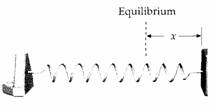
In equilibrium, the
spring exerts no force on the object. When the object is displaced an amount x
from its equilibrium position, the spring exerts a force kx,
as given by Hooke’s law
Fx= - kx
where k is the force
constant of the spring, a measure of the spring’s stiffness. The minus sign
indicates that the force is a restoring force; that is, it is opposite to the
direction of the displacement from the equilibrium position. Combining the previous equation with Newton’s second law (F = ma) we
have
-kx = max
or ax= - (k/m)x
The acceleration is
proportional to the displacement and is
oppositely directed. This is the defining characteristic of simple harmonic
motion and can be used to identify systems that will exhibit it:
Whenever the acceleration of an object is proportional
to its displacement and is oppositely directed, the object will move with
simple harmonic motion.
CONDITIONS FOR SIMPLE HARMONIC MOTION IN TERMS OF
ACCELERATION
Because the
acceleration is proportional to the net force, whenever the net force on an
object is proportional to its displacement and is oppositely directed, the
object will move with simple harmonic motion.
The time it takes
for a displaced object to execute a complete cycle of oscillatory motion from
one extreme to the other extreme and back—is called the period T. The reciprocal of the period is the frequency
f, which is the number of cycles per
second:
f= 1/T
 The unit of
frequency is the cycle per second (cy/s), which is called a hertz (Hz). For
example, if the time for one complete cycle of oscillation is 0.25 s, the
frequency is 4 Hz.
The unit of
frequency is the cycle per second (cy/s), which is called a hertz (Hz). For
example, if the time for one complete cycle of oscillation is 0.25 s, the
frequency is 4 Hz.
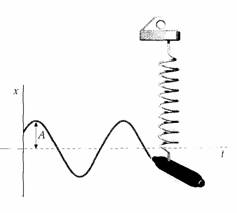
Next figure shows
how we can experimentally obtain x versus t for a mass on a spring. The general
equation for such a curve is
x=A cos(wt + d)
POSITION IN SIMPLE HARMONIC MOTION
where A, w, and d are constants. The
maximum displacement xmax from equilibrium
is called the amplitude A.
The argument of the cosine function, (wt + d), is called the phase
of the motion, and the constant d is called the phase
constant, which is the phase at t = 0. (Note that cos(wt +
d) =
sin(wt + d + p/2); thus, whether
the equation is expressed as a cosine function or a sine function simply
depends on the phase of the oscillation at the moment we designate to be t =
0.) If we have just one oscillating system, we can always choose t = 0 at which
d
=0. If we have two systems oscillating with the same amplitude and frequency
but different phase, we can choose d = 0 for one of them. The
equations for the two systems are then:
x1 = A cos(wt) and x2
= A cos(wt + d)
If the phase
difference d is 0 or an integer times 2 p then x2
= x1 and the systems are said to be in phase. If the phase
difference d is p or an odd integer times p, then x2
= -x1x and the systems are said to be 180º out of phase.
We can show that
equation x=A cos(wt + d) is a solution of equation ax= - (k/m)x by differentiating x twice with
respect to time. The first derivative of x gives the velocity v:
v= dx/dt= -wAsin(wt+
d)
VELOCITY IN SIMPLE HARMONIC MOTION
Differentiating
velocity with respect to time gives the acceleration:
A= dv/dt= -w2Acos(wt+ d)
Substituting x for A cos(wt +
d)
gives: a= -w2x
ACCELERATION IN SIMPLE HARMONIC MOTION
Comparing a= -w2x with a= - (k/m)x, we
see that x= A cos(wt +
d) is
a solution of the equation:
d2x/dt2 = - (k/m)x
The constant is called the angular
frequency w. It has units of
radians per second and dimensions of inverse time, the same as angular speed,
which is also designed by w.
The cosine (and sine) function
repeats in value when the phase increases by 2p, so:
wT = 2p
® w=2p /T
Substituting in the general
equation: x= Acos(2p t/T +d)
We can see by inspection that
each time t increases by T, the phase increases by 2p and one cycle of
the motion is completed.
Because  , the frequency and period of an object on a spring are
related to the force k and the mass m by:
, the frequency and period of an object on a spring are
related to the force k and the mass m by:

FREQUENCY
AND PERIOD FOR AN OBJECT ON A SPRING
The
frequency and period of simple harmonic motion are independent of the amplitude
Simple Harmonic
Motion and Circular Motion
There is a relation between simple harmonic
motion and circular motion with constant speed. When a
particle moves with constant speed in a circle, its projection onto a diameter
of the circle moves with simple harmonic motion.
Energy in Simple Harmonic Motion
When an object on a
spring undergoes simple harmonic motion, the system´s
potential energy and kinetic energy vary with time. Their sum, the total
mechanical energy: E= K + U, is constant.
Consider and object
a distance x from equilibrium, acted on an restoring
force – kx. The system´s
potential energy is : U= (1/2) kx2
For simple harmonic
motion, x = A cos(wt + d). Substituting gives
U= (1/2) k A2
cos2(wt +
d)
POTENTIAL ENERGY IN SIMPLE
HARMONIC MOTION
The kinetic energy
of the system is: K= (1/2) mv2 where m is the object´s
mass and v is its speed. For simple harmonic motion v=-wAsin(wt+
d).
Substituting gives:
K= (1/2) m w2A2sin(wt+
d).
Then using w2= k/m;
K= (1/2)k A2 sin2(wt+
d)
KINETIC ENERGY IN SIMPLE
HARMONIC MOTION
The total
mechanical energy is the sum of the potential and kinetic energies:
Etotal= (1/2) k A2
TOTAL MECHANICAL ENERGY IN
SIMPLE HARMONIC MOTION
The total mechanical energy in simple harmonic motion
is proportional to the square of the amplitude.
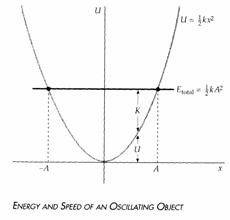 For an object at
its maximum displacement, the total energy is all potential energy. As the
object moves towards its equilibrium position, the kinetic energy of the system
increases and its potential energy decreases. As it moves through its
equilibrium position, the kinetic energy of the object is maximum,
the potential energy of the system is zero, and the total energy is kinetic. As
the object moves past the equilibrium point, its kinetic energy begins to
decrease, and the potential energy of the system increases until the object
again stops momentarily at its maximum displacement. At all times, the sum
of the potential and kinetic energies is constant.
For an object at
its maximum displacement, the total energy is all potential energy. As the
object moves towards its equilibrium position, the kinetic energy of the system
increases and its potential energy decreases. As it moves through its
equilibrium position, the kinetic energy of the object is maximum,
the potential energy of the system is zero, and the total energy is kinetic. As
the object moves past the equilibrium point, its kinetic energy begins to
decrease, and the potential energy of the system increases until the object
again stops momentarily at its maximum displacement. At all times, the sum
of the potential and kinetic energies is constant.

The Simple Pendulum
A simple pendulum
consists of a string of length L and
a bob of mass m. When the bob is
released from an initial angle j0 with the vertical, it swings
back and forth with some period T.
The forces on the
bob are its weight mg and the string tension T. At an angle j with the vertical,
the weight has components mgcos j
along the string and mgsin j tangential to the
circular arc in the direction of decreasing . Using tangential components, Newton´s second law (∑F= mat) gives:
- mgsin
j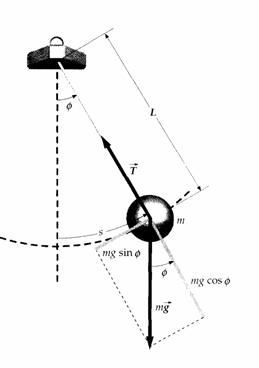 =mat
=mat
For small j, sin j=
j; so
that, - mg j=mat
x
=
j L (arc= ang x
radio; where L= Radio)
and - mg j=- mgx/L
From the Hooke´s law: F= - kx
Where k= mw2= mg/L
Thus, the motion of
a pendulum approximates simple harmonic motion for small angular displacements.
The period of the
motion is thus:

Note that the mass m does not appear in the equation. The
motion of a pendulum does not depend on its mass.
Large-Amplitude Oscillations
When the amplitude
of a pendulum´s oscillation becomes large, its motion
continues to be periodic, but it is no longer simple harmonic. A slight
dependence on the amplitude must be accounted for when determining the period.
ACTIVITIES
Conceptual Problems
1. What is the
magnitude of the acceleration of an oscillator of amplitude A and frequency f
when its speed is maximum? When its displacement from
equilibrium is maximum?
2. Are the
acceleration and the displacement (from equilibrium) of a simple harmonic
oscillator ever in the same direction? The acceleration and the velocity ? The velocity and the displacement
? Explain.
3. True or false:
(a) For a simple
harmonic oscillator, the period is proportional to the square of the amplitude.
(b) For a simple
harmonic oscillator, the frequency does not depend on the amplitude.
(c) If the
acceleration of a particle undergoing 1-dimensional motion is proportional to
the displacement from equilibrium and oppositely directed, the motion is simple
harmonic.
4. If the amplitude of a simple
harmonic oscillator is tripled, by what factor is the energy changed?
5. An object
attached to a spring has simple harmonic motion with an
amplitude of 4.0 cm. When the object is 2.0 cm from the equilibrium
position, what fraction of its total energy is potential energy?
(a)
One-quarter. (b) One-third. (c) One-half. (d)
Two-thirds. (e) Three-quarters.
6. True or false:
(a) For a given object
on a given spring, the period is the same whether the spring is vertical or
horizontal.
(b) For a given
object oscillating with amplitude A on a given spring, the maximum speed is the
same whether the spring is vertical or horizontal.
7. True or false:
The motion of a simple pendulum is simple harmonic for any initial angular
displacement.
8. True or false:
The motion of a simple pendulum is periodic for any initial angular
displacement.
9. The length of
the string or wire supporting a pendulum bob increases slightly when its
temperature is raised. How would this affect a clock operated by a simple
pendulum?
10. The effect of
the mass of a spring on the motion of an object attached to it is usually
neglected. Describe qualitatively its effect when it is not neglected.
11. A lamp hanging
from the ceiling of the club car in a train oscillates with period T when the
train is at rest. The period will be (match left and right columns) with
constant velocity.
1.
greater than T0 when A.
the train moves horizontally constant velocity.
2.
less than T0 when B.
the train rounds a curve of radius R with speed V.
3. equal to T0 when C.
the train climbs a hill of inclination q at constant speed.
D. the train goes over the crest of a hill of radius
of curvature R
with constant speed.
12. Two mass—spring
systems oscillate at frequencies fA and fB. If fA = 2fB
and the spring constants of the two springs are equal, it follows that the
masses are related by
(a) MA = 4MB ;
(b) MA = MB/ √2 ; (c) MA = MB/2 ;
(d) MA = MB/4
13. Two mass—spring
systems A and B oscillate so that their energies are equal. If MA =
2 MB which formula relates the amplitudes of oscillation? (a) AA
= AB/4 (b) AA = AB/ √2 ;
(c) AA = AB ; (d) Not enough information is given to
determine the ratio of the amplitudes.
14. Two mass—spring
systems A and B oscillate so that their energies are equal. If kA =
2kB then which formula relates the amplitudes of oscillation? (a) AA
= AB/4 (b) AA = AB/ √2 ;
(c) AA = AB ; (d) Not enough information is given to
determine the ratio of the amplitudes.
15. Pendulum A has
a bob of mass MA and a length LA; pendulum B has a bob of
mass MB and a length LB. If the period of A is twice that
of B, then (a) LA = 2LB and MA = 2 MB; (b) LA
= 4LB and MA = MB ;
(c) LA = 4LB whatever the ratio MA/MB,
(d) LA =√2 LB whatever the ratio MA/MB.
Numerical problems
1. You are on a
boat, which is bobbing up and down. The boat´s
vertical displacement y is given by:
y= 1.2
cos (t/2 + p/6)
(a) Find the amplitude,
angular frequency, phase constant, frequency, and period of the motion. (b)
Where is the boat at t=1s? (c) Find the velocity and acceleration as functions
of time t.(d) Find the initial values of the position,
velocity and acceleration of the boat.
2. An object
oscillates with angular frequency w= 8.0 rad/s.
At t=0, the object is at x=4 cm with
an initial velocity of v= -25 cm/s.
(a) Find the amplitude and phase constant for the motion. (b) Write x as a
function of time.
3. Consider an
object on a spring whose position is given by x= 5 cos
(9.90t) (cm).
(a) What is the maximum speed of the object?. (b) When
does this maximum speed first occur?. (c) What is the
maximum of the acceleration of the object? (d) When does maximum acceleration
first occur after t=0?
4. A 3 kg object
attached to a spring oscillates with an amplitude of 4
cm and a period of 2s. (a) What is the total energy?.
(b) What is the maximum speed of the object? (c) At what position x1 is the speed equal to half
its maximum value?
5. The position of
a particle is given by x = (7 cm) cos 6pt, where t is in seconds. What
are (a) the frequency, (b) the period, and (c) the amplitude of the particle’s
motion? (d) What is the first time after t=0 that the particle is at its
equilibrium position? In what direction is it moving at that time?
6. What is the
phase constant d in Equation x=A cos(wt + d) if the position of the
oscillating particle at time t = 0 is (a) 0, (b) - A, (c) A, (d) A/2?
7. A particle of mass m begins at rest from x = +25 cm and oscillates about its
equilibrium position at x=0 with a
period of 1.5 s. Write equations for (a) the position x as a function of t, (b) the velocity v as a function of t, and (c) the acceleration a as a function of t.
8. Find (a) the maximum speed and (b) the
maximum acceleration of the particle in Problem 5. (c) What is the first time
that the particle is at x = 0 and moving to the right?
9. Work Problem 7
with the particle initially at x = 25 cm and moving with velocity y = +50 cm/s.
10. The period of an oscillating particle is 8 s
and its amplitude is 12 cm. At t = 0 it is at its equilibrium position. Find
the distance travelled during the intervals (a) t = O to t = 2s, (b) t = 2s to
t = 4s, (c) t = 0 to t= ls, and (d) t = is to t = 2
s.
11. The period of
an oscillating particle is 8 s. At t = 0, the particle is at rest at x = A = 10
cm. (a) Sketch x as a function of t. (b) Find the distance travelled in the
first, second, third, and fourth second after t = 0.
12. The position of
a particle is given by x = 2.5 cos pt, where x is in meters and t is in seconds. (a) Find the maximum speed and
maximum acceleration of the particle.(b) Find the
speed and acceleration of the particle when x= 1.5m.
13 A particle moves
in a circle of radius 40 cm with a constant speed of 80 cm/s. Find (a) the
frequency of the motion and (b) the period of the motion. (c) Write an equation
for the x component of the position of the particle as a function of time t,
assuming that the particle is on the positive X axis at time t =0.
14. A particle
moves in a circle of radius 15 cm, making 1 revolution every 3 s. (a) What is the speed of
the particle? (b) What is its angular velocity w? (c) Write an
equation for the x component of the position of the particle as a function of
time t, assuming that the particle is on the positive X axis at time t = 0.
15. A 2.4-kg object
is attached to a horizontal spring of force constant k = 4.5 kN/m. The spring is stretched 10 cm from equilibrium and
released. Find its total energy.
16. Find the total
energy of a 3-kg object oscillating on a horizontal spring with an amplitude of 10 cm and a frequency of 2.4 Hz.
17.
A
l.5-kg object oscillates with simple harmonic motion on a spring of force
constant k = 500 N/m. Its maximum speed is 70 cm/s. (a) What
is the total mechanical energy? (b) What is the amplitude of the oscillation?
18. A 3-kg object
oscillating on a spring of force constant 2 kN/m has
a total energy of 0.9 J. (a) What is the amplitude of
the motion? (b) What is the maximum speed?
19. An object
oscillates on a spring with an amplitude of 4.5 cm.
Its total energy is 1.4 J. What is the force constant of the spring?
20. A 3-kg object
oscillates on a spring with an amplitude of 8 cm. Its
maximum acceleration is 3.50 m/s Find the total energy.
21. A 2.4-kg object
is attached to a horizontal spring of force constant k = 4.5 kN/rn. The spring is stretched 10 cm from equilibrium and
released. What are (a) the frequency of the motion, (b the period, (c) the
amplitude, (d) the maximum speed, and (e) the maximum acceleration? (f) When
does the object first reach its equilibrium position? What is its acceleration
at this time?
22. Answer the
questions in Problem 21 for a 5-kg object attached to a spring of force
constant k = 700 N/m when the spring is initially stretched 8 cm from
equilibrium.
23. A 3-kg object
attached to a horizontal spring oscillates with an amplitude A = 10 cm and a
frequency f = 2.4 Hz. (a) What is the force constant
of the spring? (b) What is the period of the motion? (c) What is the maximum
speed of the object? (d) What is the maximum acceleration of the object?
24. An 85 kg person
steps into a car of mass 2400 kg, causing it to sink 2.35 cm on its springs.
Assuming no damping, with what frequency will the car and passenger vibrate on
the springs?
25. A 4.5-kg object
oscillates on a horizontal spring with an amplitude of
3.8 cm. Its maximum acceleration is 26 m/s2.
Find (a) the force constant k, (b) the frequency, and (c) the period of the
motion.
26. An object
oscillates with an amplitude of 5.8 cm on a horizontal
spring of force constant 1.8 kN/m. Its maximum speed
is 2.20 m/s. Find (a) the mass of the object, (b) the frequency of the motion,
and (c) the period of the motion.
27. A 0 4 kg block attached
to a spring of force constant 12 N/m oscillates with an amplitude of 8 cm. Find
(a) the maximum speed of the block, (b) the speed and acceleration of the block
when it is at x = 4 cm from the equilibrium position, and (c) the time it takes
the block to move from x = 0 to x = 4 cm.
28. An object of
mass m is supported by a vertical
spring of force constant 1800 N/m. When pulled down 2.5 cm from equilibrium and
released from rest, the object oscillates at 5.5 Hz. (a) Find m. (bi) Find the amount the spring is
stretched from its natural length when the object is in equilibrium. (c) Write
expressions for the displacement x,
the velocity v, and the acceleration a as functions of time t.
29. An object of
unknown mass 15 hung on the end of an unstretched spring and is released from
rest. If the object falls 3.42 cm before first coming to rest, find the period
of the motion.
30. Find the length
of a simple pendulum if the period is 5 s at a location where g = 9.81 m/s
31. What would be
the period of the pendulum in Problem 30 if the pendulum were on the moon,
where the acceleration due to gravity is one-sixth that on earth?
32. If the period
of a pendulum 70 cm long is 1.68 s, what is the value of g at the location of
the pendulum?
33. A pendulum set
up in the stairwell of a l0-story building consists of
a heavy weight suspended on a 34.0-m wire. If g = 9.81 m/s what is the period
of oscillation?
34. A particle has
a displacement x = 0.4 cos (3t + p/4), where x is m meters and t is in seconds. (a)
Find the frequency f and period T of the motion. (b) Where is the particle at
t= 0? (c) Where is the particle at t=0.5 s?
35. Find an
expression for the velocity of the particle whose position is given in Problem
34. (b) What is the velocity at time t = 0? (c) What is the maximum velocity?
(d) At what time after t = O does this maximum velocity first occur?
36. An object on a
horizontal spring oscillates with a period of 4.5 s. If the object is suspended
from the spring vertically, by how much is the spring stretched from its
natural length when the object is in equilibrium?
37. As your jet
plane speeds down the run way on takeoff, you measure its acceleration by
suspending your yo-yo as a simple pendulum and noting that when the bob (mass
40 g) is at rest relative to you, the string (length = 70 cm) makes an angle of
22C with the vertical. Find the period T for small oscillations of this
pendulum.
38. A spring of
force constant k = 250 N/rn is suspended from a rigid
support. An object of mass 1 kg is attached to the unstretched spring and the
object is released from rest. (a) How far below the starting point is the
equilibrium position for the object? (b) How far down does the object move
before it starts up again? (c) What is the period of osci
lation? (d) What is the speed of the object when it
first reaches its equilibrium position? (e) When does it first reach its
equilibrium position?
39. A suitcase of
mass 20 kg is hung from two bungie cords, as shown in Figure. Each cord is
stretched
5 cm when the suitcase
is in equilibrium. If the suitcase is pulled down a little and released, what
will be its oscillation frequency?

40. A 0.12-kg block
is suspended from a spring. When a small stone of mass 30 g is placed on the block,
the spring stretches an additional 5 cm. With the stone on the block, the
spring oscillates with an amplitude of 12 cm. (a) What is the frequency of the
motion? (b) How long does the block take to travel from its lowest point to its
highest point? (c) What is the net force on the stone when it is at the point
of maximum up ward displacement?
41. In Problem 40,
find the maximum amplitude of oscillation at which the stone will remain in
contact with the block.
42. An object of
mass 2.0 kg is attached to the top of a vertical spring that is anchored to the
floor. The uncompressed length of the spring is 8.0 cm and the length of the
spring when the object is in equilibrium is 5.0 cm. When the object is resting
at its equilibrium position, it is given a down ward impulse with a hammer so
that its initial speed is 0.3 m/s. (a) To what maximum height above the floor
does the object eventually rise? (b) How long does it take for the object to
reach its maximum height for the first time? (c) Does the spring ever become
uncompressed? What minimum initial velocity must be given to the object for the
spring to be uncompressed at some time?
43. A 2.5-kg object
hanging from a vertical spring of force constant 600 N/m oscillates with an
amplitude of 3 cm. When the object is at its maximum downward displacement,
find (a) the total energy of the system, (b) the gravitational potential
energy, and (c) the potential energy in the spring.
(d) What is the
maximum kinetic energy of the object? (Choose U = O when the object is in
equilibrium)
44. A 1.5-kg object
that stretches a spring 2.8 cm from its natural length when hanging at rest
oscillates with an amplitude of 2.2 cm. (a) Find the total energy of the
system. (b) Find the gravitational potential energy at maximum downward
displacement. (c) Find the potential energy in the spring at maximum downward
displacement. (d) What is the maximum kinetic energy of the object?
45. A 1.2-kg object
hanging from a spring of force constant 300 N/m oscillates with a maximum speed
of 30 cm/s. (a) What is its maximum displacement? When the object is at its
maximum displacement, find (b) the total en energy of the system, (c) the
gravitational potential energy, and (d) the potential energy in the spring.