SCIENCE
AND SCIENTIFIC METHOD
http://home.earthlink.net/~dmocarski/chapters/chapter1/main.htm
"The most
beautiful thing we can experience is the mysterious. It is the source of all
true art and science.
"Watch the stars,
and from them learn."
Albert Einstein
Science Defined
Science is a
method of explaining and predicting events in the observable (measurable)
universe.
If a person
is asked to draw a picture of a scientist they will almost always draw a person
using some sort of lab equipment. Try it. Ask someone to draw a picture that is
instantly recognizable as a picture of a scientist. Usually they will draw a
person using the tools of science such as telescopes, microscopes, beakers, and
test tubes. Many pictures will include math equations (especially E=mc2).
The picture will almost always show some act of measurement or observation with
a clipboard or notebook to record the observations. This intuitive depiction is
really a quite accurate definition of what science is.
The reason
that people include the tools of science in their pictures is that they know,
at least at some basic level of understanding, that scientists are interested
in finding out about the things around us that can be measured and put into
numbers. That's exactly right. Scientists do
things and most of what they do involves a measurement or observation of
some kind.
The fact
that science uses measurement and observation as the basis for its explanations
and discoveries is the source of both the strength and weakness of scientific
knowledge. Its strength lies in that findings can be verified by repeating the
measurements and observations. The weakness lies in that scientists have to
limit themselves to studying those things that can be measured. That is the
definition of physical, that which can be observed and measured.
Because
scientists can only do science in the physical universe they cannot use science
to answer many important theological, ethical, and aesthetic questions.
Supernatural and philosophical experience is beyond the reach of scientific
study. This does not mean that a scientist cannot be interested in these areas.
It only means that it is impossible to deal with them in a scientific way.
Although
science is limited to what can be observed and measured it has been a very
successful and fruitful endeavor. We live in a technological paradise. We are
healthy and comfortable largely because our scientific knowledge and techniques
allow us to understand and manipulate the world around us so that it meets our
needs. The food we eat, the medicines we take, the toys we play with, are all
excellent and plentiful because we understand how things work. Unfortunately
the scientific techniques that enable us to shape our physical environment
cannot be applied to defects in our society and culture. Maybe someday we will
be able to measure human behavior in a way that lets us use the precision of
science to solve our problems. This idea was explored by the great science and
science fiction writer Issac Asimov in his "Foundation" series of
novels. It is great reading and I highly recommend them. They are fiction
however and will remain so for the foreseeable future.
What
defines science then is its use of methods of measurement and observation that
can be repeated and verified by anyone. Because of this science is limited to
the study of the natural, or physical universe.
The
critical attributes of science can be summarized as follows.
1. Science explains and predicts.
2.
Science
uses verifiable techniques of measurement and observation.
3.
Science
concerns itself with the physical universe
Areas of Study
Although
science is limited to what is observable in the universe that still leaves quite
a lot to do. The universe is a pretty big place. In fact by definition it is
everything. Because of the multitude of things to study areas of interest are
usually broken up into parts and we give those parts names like geology or
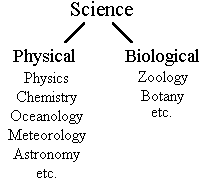
chemistry. One way of illustrating the different disciplines (areas of study)
in science is with a branching diagram. Many different schemes could be used
but the one here will give you a pretty good idea of the way science is broken
up and classified.
The basic
division is between the physical and the biological sciences. Physical sciences
are those that concentrate on nonliving matter and the biological sciences
concentrate on life.
Of all the different
disciplines of science physics and chemistry are the most fundamental. Anyone
who is interested in science must have a working knowledge of at least the
basic principles and facts that these two sciences have revealed. In the final
analysis all physical phenomena follow the rules that govern matter and energy
and matter and energy are the main concerns of physics and chemistry.
Physics
Physics is
the most basic of all sciences. A physicist is interested in observing how and
why matter and energy behave the way they do. Physicists try to discover and
explain the fundamental laws that make everything work. That's a pretty tall
order. When you hear about motion, rockets, electricity, light, sound, forces,
radioactivity, nuclear energy, and anything that has to do with the interaction
between matter and energy you are hearing about physics.
A short
definition of physics is ... The study of the interactions between matter
and energy and the forces mediating those interactions.
Chemistry
The science
called chemistry applies physical laws in determining the composition of matter
and in describing changes in composition. Chemists are interested in the
properties of matter and how they can be explained predicted and controlled.
When you hear about drugs, plastics, metals, fuels, explosives, and anything
that has to do with the composition or changes in composition in matter you are
hearing about chemistry.
A short
definition of chemistry is ... The study of the properties, composition,
and changes in composition of matter.
An
understanding of physics and chemistry forms the basis for all scientific
knowledge.
Biological
Sciences
Living
things are the most complex manifestations of physical laws. They have unique
properties and their study is usually considered separate from the physical
sciences. It is important to remember though that even living things operate by
the same rules of nature that physics and chemistry illuminate. There are many
biological sciences but they all concern themselves with living things and the
products of living things. Two well known areas are zoology and botany, the
study of animals and plants.
Since this
is a Big Book of Physical Science we will limit our discussion of the
biological sciences to times when they illustrate and amplify our main area of
interest.
Other examples of
physical sciences
The basic
physical sciences of physics and chemistry give us the tools we use to
understand lots of other areas. The planet that we live on is an important part
of our experience so we devote a lot of time to finding out about it. There are
three well known sciences that concern themselves with our planet and recently
with the study of other planets in our solar system as well. Three broad
regions of the earth can be defined and an earth science is devoted to each one
of them.
1.
Geology
This is the study of the earth's lithosphere, the solid part of the earth.
Geologists are interested in the structure and evolution of the earth's layers
and solid surface. You'll see geologists discussing rocks and minerals,
earthquakes and volcanoes, mountains and valleys, and anything having to do
with the solid earth. The word lithosphere comes from a Greek word meaning
rock.
2.
Oceanology (Oceanography)
The study of the world ocean began with mapping its shape and deep structures.
The more modern term for the scientific study of the structure and dynamics of
the ocean is Oceanology. The suffix -logy
also comes from a Greek word meaning book.
3.
Meteorology
Meteorology is not the study of meteors. It is the study of the gaseous
envelope, our atmosphere, that surrounds the earth. Meteorologists are
interested in studying the structure and composition of our atmosphere, weather
and climate, and storms. The term meteor comes from a Greek word meaning air.
The ancients thought that shooting stars, the little bits of dust and sand from
space that light up our night skies when they burn up after entering our
atmosphere, were atmospheric phenomena similar to lightning and today we still
call them meteors.
Any
classification scheme is difficult and sometimes confusing because there are
always exceptions to the rules we design to create them. A good example in our
scheme is paleontology, the study of fossils. Fossils are the
remains of once living things and are often lithified (turned into rock) and
found imbedded in the solid earth. A paleontologist then must not only know
biology but geology as well. Many sciences are connected like this and cannot
be easily separated into either biological or physical camps. Even chemistry
and physics are so intertwined that chemistry is sometimes said to be physics
applied to a larger scale. You should keep in mind that all sciences use the
same methods of measurement and observation and rely on the same facts and
laws. Each science often draws on the findings of other sciences for information.
Outside of
the earth another well known science is astronomy. This is my favorite science.
Astronomy is the science that got all other sciences started. The attempt to
explain the observed motions of the stars, moon, sun, and planets led to the
development of methods of observation and testing that underlie all scientific
studies. Astronomy is sometimes called the queen of all science. Physics is the
king. Do not. I repeat. Do not confuse astronomy with astrology which today is
completely meaningless nonsense only useful for entertainment like Saturday
cartoons.
Astronomy
Astronomy is the study of the composition, motions, structure and evolution of
the universe. That's a lot to study. Remember that the universe is everything.
Pure and Applied Science
Another way
of categorizing science is to determine whether or not the area of study is
intended to discover new facts and laws or is trying to apply existing
scientific knowledge to solve technological problems. Good examples of the
latter are engineering and most
forms of medicine. An engineer for
instance is generally attempting to design some tool or machine such as a
bridge, or spacecraft, or a new computer chip by using facts and laws that have
already been discovered. That's what applied
science is. The application of
scientific knowledge.
Pure
sciences on the other hand delve into the unknown trying to discover new and
different aspects of our universe. This can lead to tests of our present explanations
and laws and sometimes results in new and better theories of how things work.
Cosmology, not cosmetology, is the study of the
structure and evolution of the universe. The answers to cosmological questions
give us an idea of how stars, galaxies, and space and time itself began and
changed over time. Particle Physicists
smash atoms together to see what they are made of, and paleontologists try to understand the nature of creatures not seen
on our planet for millions of years. None of these endeavors directly produces
a new machine or medicine. They all are attempting
to gather new information. That's what pure
Science is .
Sometimes
people hear about studies that don't seem to have any practical value and
wonder why time and money is being spent on them. It is important to remember
that new discoveries can eventually lead to the solution of some unforeseen
problem or be applied in some way that has not yet been perceived. A good
example of this occurred in the mid 1800's when the great mathematician and
physicist James Clerk Maxwell was investigating how electricity and magnetism
were related. He discovered some equations that predicted that electricity and
magnetism would travel through space at the speed of light. In his time the
work was purely theoretical. It was a discovery that had no application. Today
we use that knowledge as the basis for all of our electronics and
communications industries. That means your cellular phone, computer, and yes
your beloved television were derived from work that was done in the pursuit of
knowledge.
Testing the Hypothesis
What makes
science so very successful can be attributed to one fundamental idea. That is
that scientists limit themselves to what can be observed. What can be observed
can be observed by all. They don't argue endlessly about their theories and
ideas. They do argue, sometimes for a long time, but not endlessly. The basic
premise of science is that a scientist can say "Look, if I'm right you'll
see this happen when you do this." Because scientists deal only in the
observable universe their ideas and conclusions can be tested.
A few definitions
1.
Data: Data is any observation or information that is
verifiable.
2. Fact: A fact is a simple observation that can be verified. Facts are data.
3.
Hypothesis: An hypothesis is a possible solution
to a scientific question or problem.
4.
Scientific Theory: A theory is an explanation of many
facts and observations. A good scientific theory has been well tested and works
well under many circumstances.
5.
Scientific Law: A law in science is an explanation
or relationship that is always true.
6.
Variable: A variable is a factor that can
affect the outcome of an experiment. It is a factor that causes a system to
behave in a particular way.
The classic
description of how scientific problems are solved is usually called the scientific method, the sequence of events that leads to scientific discoveries and
solutions to scientific problems. The sequence can be described and
analyzed in great detail but it all boils down to the following essentials.
· observation and data collection
·
recognition
of a problem or question
· development of an hypothesis
· test of the hypothesis
· analysis of the test
The really
distinctive items on this list are the collection of data and the test of the hypothesis.
Good science will always seek measurable data and develop hypotheses that can
be tested by accumulating more data.
The notion
of a testable hypothesis is crucial to differentiating good science from
crackpot pseudo-scientific theories like the Roswell UFO crash and paranormal
X-file type explanations of events. The crackpot theory usually relies on an
approach called negative proof. Negative proof is non testable. Negative proof is an "it's true because you can't prove it's
not true" approach. It requires only belief and you can believe
anything you want. Science on the other hand requires positive proof. That is a
"you can see that this happens under these circumstances" approach.
It does not require belief but observation.
The problem
with negative proof is that there is no way to test it. A typical scenario of pseudo-science (theories that sound scientific but do not really use scientific
methods to verify them) goes something like this. A bright light in sky is
seen in some out of the way place and is witnessed by several people that
cannot immediately identify its cause. An hypothesis develops that it was an
alien spacecraft in the process of crashing to earth. This is OK so far but
where the hypothesis falls apart is that there is no verifiable evidence.
Invariably there are no bits of the spacecraft or clear non-faked photographs.
The only proof is of the "you can't prove it's not true" type. The
lack of evidence is usually attributed to a government cover-up. But here again
there is never any clear evidence of the cover-up.
Here is
another example of how meaningless a "proof" without measurable
evidence can be.
Suppose I
tell you that there is a tiny man that lives in the pipes running throughout
your house. He is the gremlin that causes all the household plumbing problems
that can crop up from time to time. You know, like leaky faucets, running
toilets and the like. The reason that you have never seen him is that he and
his race of beings have the power to make themselves virtually undetectable. By
the way, the government is aware of the existence of these creatures but since
they have not been able to do anything about them they don't want to frighten
us and all that is known about these creatures is kept hidden in a secret army
base in a cavern under the
You might
say that this is ridiculous and that you don't believe it. My response to you
might be that it is true and that you can't prove that it is not. This is
exactly the "proofs" of many pseudo-scientific ideas. They might be
great fun but they certainly offer nothing in the way of a real understanding
of how things work.
All this
doesn't mean that speculation and imagination do not have a role in science.
They do. New and radical ideas spur the advancement of science into new and
exciting directions. To be useful and productive however ideas must produce
testable hypotheses. That's what science is all about. Science fiction and
ghost stories are very entertaining but they are not science. They may even
predict what will someday occur. They may even be true. But they aren't science
until they produce measurable data and verifiable hypotheses.
Experiments
The best
test of an hypothesis is a controlled
experiment. The critical attribute of a controlled experiment is that the
effect of a change in only one variable is tested. The factor that is being tested is often called the experimental variable. In a classic
experiment two sets of data are collected. The set used as a standard of comparison is known as the control group. The other set in which one variable is made different from the control group is called
the experimental group. It is
important in a good experiment to keep all the factors, except one, the same
between the two groups. All those factors
that are the same between the two groups are sometimes called constants. The basic idea is to
experiment on only one variable at a time in order to see what effect is has on
the system.
A pretty
good science fair project might be to take two cuttings from an ivy plant with
the same number and size of leaves. One cutting is grown in distilled (pure)
water and the other is grown in the same amount of distilled water in which a
fertilizer has been dissolved. The growth rate of the two plants is then
monitored over time and compared. If care is taken to keep both plants in the
same environment any difference in growth rate, which can be measured by the
number of leaves, length of stem, and weight of the plant, can be attributed to
the presence of the fertilizer in one and not the other.
This is a
good experiment to determine the effect of the fertilizer. An hypothesis might
be that the fertilizer will help the plant grow better. This experiment will
determine if that hypothesis is correct or not. It is a good experiment because
the plants are clones of each other so that they have the same genetics and
everything is kept the same about them except for the presence of fertilizer in
the experimental plant. Besides that, you or I can repeat the procedure for
ourselves to verify the results. Now that's pretty good science.
In this
experiment the constants are everything that is the same about the two systems.
The control is the plant in distilled water. The experimental variable is the
fertilizer.
Other ways of testing hypotheses
We cannot
perform experiments on many systems in which we are interested. For example the
atmosphere of earth is too big, the sun is too hot and far away, tornadoes are
too violent, people are too complex and hard to control. To investigate these
large and complex systems scientists can use various other techniques. For one
thing they can pick a small part of the larger system that they can control and
experiment on that. Another technique is to use models which represent the system.
One well
known type of model is a scale model. This
is a representation of a system that is
made more manageable by changing its size. An engineer might, for example,
build a model of a plane that is 1/60 the size of the real thing so that its
properties can be tested in a wind tunnel.
Conceptual or theoretical
models describe how a system works.
Predictions made by the model can be tested by observing the real system and
determining if it acts the way that the model predicts. A great example of this
is our model of the atom. The atom is described by mathematical equations whose
solutions give the position, properties, and behavior of the parts of an atom.
Taken together they describe how an atom will work and they explain why it does
what it does. We refine our model by observing atoms and comparing what we
observe to what the model predicts.
There are
many examples of theoretical models. They are very common and important parts
of scientific research. Theoretical models of the atmosphere are being used to
try and determine the effect of greenhouse gases on climate. Models of the
conditions in the young solar system help us understand the origins of the
earth. Models of the sun allow us to estimate its age, life-span, and energy source.
The Scientific Revolution
Modern
science actually developed from our struggle to produce a model of the universe
that could explain our place in it. This struggle is known as the Scientific
Revolution.
Since
ancient times people have observed and recorded the movements of the sun, moon,
stars, and planets in the sky. There are many ruins of large and important
astronomical observatories like
If you go
outside and watch the skies you will see that on a daily basis the sun, moon,
and everything else generally appear to move from the east to the west each
day. Careful observation would show that the stars are fixed in their positions
relative to each other. That's why we have recognizable patterns that we call
constellations. If your observations were long term you would eventually notice
that the constellations shift westward slowly over the course of a year so that
different constellations can be seen at different times of the year. You would
also eventually notice that five of the stars in the sky are not fixed like the
others. You would see them wander among the constellations over the course of
months and years. These wandering stars are called planets after a Greek word
for wanderer. The movements of the planets through the constellations are very
complex but still predictable. Most of them most of the time slowly creep
eastward but every once and a while they loop back west for a few weeks and
then resume their eastward motion.
There are
many ways that these observations can be explained. The most obvious is that
all the objects that appear to move actually move and since the earth appears
to be in the center of all this motion they move around a stationary earth.
This was in fact the model accepted by educated people in ancient times. They
realized that there were alternative explanations but a stationary earth with
the heavenly bodies in orbit around it seemed to make the most sense. In fact a
detailed model constructed by a Greek mathematician and astronomer known as Ptolemy (127-151 A.D.) worked so well
that it was used for 1,500 years before being significantly improved upon.
Ptolemy's model is known as a geocentric
model because it puts earth at the
center and has everything else revolving around it. A simplified diagram of
Ptolemy's model shows the earth at the center with the sun and a planet in
orbit around it. The fixed stars are located on the largest circle surrounding
the solar system.
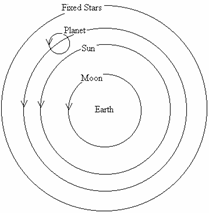
The looping motion of the planets in the sky
is called retrograde motion. That is
when they move westward for a few weeks before turning back toward the east.
Ptolemy explained the retrograde motion of the planets by having them follow a
little secondary orbit called an epicycle. The little circle that loops
around the planet's orbit while orbiting the earth is this so called epicycle.
The word means circle on a circle.
This
geocentric model explains and predicts the motions of objects in the sky quite
well. It is a very clever hypothesis and stands up to observations pretty well.
In the 15th
century a Polish astronomer, Copernicus,
devised a simpler model that worked at least as well as Ptolemy's. The model is
known as the heliocentric model because
it puts the sun at the center of the
solar system. The Greek word for sun is helios. This model requires that
the earth spin like a top and move around the sun so to many people it might
seem that on the face of it the hypothesis is incorrect. The earth doesn't seem
to move.
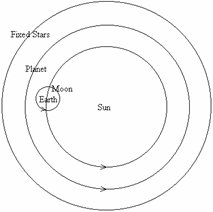
However the heliocentric model
has a lot going for it. It explains the retrograde motion of the planets
because planets nearer the sun move around it faster so they pass up the outer
planets. That's when they appear to move backward. Also it explains why the
constellations appear to move a little westward each night. Since the earth is
going around the sun we get a different view of outer space as we change
position.
Both models
work well as long as the observations are not very precise. Both provide mathematical
and measurable predictions about the positions of the objects in the sky. They
are both based upon fact and can be tested against facts.
The
heliocentric theory eventually proved to be superior to the earth centered
theory primarily because of the work of four scientists. They were known as
Tycho, Kepler, Galileo, and
Tycho Brahe (1546-1601) was a Danish astronomer who made
extremely accurate measurements of the positions of the stars and planets.
These measurements were so accurate that you and I could not do better without
the aid of modern instruments. He never accepted the heliocentric model but his
observations provided the data that allowed others to show that it was a better
description of the solar system than the geocentric model.
Johann Kepler (1571-1630) worked with Tycho and used his
precise observations to plot out the paths that the planets would have to
follow in the heliocentric model. He found that if he used the mathematical
shape called an ellipse to represent the orbits of the planets around the sun
he could predict where the planets would be at any given time. He was able to
construct a heliocentric model based on three laws of planetary motion.
1.
The
planets orbit the sun in elliptical orbits.
2.
Planets
move fastest when they are closest to the sun.
3.
The
time that it takes for a planet to go around the sun can be predicted precisely
if you know its distance from the sun.
These three
laws form the basis of a model that still stands the test of observation today.
Not only do they work for planets orbiting the sun but they work for any object
orbiting around a significantly larger object.
Galileo Galilei (1564-1642) was a mathematician and scientist
who understood that the heliocentric hypothesis was the correct model of our
solar system. Galileo was an extremely talented individual. He can easily be
said to be the first great scientist. His investigations of the sky with a
telescope revealed four moons orbiting around Jupiter proving that not
everything revolved around the earth. He saw that Venus went through phases
just like our moon suggesting that it orbited the sun rather than the earth. He
saw mountains on the moon and spots on the sun and stars in the milky way for
the first time. His studies of motion showed that nothing had to be pushing the
planets around the sun and that people would not necessarily feel the motion of
the earth because they were moving along with it. After Galileo no one could
seriously doubt the validity of the heliocentric hypothesis. Although for
religious and political reasons it remained unacceptable to write and speak
publicly about it for some time during and after his life. In fact Galileo
spent the last years of his life under house arrest forbidden from publishing
much of his work.
The methods
used in finding out how our planet fits into the scheme of our solar system
used the essential tools of scientific inquiry. That is observation,
hypothesis, test, and more observation. Humans learned that by using these
methods very concrete and useful results could be obtained. These methods of
finding things out quickly extended to many areas outside of astronomy, notably
biology and chemistry. The general acceptance of the scientific method has come
to be called the scientific revolution and the idea of revolution meaning
upheaval and great change comes from the fact that in trying to understand the
revolutions of the planets around the sun we dramatically changed our way of
understanding and finding out about all aspects of our physical universe.
In the year
Galileo died Issac Newton
(1642-1729) was born in
The
scientific revolution illustrates how scientific knowledge grows. Observation,
hypothesis, test, and more observation is the general pattern. Luck and
creative thinking are always a big part of breakthroughs that allow us to see
things in a new and better way but confirming the lucky find or bringing to
fruition a great idea still involves slogging through test after test and
observation after observation.
Albert Einstein (1879-1955) is perhaps the best known
scientist and he is best known for his theory of relativity. The first test of
this theory is another good example of how science works. As a young man
Einstein became aware of some logical problems with the way that light moves
through space and the scientific theories explaining the nature of light that
were available at the time. Einstein developed new theories that linked space
and time and provided a better understanding of the basic laws that govern the
behavior of matter and energy. One of the predictions that Einstein could make
using his theories was that given a large enough mass the gravity from that
mass could bend a beam of light passing through the space near it. A clever way
was designed to test this prediction in 1919. The positions of the stars in the
sky are well known. Einstein's theory predicted that starlight passing near the
sun would be deflected just enough by the sun's gravity so that the stars would
appear to be a little out of position as illustrated in the diagram.
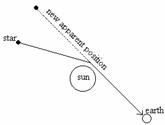
During a
total eclipse of the sun we can observe stars near the sun and measure their
positions. In a test of Einstein's theory an expedition was mounted to observe
the stars near the sun during a solar eclipse visible from the west coast of
Facts, Theories, and Laws
Scientists
make observations, collect data, develop hypothesis, test those hypotheses,
derive laws from them, and formulate theories explaining them. Many of these
terms are often confused so it might be instructive to dwell on them a little.
Facts are simple
observations that require no tests or proofs. They are simply observations.
Everybody agrees on them. An hypothesis
is an explanation that is open to
question and must be tested. In fact scientists are pretty much engaged in
the business of trying to disprove their hypotheses. That's how science
advances. Theories are similar to hypotheses but they are usually
more encompassing in what they explain. Good scientific theories are well tested and explain many related
phenomena. Examples of some current fundamental scientific theories are
listed below.
1. The Big Bang Theory: Explains the origin of space, time, and matter. Explains the observed abundance of elements. Explains the apparent expansion of the universe. Explains the observed cosmic background radiation.
2. Biological Evolution: Explains the physical development and origin of life on earth. Ties together genetics, heredity, and the diversity of life.
3.
Plate Tectonics: Explains the origins and development
of geological structures on earth as a result of movement of material in the
earth's layers.
4.
Atomic Theory: Explains the behavior and structure
of atoms
5.
Relativity Theory: Provides a framework for
understanding space, time, matter, and energy.
Where theories are open to revision and question scientific laws are the rules of nature that are never observed to change. They are relationships between matter and energy that are always and everywhere observed to work the same way. This isn't to say that we know everything. We don't. It's just that as far as we can tell these are the rules by which nature works. As you might expect there are very few scientific laws that truly deserve the status of laws. A few of them are listed below
1.
2. Newton's Law of Universal Gravitation
3.
The Laws of Conservation of Matter
and Energy