UNITS AND DIMENSIONS
http://physics.webplasma.com/physics03.html
http://library.thinkquest.org/16600/beginner/units.shtml
http://library.thinkquest.org/2923/basic.html
Measuring a quantity:
When a length is measured
as 7 feets it means 7 times the length or a foot. What is measured (i.e. the
quantity) consist of a number (7) multiplied by the chosen unit (foot, metre,
etc.).
Fundamental and derived quantities:
Several quantities, like mass, length, time, temperature,
are called fundamental or base quantities, while other are derived from these.
One example is a velocity which is a length divided by a time.
S.I. units:
The International System of Units suggests a set of
convenient units (and suitable abbreviations for them) that have been widely
accepted.
The system uses seven base units including the
kilogram (kg), metre (m) and second (s), and all other SI units are derived
from these: e.g. metre per second for velocity.
Dimensions:
Regardless of the units employed, a velocity is always
a length divided by a time and a force is always a mass multiplied by a length
and divide by time squared as seen form F=
m.a. or F= m.v2/r. We write:
[ F]= mass. lenght/time2
The powers of the multiplying quantities (mass, length
and time here) are the “dimensions” of the derived quantity (force in the
example used here).
So the dimensions of a quantity are the base
quantities from which it is made up in the same way that the dimensions of a
box would be length, width and depth of the box.
Square brackets are used to indicate “the dimensions
of “ and the symbols M,L and T are used to denote mass, length and time when we
are dealing with dimensions.
Thus the dimensions of a force are: [ F]=M.L/T2
Standard Units. Why?
Before we begin, we have to talk about standard units
since they will be used in our discussions.
So you want to lose thirty grams? Just run thirty meters everyday in thirty
seconds and in perhaps thirty days you will lose the thirty grams. You know
exactly what I am talking about, even if it's not true, right? It would be
different if I said you can lose thirty foolargs if you just run thirty mortags
in a mere thirty tristargs! What's a foolarg, a mortag, and a tristarg!?
That is why we have standard units. Almost everyone understands what you mean
if you say 1 meter or 1 gram. They actually have all of these measurements
stored in a place called the Internation Bureau of Weights and Measures near
Now what are the standard units? Scientists like to speak the same language and
they think everyone should use one system, the metric system (also called the
SI system). Why the metric system? Because it is simple to understand and easy
to make conversions. A kilometer is 1000 meters. A kilogram is 1000 grams. The
"English System" is still used in the
Units and Conversion Factors
|
SI PREFIXES |
||
|
Prefix |
Symbol |
Factor |
|
yotta |
Y |
1024 |
|
zetta |
Z |
1021 |
|
exa |
E |
1018 |
|
peta |
P |
1015 |
|
tera |
T |
1012 |
|
giga |
G |
109 |
|
mega |
M |
106 |
|
kilo |
k |
103 |
|
hecto |
h |
102 |
|
deka |
da |
101 |
|
deci |
d |
10-1 |
|
centi |
c |
10-2 |
|
milli |
m |
10-3 |
|
micro |
m |
10-6 |
|
nano |
n |
10-9 |
|
pico |
p |
10-12 |
|
femto |
f |
10-15 |
|
atto |
a |
10-18 |
|
zepto |
z |
10-21 |
|
yocto |
y |
10-24 |
|
LENGTH MASS TIME |
AREA VOLUME ANGLE SPEED ACCELERATION FORCE PRESSURE ENERGY POWER |
Units: What are they good for?
Well, that is a very good question indeed. Let me
begin by asking another question. If I were to tell you that a dog is 12 long,
would you really know how long that dog was?
Now, if I were to tell you that the dog was 12 inches
long, you would have a much better idea of the size of the dog. That, in
essence, is what units give us. They give us a common standard to which we can
compare other things. Since we all know how long one inch is, we can use that
knowledge to see how long a 12 inch dog is.
Most of us know English units fairly well (assuming
you are in the USA), but they are not the most ideal units to work in because
there are some weird units such as bushels that just don't make any sense to
most folks.
This is why we are going to use the metric system. Or,
in your best Inspector Clusso impersonation, Systeme Internationale. There are
some obvious accents missing, but I didn't take no French when I was in high
school. You might be surprised to learn that the
So, the units we will use from now on will all be in
S.I. units, which is short for Systeme Internationale.
1. Basic
Units
·
Length
The unit that we measure length in is meters. In most cases, we will use
"m" for short.
·
Mass
The unit that we measure mass in is kilograms. "kg" for short.
·
Time
The unit that we measure time in is seconds. "sec" for short.
You might
be surprised to know that, with these three units, we can derive the majority
of the other units that we need.
For
instance, if you want the units for area, it is just "m*m", where the
"*" stands for multiplying. This should be obvious because, for example,
the area of a rectangle is given by the formula, length*width. Since length and
width would just be measured in meters, the result is that area has units of
"m*m".
Likewise,
since the volume of a box can be determined by the formula, length*width*height,
it should not come as a surprise that the units for volume is
"m*m*m".
As you
have probably guessed by now, we can just derive the units of a new quantity by
looking at the formula or how it is defined. Let us do that for several of the
things that we have already talked about. Namely, let us do this for speed,
acceleration, and force.
2. Derived
Units
·
Speed
Recall
the definition of average speed. Average speed is defined
as distance over time. Since average speed is just
distance over time, the units for average speed would be "m/sec".
"m/sec" is also the unit for instantaneous speed.
Remember,
we are now using S.I. units. An old familiar unit of speed would be "miles
per hour" or, alternatively, "miles over hour". If you will
compare this with "meters over second" or "m/sec" for
short, you will see that they are in the same form, just different units. Both
are distance over time.
Thought Question: What is
the unit of velocity?
To
answer this question, think of the difference between speed and velocity. They
differ only in that we need to specify a direction when we are talking about
velocity. Therefore, both speed and velocity have the same units, namely
"m/sec".
·
Acceleration
Recall
the definition of acceleration. Since
acceleration is defined as the change in velocity over time, we can just write
the unit of acceleration as the unit of velocity over the unit of time.
Since
the unit of speed, "m/sec", is the same as the unit of velocity, the
unit for acceleration would be "(m/sec)/sec". Alternatively, we can
write it as "m/(sec*sec)". Either way is fine.
·
Force
To
figure out the units of force, we will need to recall the formula for force
given by Newton's 2nd Law. The formula is F = ma.
Therefore,
the units of force are mass times acceleration. We already know the units for
mass, and we just figured out the units of acceleration. Therefore, the unit
for force is "(kg)*[m/(sec*sec)]". Alternatively, we may write the
unit for force as "(kg*m)/(sec*sec)".
At this
point, you might recall that we had an easier unit for force, namely the "
As an
aside, the English unit for force is pounds. Both pounds and
1. Converting
Units
Now, if
everything in the world was easy, then we would only have to deal with one set
of units. Alas, such is not the state of the world, and on occasion, we will
have to convert units from one system to another.
One
example of such a conversion is finding out the metric equivalent of 12 feet.
In order to do this, we need to first know the correct unit conversion factor.
Well, it turns out that 1 feet is equal
to 0.3048 meters.
Conversion factor: 1 feet = 0.3048 meters
Converting
units is not a hard thing to do. In fact, it really just involves multiplying and
dividing. The best way to learn is to do an example, so here it goes.
·
Example 1: How many meters does 12 feet
equal?
The
procedure we follow here will be the general procedure used in converting
units.
In
general, to convert units, we need to multiply the quantity we want to convert
(12 feet in this case) by its conversion factor. The conversion factor basically tells us how to convert one unit into
another.
The
conversion factor is basically a fraction we multiply to the quantity we want
to convert. In this case, we know 1 feet
= 0.3048 meters. As a result, we place the 0.3048 meters on the top portion
of the fraction, and we place the 1 feet in the bottom portion of the fraction.
Technically, the top portion of the fraction is called the numerator and the
bottom portion is called the denominator.
So, how
did we know to place the 0.3048 meters in the top and the 1 feet in the bottom
portion of the fraction? Well, in a sense, we had to do this because we needed
to cancel the "feet" in the "12 feet". To cancel the
"feet" in the "12 feet", we had to divide it by the "1
feet" in the conversion factor. Since we want to convert "feet"
into "meters", we needed to cancel the "feet" in the
"12 feet" and be left with "meters". This is precisely what
we did above. In a sense, we are multiplying and dividing the units just like
we do with numbers.
I have
done so explicitly in the picture above. You will see that the "feet"
cancel because they are divided by each other thus canceling each other. The
only unit we are left with is "meters" which is precisely what we
want because we wanted to convert the 12 feet into meters. In the picture
below, I have just multiplied and divided the units exclusively without the
numbers in order to make it a little more clear. You should notice that we are
left with the desired unit of "meters" after all the multiplying and
dividing.
Let me
describe what we just did in words. First we take the "feet" and
multiply it by "meters" and then divide it by "feet". As a
result, the "feet" divided by "feet" cancel each other out,
and we are left with just "meters".
Now that
we have done it correctly, let's do it the wrong way and see the result we get.
Instead of putting the 0.3048 meters on top and the 1 feet on the bottom, let's
pretend we made a mistake and put the 1 feet on top and the 0.3048 meters on
the bottom. Remember to also multiply and divide the units as well as the
numbers.
Well,
you see that putting the 1 feet on top and the 0.3048 meters on the bottom just
doesn't work. None of the units cancel. In fact, we are left with a weird unit
(feet*feet/meters) which wasn't the one we were after.
Okay, so
we've done one example. Let's do another one just to make sure we have this
down pat.
·
Example 2: How many feet does 3 meters equal?
Remember,
to convert this, all we have to do is multiply the "3 meters" by the
appropriate conversion factor. The tricky part is what to put on top and what
to put on the bottom in the conversion factor. Try doing this on your own
first. One hint you might need is that the conversion factor of 1 feet = 0.3048 meters works for both
converting feet to meters and meters to feet. This should be fairly obvious.
The
answer you should get is that 3 meters is equal to 9.8425 feet. If you didn't get this answer, try it a couple of
times and redo example 1 above before looking at the hint below.
If you
will notice in the hint above, we used basically the same conversion factor we
used in example 1 above
with the exception that "1 feet" is now on top and "0.3048
meters" is now on the bottom.
If you
are still having some trouble with this, try redoing example 1 above and
apply the same line of reasoning in this example. In addition, you might want
to multiply the "3 meters" by the incorrect conversion factor where
"0.3048 meters" is on top and "1 feet" is on the bottom. If
you do this, you will realize that this is the incorrect conversion factor
because it does not leave you with the desired unit of "feet" at the
end. In fact, it will leave you with the undesired unit of
"meters*meters/feet".
If you
fully understand what you just did, then you are well on your way to understanding
how to convert units. Next,
let's try converting something a little more difficult.
·
Example 3: What is 55 mph in terms of
meters/sec?
First,
let's write 55 mph as 55 miles/hour. In this form, we see that, in order to
convert it to "meters/sec", we need to convert the "miles"
on top to "meters", and we need to convert the "hour" on
bottom to "seconds". So, it turns out that it really isn't too
difficult. We are just converting two units instead of one.
To do this
example, you will need to know the following two things.
1 mile = 1609.344 meters and 1 hour = 3600 seconds
You
probably already knew the second fact above because there are 60 minutes in an
hour and 60 seconds in every minute. Now you know everything you need to know.
Try doing the problem on your own first. All you have to do is be a little
careful and remember to use two conversion factors. The answer you should get
is that 55 miles/hour is equal to 24.5872
meters/sec.
As
stated above, we needed two conversion factors, which we multiplied to the 55
miles/hour. The first conversion factor converted the "miles" on top
to "meters". The second conversion factor changed the
"hour" on the bottom to "seconds".
The
converting "miles" to "meters" should have been fairly easy
because it was very similar to what we did in example 1 and example 2 above.
The only thing tricky might have been the second conversion factor which
converted the "hour" on the bottom of 55 miles/hour to
"seconds" on the bottom in the final answer. This shouldn't have
posed too much of a problem if you were already comfortable with converting
units. The main thing to remember in the second conversion factor is that we
wanted to end up with "seconds" on the bottom and not on the top.
This
last example might have been confusing. If you are still having trouble with
it, take your time with it. If you are still getting the incorrect answer, make
sure to take a look at your units. If the units you end up with are not
"meters/sec" and you have some weird leftover units, then what you
did was incorrect. The whole point of converting units is to end up with the
correct units. If you set up the conversion factors so that the units you end
up with are correct, the number answer you get from that should also be
correct.
·
Example 4: Convert 10 meter/sec to
miles/hour
If you
were able to do example 3 above,
this shouldn't be any trouble at all. It's mostly just for practice. If you
still aren't comfortable with converting units, make sure you understand example 3 above
before proceeding with this problem.
Once
again, try to do this on your own first before looking at the hint. The answer is 22.369 miles/hour.
Exercises:
1.
What are the dimensions of:
a)
Force;
b) moment; d) work; d) pressure
2.
Which of the following units could be used
for capacitance?
A) kg.m2.s-1
C ; B) kg.m2.s-2.C2; C) kg-1 m-1
C2; D)kg-1. m-2. s2. C2; E) kg-1.m-2.s3.C
3.
What are the dimensions of:
a) density
b) area
c) cubic feet per minute
d) distance/velocity
e) force x time
f)
angle moved through per second
4. A liquid
having mall depth but large volume is forced by an applied pressure P above it to escape with velocity v through a small hole below. The
velocity v is given by: v= CPxdy,
where C, x and y are dimensionless constants. Determine x and y.
5.
Evaluate x and y in the equation: E= Cmxvy,
where E is kinetic energy, m is mass, v is velocity and C is a dimensionless
constant.
6. Convert:
a)
30 km/h to m/s ; b) 400 nm to mm; c)
0,01 m2 to mm2; d)120000 min-1 to s-1.
7.
The S.I. unit of power, the watt, expressed
in terms of the base units of kg, m and s is:
A)
kg.m2.s-2; B) kg.m2.s-3;C)
kg.m.s-2;D) kg.m.s-3;E) kg.m2.s-1;
8.
 Kepler
discovered that the orbital periods T of the planets about the Sun are related
to their distances r from the Sun.
From Newton´s laws, the following relationship may be derived:
Kepler
discovered that the orbital periods T of the planets about the Sun are related
to their distances r from the Sun.
From Newton´s laws, the following relationship may be derived:
Where M is the mass
of the Sun. Use the equation to find units for G in terms of base units.
ERRORS AND MISTAKES
In physics we like
to reserve the term “errors” for innaccuracies which occur when a quantity is
measured and when calculations are made using measurements of limited accuracy,
i.e. experimental errors.
For slips such as
we might make in a calculation we can use the work “mistakes”. Errors and
mistakes can both lead to wrong answers.
Errors of measurement:
When we count a number of items, the answer is a whole
number and it can be faultlessly accurate. When a quantity is measured there is
always some uncertainly left as to its value, depending upon the measuring
instrument and the skill with which it is used. Thus any answer written down is
subject to some error.
Systematic and
random errors:
If the measuring technique gives answers which are
constantly greater or constantly smaller than they should be then we have a systematic error. Repeating the
measurements and averaging the answers does not remove the error. Using a
thermometer with a scale that has moved could produce this kind of error.
Random errors have
equal probability of giving higher or lower answers. Averaging a sufficient
number of answers will make these errors negligible. Careless reading of a
scales could produce errors of this kind.
Number of
significant figures:
When we write 2,43 cm it is assumed that the
measurement shows the answer to be closer to 2,43 than 2,42 or 2,44. We can
write 2,43 ± 0,005 cm. The 2,43 consist of “three significant figures”. Similarly 2,00 implies greater accuracy than
2 cm.
If one centimetre was measured with a ruler and then
divided by three using a calculater we might get 0,3333333 cm. A ruler cannot
give an answer of such accuracy. Not more than two figures would be justified
(0,33).

Factor-label Method
In
math you use numbers, in chemistry we use quantities.
A
quantity is described by a number and a
unit.
100
is a number : 100 Kg is a quantity (notice that in chemistry we give meaning to
the numbers). In science we solve a lot of the "math" by watching the
units of the quantities
There are two main rules to solving
science problems with the factor-label method:
1. Always carry along your units
with any measurement you use.
2. You need to form the appropriate
labeled ratios (equalities).
Example Problem:
How
many centimeters in 2 meters?
You
will see from the metric conversion chart that 1 meter = 100 cm
we
turn this into a ratio by writing it like this:

or

Once
you have the equalities you must pick the one that will cancel out the units
leaving the desired units.
Then
multiply your starting quantity (2 meters) by the equality that will give you
your desired units.
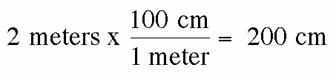

As a rule of thumb
your problem set up should look like this:
Practice
Problems:
1.
How many wheels on 350 Ford pickups (use the equality 1 pickup = 4 tires)
-the
starting units are pickups, the ending units need to be wheels.

2.
How many millimeters in 34 hectometers (use the equality 10,000 mm = 1
hectometer)?
Sometimes
you will need to multiply by more than one ratio to get to your desired units,
you can do this by using linking units. Your setup will look like this:

3.
How many inches in 1 meter given the equality 1 inch = 2.54 cm and 1 meter =
100 cm? (note the linking unit in this problem is cm)
4.
If a warehouse holds 3000 boxes, and a truck holds 235 boxes. How many
truckloads will it take to fill up one warehouse?
5.
How many grams in 150 pounds given the equalities 1 pound = 0.454 kg and 1 kg =
1000 grams?
Significant Digits
|
Number |
Digits to count |
Example |
Number of
Significant Digits |
|
Nonzero digits |
All |
*8341* |
4 |
|
Leading Zeros |
None |
0.000*79* |
2 |
|
Captive zeros |
All |
*1200.00043* |
9 |
|
Trailing Zeros |
Only if decimal point |
*400.0* and *4*00 |
4 and 1 |
|
Scientific Notation |
All |
*3.7* X 10-2 |
2 |
Rounding Fives with Significant
Digits:
For
a 5, even with zeros trailing it, increase the last significant digit (see
above) by 1 if the digit preceding the 5 is odd. Do not change the last
significant digit if the digit preceding the 5 is even. Take a look at these
examples:
3.7500 becomes 3.8
3.6500 becomes 3.6
For a five followed by non-zero
digits, just increase the last significant digit by 1.
8.652 becomes 8.7
8.6504 becomes 8.7