ELECTRICITY
ELECTRIC CHARGE:
Object normally
contain equal numbers of protons and
electrons. A negatively charged
object has more electrons than protons; and a positively charged object has
more protons than electrons (deficiency of electrons).
The net charge on an object is measured en coulombs (C). This is the S.I. unit for charge and it is defined
below.
ELECTRIC CURRENT:
A current is a flow of
charge.
Electric current is the flow of charged particles around a circuit of
conducting material such as metals. In a metal wire many electrons are free to move, so that a current can flow in
a metal wire as a flow of electrons.
The rate of flow of electric charge is called "CURRENT".
I means the current between two points. It is
the charge which flows/time taken.
Current size (I) is a basic quantity. The unit for current is the ampere (A) in the S.I.

Current size is
related to charge (Q) moving through (entering and leaving) a wire in time (t)
by:
And 1 A (ampere) = 1 C(coulomb)/s
ELECTRIC CIRCUIT:
To make a steady direct current flow in a simple electric circuit we
need two main componentes:
1. A source of electric potential (e.g. cells or battery): A power supply like a cell or battery.
2. An energy-consuming device (e.g. a resistor). You must join the two
terminals (+ and - ) to a continous closed loop of contuctors. One of these
conductors may be a light bulb, a buzzer, or some other device you wish to use.
A switch can make or break contact with a loop of conductors, and no current flows if the loop is not
complete. The complete loop of comoponents is
called circuit.
Current is flow
of negatively charged electrons from the negatively charged terminal to the
positively charged terminal of the electrical supply. However, the conventional
direction of current flow is usually shown by an arrow opposite to that of the
electron flow. The direction of current flow and electron flow are opposite.
In a conventional current flow goes from the cell´s
positive terminal to its negative terminal.
CELLS AND BATTERIES:
The energy given to the electrons to push them round an electrical
circuit is transferred from electrical sources such as batteries, solar cells
and generators to components in a circuit, such as lamps, resistors, bells,
motors, LEDs and buzzers. The energy transferred
makes things happen in the circuit such as light, heat and sound.
Cemical cells can be made with two different metal electrodes
dipping into varios ionic solutions.
The chemicals react with one another, causing an electric current to flow
through the cells. Thus chemical energy is again transformed into electrical
energy as the reactants are changed into chemical products of the reactions.
Group of cells connected together are called batteries. They provide the electromotive force (e.m.f) which drives electric current. We can measure emf in volts (V) by connecting a voltmeter to a cell.
Rechargeable batteries are those in which
the chemical process from reactants to products can be reversed by driving a
reverse electric current through the battery.
POTENTIAL AND POTENTIAL DIFFERENCE:
The potential of a place may be
thought of as its attractiveness for electrons and unattractiveness for
positive charge. A place where there is a high
concentration of electrons or which has a lot of electrons near it will
have a low potential.
The difference of potential (PD) V between two places is defined as the work done W per coulomb of charge moved
from the one place to the other.
V= W/Q
Where W is the work done (if
positive charge Q moves from lower potential to higher potential, from - to +)
or energy obtainable from the movement (if negative charges goes from - to +
place).
The unit for PD is the volt
(V).
The potential of a place measured in volts is the PD between the place
concerned and some reference point.
Electric current flows spontaneously from a higher
potential place (+) to a lower potential place (-) if the two places are joined
bya a conducting path.
OHM´S LAW:
This law states that the current I through a given conductor is proportional
to the PD between its ends, provided that its temperature does not change: V/I = constant.
RESISTANCE "R" OF A CONDUCTOR:
This is the opposition of the conductor to current flow through it. It
is defined as the Potential Difference needed across it (between its ends) per
ampere of current.
R= V/I
The unit for resistance is the ohm
(W).
RESISTORS:
These are device for providing resistance to the flow of current. Some
variable resistors are called rheostats.
A thermitor is a temperature sensitive resistor.
RESISTIVITY "r " OF A MATERIAL:
The resistance R of a conductor is proporcional
to its length, inversely proportional to its area of cross-section A, and
dependent upon the nature of the material, described by its resistivity
r.
R= r.l/A
ELECTRIC CIRCUIT:
Often a current is produced by use of a votaic
cell or battery (two or more cells joined together). The cell creates and mantains a PD between its terminals.
A currente is obtained if these two terminals
are joined by a conducting path, i.e. when a complete circuit is formed.
SCHEMATIC DIAGRAMS
This section lists the main components of
|
|
This is a source of emf (electromotive force),
with a voltage of , measured in units of volts, V. The most common source you
will see will be a battery. |
|
|
This is a resistance, measured in units ohms (W), . Most often it will be a
resistor. However, wires connecting parts of a circuit are really not
resistance-free. We can model this real-life case by putting a 'resistor'
in the circuit which has the same resistance as the wires would have. Thus
the wires can still be considered resistance-free since their resistance is
represented by an additional resistor. |
|
|
This is a capacitor, with capacitance C measured in units of farads,
F. The perfect capacitor will have no resistance (or inductance; see next),
and we will assume that this symbol represents such an ideal capacitor. If a
capacitor is not ideal, that is, it has some resistance (or inductance)
associated with it, then we can model this by putting a 'resistor' (or
inductor) in parallel with the capacitor. This resistor (or inductor) will
have the same resistance (or inductance) as the non-ideal capacitor. |
|
|
This is an inductor, with inductance L, measured in units of henrys,
H. To model a non-ideal inductor in a circuit (an inductor with an associated
resistance or capacitance) we can put a resistor in series or a capacitor in
parallel with the inductor. Giving these the same values as the inductor will
represent an imperfect inductor. |


DC Circuits
RESISTORS IN SERIES
|
|
Figure 1 Resistors connected in series. |
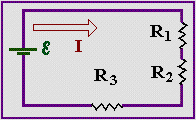
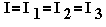
Note that since there is only one path for the current to travel, the
current through each of the resistors is the same.
Also, the voltage drops across the resistors must add up to the total
voltage supplied by the battery:

Since V = I R, then

But Ohm's Law must also be satisfied for the complete circuit:

In general, the equivalent resistance of resistors connected in series
is the sum of their resistances. That is,

RESISTORS IN PARALLEL
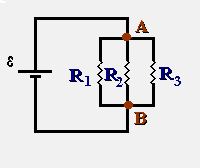
 Resistors can be
connected such that they branch out from a single point (known as a node), and join up again somewhere else
in the ciruit. This is known as a parallel connection. Each of the three
resistors in Figure 1 is another path for current to travel between points A and B.
Resistors can be
connected such that they branch out from a single point (known as a node), and join up again somewhere else
in the ciruit. This is known as a parallel connection. Each of the three
resistors in Figure 1 is another path for current to travel between points A and B.
|
|
|
|
Note that the node does not have to physically be a single point; as long as
the current has several alternate paths to follow, then that part of the
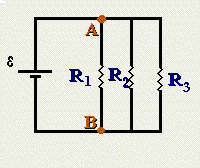
circuit is considered to be parallel. Figures 1 and 2 are identical circuits,
but with different appearances.
At A the potential must be
the same for each resistor. Similarly, at B
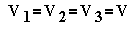
the potential must also be the same for each resistor. So, between points A and B, the potential difference is the same. That is, each of the three
resistors in the parallel circuit must have the same voltage.
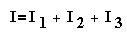
Also, the current splits as it travels from A to B. So, the sum of
the currents through the three branches is the same as the current at A and at B (where the currents from the branch reunite).
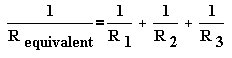
And the
equivalent resistance will be:
http://www.glenbrook.k12.il.us/gbssci/phys/THender/quizzes/u8/q191.html
ELECTROSTATIC Quiz#1
Part 1: FIll in the Blank
1. A neutral object becomes
________________ charged if electrons are removed.
2. Unlike charges _______________
one another.
3. _______________ are materials with
a conductive capacity between conductors and insulators.
4. The process of charging a
neutral body by touching it with a charged body is called charging by
________________.
5. Charges added to a(n)
_______________ will immediately spread throughout the body.
6. Charges added to one part of a
________________ will remain in that part.
Part 2: Multiple Choice
Choose the one best answer to the
following questions. (1 pt. each)
1. Two like charges ________.
a.
attract each other
b.
repel each other
c.
neutralize each other
d.
have no effect
on each other
e.
must be neutrons
2. Protons and
electrons ____________.
a.
repel each other
b. attract each other
c.
do not interact
3. The electrical force between
charges is strongest when the charges are __________.
a.
close togethere
b.
far apart
c.
the electric
force is constant everywhere
4. If you comb your hair and the
comb becomes positively charged, then your hair becomes __________.
a.
positively charged
b. negatively charged
c.
uncharged
5. A conductor differs from an
insulator in that a conductor ________.
a.
has more electrons than protons
b. has more protons than electrons
c.
has more
energy than an insulator
d. has faster moving molecules
e.
none of these
6. A negatively charged rod is
brought near a metal can that rests on a wood table. You touch the opposite
side of the can momentarily with your finger. The can is then _______.
a.
positively charged
b. negatively charged
c.
uncharged
d.
charged the
same as it was
7. An electroscope is charged positively
as shown by foil leaves that stand apart. As a negative charge is brought close
to the electroscope, the leaves _________.
a.
fall closer together
b. spread apart further
c.
do not move
8. Two charges separated by one
meter exert a one N force on each other. If the charges are pulled to 3 m
separation distance, the force on each charge will be ________.
a.
0.33 N
b. 0.11 N
c.
0 N
d. 3 N
e.
9 N
9. Two charges separated by one
meter exert a one N force on each other. If the magnitude of each charge is
doubled, the force on each charge is _________.
a.
1 N
b. 2 N
c.
8 N
d. 4 N
e.
none of these
10. A positive charge and a
negative charge held near each other are released. As they move, the
force on each particle __________.
a.
increases
b. decreases
c.
stays the same
Part 3: Problem-Solving
To receive credit for the
following problems, show some work.
1. A hydrogen atom contains a
proton and an elctron separated by a distance of 5.0
x10-11 meters. The charge on the proton is the same as the charge on
the electron: 1.6x10⁻¹⁹ C. Calculate the force of attraction between
the two particles.
2. A positve
charge of 1.8x10⁻⁶ C and a negative charge of -1.0x10⁻⁶ C
are 0.014 m apart. What is the force between the two particles?
3. Two charged objects have a
repulsive force of .020 N. If the charge of one of the objects is doubled, then
what is the new force?
4. Two charged objects have a
repulsive force of .04 N. If the distance separating the objects is halved,
then what is the new force?
5. Two charged objects have an
attractive force of .02 N. If the charge of one of the objects is halved, and
the distance separating the objects is doubled, then what is the new force?
6. Two charged objects have a
repulsive force of .020 N. If the charge of both of the objects is doubled and
the distance separating the objects is doubled, then what is the new force?
Part 4: Correcting False Statements
The following statements are
false. In three complete sentences or less, explain what is wrong with the
statement and correct it.
1. Object A is positively charged
and Object B is electrically neutral. When object A touches Object B, protons
are transferred from Object A to Object B.
2. If an electroscope is touched
by a charged object, the leaves will diverge. However, when the object is drawn
away, the leaves will relax to their original rest position.
3. Object A is positively
charged. Object B is an electrically neutral insulator. If Object A is brought
near to Object B, the electrons in Object B travel to the surface which is
nearest to Object A.
4. The leaves of a positively
charged electroscope are separated. If a physics student, standing on the
ground, touches the electroscope with a plastic baseball bat, then the
electroscope will be discharged and the leaves will relax to their original
rest position.
5. The leaves of a positively
charged electroscope are separated. When the electroscope is touched by a
person standing upon the ground, the positive charges within the electroscope
will be transmitted through the person and into the earth.
Part 5: Short Answer
Using three complete sentences or
less, answer three of the following
questions.
1. Distinguish between a
conductor and an insulator.
2. Distinguish between a
positively charged object and a negatively charged object.
3. Distinguish between charging
by contact and charging by conduction.
4. Explain how an electrically
neutral object can be attracted to a charged body.
5. How can you charge an object
negatively with only the help of a positively charged object?
ELECTROSTATIC Quiz#2
1. In a neutral atom the number of electrons is equal to
f.
the number of
protons.
g.
the number of
neutrons.
h. the sum of the number
of protons and neutrons.
i.
the difference between the number of protons and
neutrons.
j.
the product of the number of protons and neutrons.
2. An uncharged body would acquire a negative charge if it
d.
gained some atoms.
e.
lost some neutrons.
f.
gained some electrons.
g.
lost some electrons.
h.
gained some protons.
3. A positively charged body must have
d.
an excess of
neutrons.
e.
an excess of
electrons.
f.
a deficiency of protons.
g.
a deficiency of electrons.
4. A positively charged balloon will be attracted to an electrically
neutral wooden cabinet. The explanation of why this
occurs is that
d. the molecules of the
wooden cabinet are able to polarize and be attracted to the balloon.
e. the molecules of the
balloon are able to polarize and thus be attracted to the cabinet.
f.
the balloon is a conductor and the wood is an
insulator; opposites attract.
g. the balloon is an insultor and the wood is a conductor; opposites attract.
5. A plastic tube is charged by rubbing it with fur. The plastic tude acquires a negative charge. This is evidence that
f.
plastic molecules have a greater attraction for
electrons than fur molecules.
g. fur molecules have a
greater attraction for electrons than plastic molecules.
h. plastic is an
insulator and fur is a conductor.
i.
fur is a insulator and plastic is a conductor.
6. A neutral electroscope is charged by contact using a positively
charged electrophorus plate. The electroscope
e.
acquires a positive charge
f.
acquires a negative charge
g. will merely have a
temporary separation of postive and negative charge.
7. A physics student, standing on the ground, touches a plastic baseball
bat to a negatively charged electroscope. This will cause
d. the electroscope to be
grounded as electrons flow out of the electroscope.
e. the needle of the
electroscope to deflect even more.
f.
the baseball bat to acquire an excess of protons.
g.
... absolutely nothing to happen.
8. A negatively charged plastic tube is used to charge a metal sphere by
the process of induction. The charge on
the metal sphere will be
f.
positive.
g.
negative.
h. not enough information
to tell.
9. An electroscope has an overall negative charge. Thus, the needle of
the electroscope is deflected. A positively charged balloon is held just above
the plate of the electroscope (without making contact with it). The needle will
f.
deflect even more.
g. return to the upright
position.
h. remain in a deflected
position since there is no contact between balloon and electroscope.
10. An electroscope has an overall positive charge. Jin Erator touches the metal base of the electroscope and
grounds the electroscope. The electroscope is no longer charged after the
grounding process because
d. protons flowed through
Jin's body into the ground.
e. electrons flowed
through Jin's body into the ground.
f.
electrons flowed throuch
Jin's body into the electroscope.
g. Jin must have been
negatively charged prior to touching the electroscope.
11. The needle of a positively charged electroscope will deflect even
more when a charged object is brought near the plate of the electroscope. The object MUST be
a.
a conductor.
b.
an insulator.
c.
positively charged.
d.
negatively charged.
e.
neutral.
12. A plastic comb is used to comb a student's hair. The comb is then
brought near a negatively charged metal electroscope. If the needle of the
electroscope deflects further, the comb has
a.
an excess of
electrons.
b.
an excess of
protons.
c.
an excess of
neutrons.
d.
a deficiency of neutrons.
e. equal numbers of
electrons and protons.
13. The electric force between two charged spheres is 18 units. If the
distance between the centers of the spheres is
tripled, the resulting electric force will be
a.
6 units.
b.
2 units.
c.
3 units.
d.
54 units.
14. A metal sphere has a deficit of 1.0 x 10¹² electrons (charge on 1
electron = 1.6 x 10⁻¹⁹ C). What is the charge
on the sphere?
a.
6.25 x 1030
C
b.
1.6 x 10⁻⁷
C
c.
-1.6 x 10⁻⁷
C
d.
1.6 x 10⁻³¹
C
e.
-1.6 x 10⁻³¹
C
15. The force of attraction between two point charges can be doubled by
a. halving the distance
between them.
b. doubling the distance
between them.
c. doubling the charge on
both objects.
d. doubling the charge on
one object, only.
|
|
16. Two oppositely charged balloons with a charge of +5.0 x 10⁻⁶
C and -4.0 x 10⁻⁷ C experience an electric attractive force with a
magnitude of .072 N. Determine the distance between the centers
of the two balloons.
ELECTRIC CURRENT
Quiz #1
Equations:

Part 1: Multiple Choice
1. Electrons are able to move in an electrical circuit because.
k. they are continually
colliding with other electrons
l.
they are continually colliding with atoms of the
conducting wires
m. an electric potential difference
is established across the ends of the circuit
n. the wires which make
up the circuit are so thin
o.
none of the
above
2. The role of the power supply in an electric circuit is to
i.
maintain an electric potential difference between the
two ends of the circuit.
j.
act as a charge pump in order to pump charge from the
- terminal to the + terminal.
k. do work upon the
charge in order to move it from a location of low potential to high potential.
l.
all of the
above
m.
none of the
above
|
3. The current in this circuit is h.
1.5 amps i.
3.0 amps j.
6.0 amps k.
18.0 amps l.
72.0 amps 4. The amount of charge which flows into the battery at location B is h.
1.5 C every 2 sec i.
3.0 C every 1 sec j.
3.0 C every 2 sec k.
4.0 C every 2 sec l.
Not enough information to tell |
|
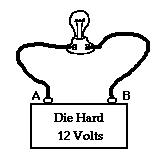
5. The power delivered to the light bulb is.
j.
2.0 Watts
k.
8.0 Watts
l.
12.0 Watts
m.
18.0 Watts
n.
36.0 Watts
6. The amount of work done by the battery to move 3.0 Coulombs of charge
from terminal B to terminal A is
h.
4.0 Joules
i.
8.0 Joules
j.
12.0 Joules
k.
18.0 Joules
l.
36.0 Joules
7. A 60 Watt light bulb is connected to a 120 volt plug. What is the
current in the light bulb?
h.
0.25 A
i.
0.5 A
j.
2 A
k.
4 A
l.
more than 4 A
8. The current flow in a conducting wire will _________ as the length of
that wire is increased.
i.
increase
j.
decrease
k.
remain the same
9. Which one of the following does not represent units of current?
i.
amperes
j.
volt/ohm
k.
C/sec
l.
J/C
10. A kilowatt x hour is a unit of
h.
potential
i.
force
j.
current
k.
energy
l.
power
11. A device used to measure current is known as the ___________.
f.
voltmeter
g.
ammeter
h.
watthour meter
i.
potentiometer

12. Which one of
the following symbols represents the schematic circuit symbol of a resistor?
13. A circuit consists of a 6-Volt battery and a lamp bulb. The battery
does 12 J of work in order to move 2 C of charge through the internal circuit.
As the 2 C charge flows through the external circuit, it does _______ of work
upon the light bulb.
f.
1 J
g.
2 J
h.
6 J
i.
12 J
j.
24 J
14. Charge encounters resistance as it flows through circuits because of
e. collisions with atoms
in the conducting elements.
f.
the presence of insulators within the conducting
elements.
g. the rate at which a
battery does work is less than the rate at which charge is able to flow.
h. the inability of
humans to produce the extreme voltages required for reducing resistance.
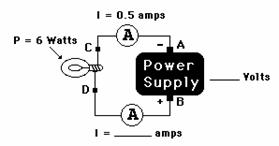
A power supply,
light bulb, and two ammeters are connected in a circuit as shown below. Use the
information in the diagram to answer the following questions.
15. The ammeter at the "bottom" of the diagram will read
f.
more than 0.5 amps
g.
0.5 amps
h.
less than 0.5 amps
i.
not enough information
to tell
16. The voltage of the power supply is
e.
0.5 Volts
f.
3 Volts
g.
6 Volts
h.
12 Volts
17. Conventional current will flow through the external circuit from
a. B to D to C to A
b. A to C to D to B
c.
A to B
d.
B to A
18. The electric potential at A is ____________ the electrical potential
at C.
a.
less than
b.
greater than
c.
approximately equal to
19. The electric potential at C is ____________ the electrical potential
at D.
a.
less than
b.
greater than
c.
approximately equal to
20. The amount of energy lost by 1 Coulomb of charge as it flows through
the external circuit is
a.
0.5 Joules
b.
3 Joules
c.
6 Joules
d.
12 Joules
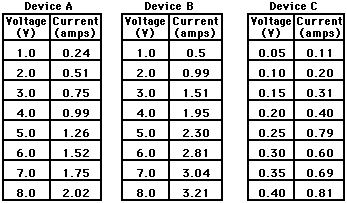
Anna Litical performed an experiment to measure the resistance
of three different electrical devices (A, B, and C). Anna set up a circuit and
collected voltage-current data for each of the three devices. Anna then
constructed graphs of Voltage vs. Current for her data. Her data sets are shown
below. Use the data in the tables to answer the next several questions.
21. An analysis of Anna's data would indicate that the device with the
greatest resistance is
a.
Device A
b.
Device B
c.
Device C
d.
Not enough info
to tell
22. The device which fails to obey Ohm's law seems to be
a.
Device A
b.
Device B
c.
Device C
d.
Not enough info
to tell
23. An analysis of the data set for Device C show that one of the pairs
of measured data (0.25 V, 0.79 amps) seems to be inconsistent with the other
measurements. The best way for Anna to treat this particular data pair is
a. to change the current
measurement to a more consistent value, such as 0.50 amps.
b. to conclude that the
device acts inconsistent at a voltage of 0.25 V.
c. to repeat the
measurement of voltage for a current of 0.79 amps (assuming time permits).
d. to repeat the
measurement of current at the voltage of 0.25 V (assuming time permits).
24. An analysis of the data set for Device A shows that the ratio of V/I
for each data pair is not exactly constant. The appropriate response to this fact would
be to
a. change certain
measured values until the ratio of V/I is constant.
b. conclude that the V/I
ratio should not be constant.
c. discard the data and
repeat the experiment until the ratio of V/I is constant.
d. blame the lack of a
constant V/I ratio upon faulty equipment.
e.
 construct a graph
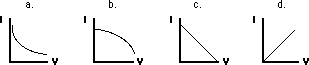
25. A voltage vs. current graph
of the data for Device A would look like the graph at the right. If the axes were reversed and a graph of current
vs. voltage was constructed instead, then the graph would look like.
Part 2:
Problem-Solving
For the following problems, show
all your work (with units) to receive full or partial credit. The solution to each
problem will demand a careful treatment of units, thoughtful reasoning, and the
appropriate usage of more than one equation.
26. An electric heater provides
2.00 kW of power when connected to a 120-V potential difference. How much
energy is used if the heater is on for five hours?
27. Eighty percent of the
electrical energy used by a sun lamp is converted into thermal energy. When the
sun lamp is plugged into a 120-V outlet, it draws 2.00 A. How much thermal
energy (heat) is released by this lamp in 30.0 minutes?
ELECTRIC CURRENT
Quiz#2
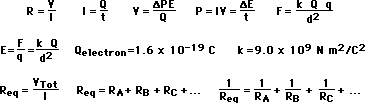 Equations:
Part 1: Multiple Choice
1. A 100-W and a 60-W light bulb is used in two different lamps in your
home. The difference between a 100-W light bulb and a 60-W light bulb is the
p. voltage drop across
the 100-W light bulb is greater than that of the 60-W light bulb.
q. current flowing
through the 60-W light bulb is greater than that of the 100-W light bulb.
r.
the resistance of the 60-W light bulb is greater than
that of the 100-W light bulb.
s. the energy delivered
to the 60-W light bulb is greater than that of the 100-W light bulb.
t.
two of the
above.
2. A 3-Volt battery, a resistor, and an ammeter are connected in series
in a circuit. If the 3-Volt battery is replaced by a 6-Volt battery, then
n. the resistance of the
resistor will decrease by a factor of two.
o. the resistance of the
resistor will increase by a factor of two.
p. the ammeter reading
will decrease by a factor of two.
q. the ammeter reading
will increase by a factor of two.
r.
None of the above; both the current and the resistance
will remain constant.
3. Where do the electrons which flow through the circuit to light your
household lamps originate?
m. The electrons
originate at the power plant and travel to our homes through power lines.
n. The electrons
originate in the fuse box of the home.
o. The electrons were
present in the wires of the circuit before the switch was "flipped."
p. The electrons
originate in the switch; when flipped, they flow from the switch to the lamp.
q. Nonsense ... electrons
do not move through the wires; only positive charge flows.
4. The speed at which charge flows through electrical circuits is
m. very small because
moving charge is continually colliding with atoms.
n. very large because the
strength of the electric field exerts large forces upon moving charge.
o. not possible to
determine because lights turn on immediately after the switch is
"flipped".
p. sometimes very large
and sometimes very small, depending upon the age of the battery.
5. Increasing the current in a resistor by a factor of five will
increase the heat produced by the resistor by a factor of
o.
1/5
p.
1/25
q.
5
r.
25
6. The resistance in a conducting wire will ___________ as the diameter
of that wire is increased.
m.
increase
n.
decrease
o.
remain the same
7. The resistance in a conducting wire will ____________ as the length
of that wire is increased.
m.
increase
n.
decrease
o.
remain the same
8. Which one of the following factors would not allow for the
transmission of electric energy over long distances with very little energy
losses?
l.
The use of wires with low resistance.
m. The use of high
voltage power lines.
n. The use of a high
current.
9. The power loss of a resistor is equal to _____________.
m.
IR2
n.
I/V
o.
I2R
p.
I2 Rt
10. The work required to move 2 coulombs of charge through a potential
difference of 5 volts is
m.
10 joules
n.
2 joules
o.
25 joules
p.
50 joules.
11. How many coulombs of charge move past point "x" in 10
seconds? (See diagram below)
j.
0.50
k.
5.0
l.
12
m.
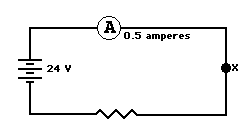
48
12. Current
is a measure of
k. the force that moves a
charge past a point.
l.
the resistance to the movement of charge past a point.
m. the energy used to
move a charge past a point.
n. the amount of charge
that moves in a certain time past a point.
o. the speed that the charge
moves past a point.
13. One
volt is equivalent
to
i.
1 W-s
j.
1 J/s
k.
1 J/C
l.
1 s/J.
m.
1 C/J.
14. A current of 0.80 A flows for 1.0 min. The total electric charge
passing a point in this time is
j.
0.80 C.
k.
1.3 C.
l.
48 C.
m.
75 C
n.
2.9 x 10³
C.
|
i.
24 joules j.
240 joules k.
360 joules l.
600 joules |
|
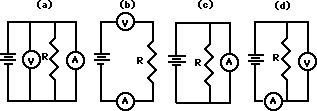
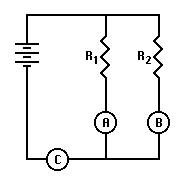
16. A resistor
is placed in a circuit with a power supply. A student wishes to measure the current
throught the resistor and the voltage drop across the
resistor. Which circuit in the diagram below shows the meter(s) connected
correctly?
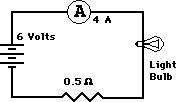 Use the circuit
diagram at the right to answer the next two questions.
Use the circuit
diagram at the right to answer the next two questions.
17. The electric current
through the light bulb is
e.
0.67 ampere
f.
2.0 amperes
g.
6.0 amperes
h.
4.0 amperes
18. The resistance of the light bulb is
d.
1.0 ohm
e.
0.5 ohm
f.
0.17 ohm
g.
23.5 ohms
|
|
|
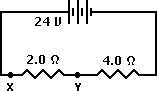 Use the circuit
diagram below to answer the next three questions.
Use the circuit
diagram below to answer the next three questions.
|
19. The potential difference between X and Y is d.
24 V e.
16 V f.
12 V g.
8.0 V h.
2.0 V |
|
20. The equivalent resistance of the circuit is
e.
24 ohm
f.
6.0 ohm
g.
2.0 ohm
h.
1.3 ohm
i.
0.75 ohm
21. The
current at Y is
e.
2.0 A.
f.
2.7 A.
g.
4.0 A.
h.
6.0 A.
i.
1.4 x 10³
A.
22. Two 10 ohm resistors connected IN SERIES draw a larger current from
a battery than a single 10 ohm resistor would draw.
e.
True
f.
False
23. As resistors are added in parallel to a circuit, the current in the
circuit
e.
decreases
f.
increases
g.
remains the same.
24. A 12 ohm resistor is connected in parallel with a 6.0 ohm resistor. The equivalent resistance
is
f.
18 ohm
g.
12 ohm
h.
6.0 ohm
i.
4.0 ohm
j.
0.25 ohm
|
25. The potential difference across the ends of resistor R2
is a.
0.67 volt b.
1.5 volts c.
6.0 volts d.
28 volts 26. Compared to the potential difference across R2, the potential
difference across R1 is a.
one-half as great.
b.
twice as great. c.
the same. d.
four times as great. |
|
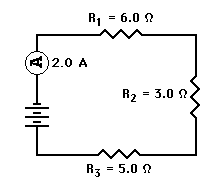
27. Compared to the rate of heat production in R2, the rate
of heat production in R3 is
a.
less
b.
greater
c.
the same.
|
a.
1.4 amp b.
5 amp. c.
3 amp d.
7 amp. 29. How much energy is consumed when a 60.0 W light bulb is left on
for 3.00 h? a.
20.0 J b.
180 J c.
540 J d.
10.8 kJ e.
648 kJ |
|
30. How long must a 100-watt light bulb be used in order to dissipate 1,000
joules of electrical energy?
a.
10 sec
b.
100 sec
c.
1,000 sec
d.
100,000 sec.
Part 2: Short Answer
31. Using conversion factors, convert the quantity 1 kiloWatt
x hour to units of Joules. Show all your conversion factors in the space below.

32. The table below
lists quantities discussed in the last two units. For each quantity, list the
symbol used to represent that quantity and write the full name of the standard
metric unit for that quantity.
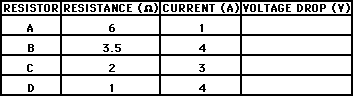
Four resistors
(A, B, C, and D) are placed in a circuit and connected to a 24-V power supply.
Two of the resistors and connected in parallel and two of the resistors are
connected in series. Ammeters are placed in the circuit to measure the current
passing through each resistor. The measured currents and the known resistances
of the four devices are shown below. Use this information to answer the next
three questions.
33. Which two resistors are placed in series? ___________ in parallel?
___________
34. Construct a circuit diagram of this circuit. Use the appropriate
circuit symbols. Label each resistor as A, B, C, and D. Be sure to show the
placement of the ammeters in the circuit. Indicate the voltage of the power
supply.
35. Fill in the remaining column of the data table above, showing the
voltage drop across each resistor.
MAGNETISM
http://www.mcwdn.org/Physics/MagnetQuiz.html
1. This is a force where
objects are attracted or repelled to one another:
a)light
b) sound
c) magnetism
2. Magnets have a north
seeking pole and a south seeking pole.
a) True
b) False
3. Two of the same kinds
of poles repel each other.
a) True
b) False
4. Two opposite poles
attract each other.
a) True
b) False
5. The area around a
magnet that behaves like a magnet is a magnetic
a) color
b) field
c) sound
6. The further apart two magnets
are from one another the stronger the forces that attract or repel the magnets.
a) True
b) False
7. When magnets are
broken into small bits, the bits themselves can become small magnets.
a) True
b) False
8. Naturally occurring magnets
in nature are called
a) plastic
b) stones
c) lodestones
9. Which of these is not
used to create a simple electromagnet?
a) battery
b) bulb
c) copper
wire