The Atmosphere
http://www.al.noaa.gov/WWWHD/Pubdocs/mission.html
Environmental
conditions, temperature, density, and pressure, are continually changing. Air
is everywhere in the earth's atmosphere. It takes up space and has mass. Heat
warms the air around the earth, causing changes in atmospheric conditions:
temperature, density, and pressure.
The earth
is made up of three layers, the lithosphere (land), hydrosphere (water) and the
atmosphere (air). The atmosphere, a mixture of gases surrounding the earth and
held by the earth's gravity, is where flight takes place.
When earth
was formed, it had no atmosphere. As volcanoes grew and erupted, gases began to
form an atmosphere. This early atmosphere did not contain oxygen. Plants
appeared and developed a way to use the sun's energy to produce oxygen in the
air. This process is called photosynthesis. The first oxygen-breathing animals
appeared about 500 million years ago.
The Regions of the Atmosphere. The Earth's atmosphere has layers,
which are actually characterized by how the temperature of the atmosphere
changes with altitude. The troposphere
begins at the Earth's surface, which acts as a source of heat resulting from
absorption of visible sunlight. The temperature decreases with height in the
troposphere, and so the air is well mixed in this region (Greek: tropos, a
turning). Weather phenomena such as thunderstorms and clouds occur in this
layer, as does most of the commercial airline traffic at present (exceptions
include the higher-flying supersonic aircraft, for example, the Concorde). Near
about 9-12 kilometers (16-17 kilometers
in the tropics) a new region called the stratosphere
begins. The stratosphere is heated from above (absorption of solar ultraviolet
radiation by oxygen and ozone) and temperature increases with altitude. In this
region there is much slower mixing (Latin: stratum,
layer). The "ozone layer" resides in the stratosphere. At about 50 kilometers (30 miles), temperature begins to decrease with
altitude again and the mesosphere begins.
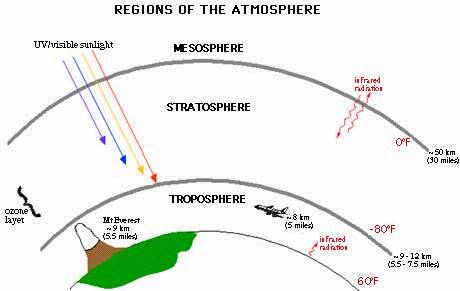
Both the stratosphere and the
troposphere have important direct and indirect effects on the well-being of
humankind. In this century, it has become increasingly clear that humans are
influencing the chemical composition of the troposphere and stratosphere in
ways that can impact conditions at the Earth's surface. Some of the most
challenging environmental issues of our time have arisen. At the Aeronomy Lab, over 120 scientists, engineers, students, and
supporting staff are engaged in studies of these issues, working
Layers
The
atmosphere around the earth is made up of layers that are distinguished by
temperature.
The first
layer closest to the earth is the troposphere. This layer contains about 75% of
the total mass of the atmosphere. This is where all plants and animals live and
breathe. Climate and weather also occur in this layer.
The next
layer is the stratosphere. It extends to about 30 miles above the earth. Ozone
in this layer stops many of the sun's harmful ultraviolet rays from reaching
the earth. This layer plus the troposphere make up 99% of the total mass of the
atmosphere.
The third
layer is the mesosphere. The temperature can drop to -173 degrees Fahrenheit. This
is where we see "falling stars," meteors that fall to the earth and
burn up in the atmosphere. At certain times of the year, we can see many of
these "falling stars" when the earth goes through the pieces of a
broken comet.
The
thermosphere layer has many temperature changes. Energy from the sun is
absorbed and bounced back. The top of this layer can get to 441 degrees
Fahrenheit.
The
exosphere is the highest layer of the atmosphere. It extends to 40,000 miles
above the earth's surface. The thermosphere and the exosphere together make up
the upper atmosphere.
Radio waves
transmitted from the earth bounce off tiny energy particles called ions,
located in the upper atmosphere, and return to a different location on the
earth. The upper atmosphere also contains the magnetosphere. This layer
produces the beautiful "northern lights" or "aurora
borealis." with colleagues from other institutions across the