

|
Corrasion, otherwise
known as abrasion, is the grinding of rock fragments carried by the river
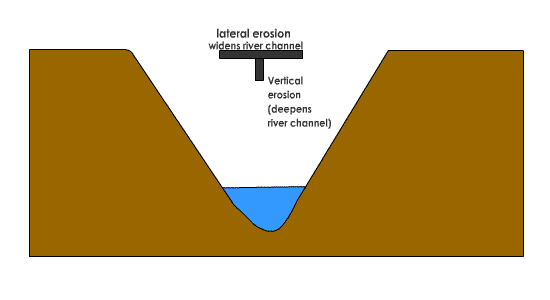
against the bed and banks of the river. This action both widens and deepens
the channel. The power of the grinding is especially powerful in floods when
large fragments of rock are carried along the river bed eroding the bed and
the banks. |
Attrition is the knocking of rock fragments in the water
against one another. The fragments are broken into smaller pieces and become
smoother along the process. |
|
For
example, when a river stream flows over an area of limestone (calcium
carbonate), it erodes the limestone by reacting chemically with it and
dissolves it. |
Hydraulic action is the breaking down of rocks and dragging them away
from the bed and banks by the force of the running water itself. When water
from a fast moving stream enters cracks in a rock, the force breaks up the
force into pieces. |
Some
rivers have greater volume than others. There are four factors that influence volume.

The
presence of vegetation affects the rate at which water is intercepted
and is able to infiltrate the ground. If an area is covered with vegetation,
the vegetation will intercept the rain and allows some of it to infiltrate into
the ground. As a result, there will be less water as surface runoff into the
river and so the volume of water into the river will be lowered. On the other
hand, in an area with no vegetation, there will be no interception and little
infiltration into the ground. This will result in more water as surface runoff
into the river and so the volume of the water is higher than that of a
vegetated area.

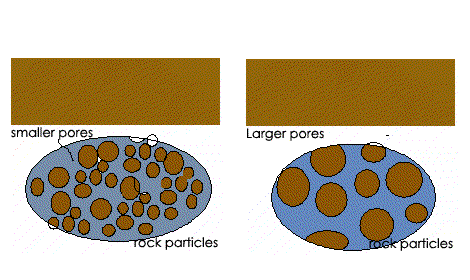
The permeability
of rocks is determined by the size of the pores between the rock
particles. If the rock has small pores, water cannot easily infiltrate into the
rock and this means that the rock is impermeable. On the other hand, if the
rock has large pores, water can easily infiltrate and thus the rock is
permeable. When water flows through an area of impermeable rock,little water infiltrates the ground, as a result
there is high surface runoff and leads to a high volume of flow of water.

A larger drainage
basin will have a greater volume of water. This is because there is a
greater amount of tributaries bringing water to the river resulting in a higher
surface runoff.
Drainage
Basin refers to the area drained by a river and its tributaries.

Climate:
The
amount of precipitation and
temperature affects the
volume of river. During dry season,
a river channel may be almost empty therefore the volume is low. During the wet season, the volume will be high
and water may overflow the channel and flood the surrounding land.
Temperature
also plays a part in influencing the volume of rivers. When the temperature is
high, there is more evaporation and transpiration which reduces the amount of
water in the river.

The three factors that influence the
velocity of a river are the river gradient
,channel roughness and channel shape. Click on any of
the sections above to begin.
A river flowing
down a steep slope or gradient has higher velocity than one which flows down a
gentler gradient. For example, the speed of flow in a river that plunges down a
steep slope in the form of a waterfall is much higher than the speed of flow in
a river that winds down a gentler slope.
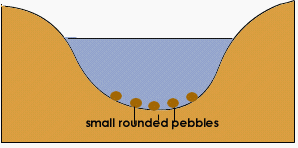
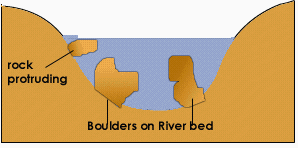
In figure A, the channel is smooth while
that in figure B is
rough or uneven with boulders on the river bed as well as rocks that protrude
out from the bank. A river that flows through such a river has to overcome such
obstacles and therefore there will be more friction and the velocity of the
river is reduced.

A river
uses its energy to carry or transport eroded materials such as mud, sand,
boulders and dissolved materials. These materials are called its load. River
transport their load by four processes. These processes are traction, saltation, suspension and solution.
Large
particles such as gravel and coarse sand are lifted and dropped along the
river, so they
bounce along the river bed in a series of bed.
Larger
particles like pebbles and boulders roll and slide along the river bed.
Dissolved
materials containing minerals like calcium and sodium are carried in the water.
Trying to look out for these type of load in a river?
Too bad, they cannot be seen by a naked eye.
Smaller
particles such as clay, silt and fine sand are carried along without contact
with the river
bed. Materials carried in suspension usually forms the greatest part of the
total river bed.