The hydrological cycle
http://www.aquatic.uoguelph.ca/general/page34.htm
The
hydrological cycle provides a model for understanding the global plumbing
system. Water spends time in the ocean, in the air, on the surface, and under
the surface as groundwater. The hydrological cycle is a closed system because
water is neither created nor destroyed on a large scale. Water exists as solid,
liquid and gas phases that are interchangeable at temperatures found on earth.
The hydrological cycle describes the movement of water as it passes through
these phases. Water links the atmosphere, oceans and land through energy and
matter exchanges as it evaporates, precipitates and flows.
The residence time of water in each part of the hydrological cycle
determines its impact on climates. The short time spent by water in transit
through the atmosphere results in short-term fluctuations in regional weather
patterns. By contrast the long residence times, of 3,000 to 10,000 years in
deep-ocean circulations, groundwater aquifers, and glacial ice act to moderate
temperatures and climates. These slower parts of the water cycle work as a
system memory, which both store and release heat, buffering climate change.
There are four main components to the hydrological cycle: evaporation and
transpiration, precipitation, surface water, and atmospheric water.

Water is essential to life. Without it, the
biosphere that exists on the surface of the earth wouldn't be possible.
Nicknamed the "water" planet, Earth is covered by one of our most
precious resources. However, almost 93% is locked in the oceans, toxic to
humans and many plants and animals.
How do we obtain fresh water resources then? Where does drinkable water come
from? To understand, we need to turn to the Hydrologic Cycle.
Water's molecular arrangement is very simple, two hydrogens to each
oxygen atoms, but this is misleading. Water has many unique properties that
allow it to be such a universal material. One special characteristic of water
is its ability to change state very easily under Earth conditions. It can be
found readily on the planet in all of its three forms, solid, liquid, and gas.
These forms also play a great part in the hydrologic cycle. Now, exactly what
is the hydrologic cycle.? The hydrologic cycle takes place in the hydrosphere,this
is the region containing all the water in the atmosphere and on the surface of
the earth. The cycle is the movement of water through this hydrosphere.
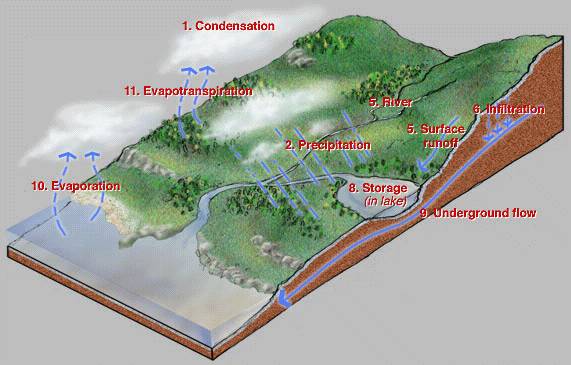
The process begins with condensation, when water vapor
condenses in the atmosphere to form clouds. Condensation occurs when the
temperature of the air or earth changes. Water changes states when temperatures
fluctuate. So when the air cools enough, water vapor has to condense on
particles in the air to form clouds. This process is very noticeable on plants
as they dew in the morning
As clouds form, winds move them across the globe, spreading out the
water vapor. When eventually the clouds can't hold the moisture, they release
it in the form of precipitation, which can be snow, rain, hail, etc.
The next three stages: infiltration, runoff, and evaporation occur
simultaneously. Infiltration occurs when precipitation seeps
into the ground. This depends a lot on the permeability of the ground.
Permeability is the measure of how easily something flows through a
substance.The more permeable, the more precipitation seeps into the ground. If
precipitation occurs faster than it can infiltrate the ground, it becomes runoff.
Runoff remains on the surface and flows into streams, rivers, and eventually
large bodies such as lakes or the ocean. Infiltrated groundwater moves
similarily as it recharges rivers and heads towards large bodies of water.
As both of these processes are happening, the power of the sun is
driving this cycle by causing evaporation. Evaporation is the
change of liquid water to a vapor. Sunlight aids this process as it raises the
temperature of liquid water in oceans and lakes.
As the liquid heats, molecule are released and change into a gas. Warm
air rises up into the atmosphere and becomes the vapor involved in condensation.
Considering so little of the water on earth is drinkable to people, it
is amazing the supply has survived as long as it has. The hydrologic cycle
continues to move water and keep sources fresh. It is estimated that 100
million billion gallons a year are cycled through this process. Without this
process life on Earth would be impossible. We need it to sustain us and for all
of our life processes to function. Without water, life would not be possible on
Earth.
OCEANS
http://www.physicalgeography.net/fundamentals/8o.html
Oceans cover
approximately 71 % or 360 million square kilometers of the Earth's surface. On
average, the depth of the world's oceans is about 3.9 kilometers. Maximum
depths, however, can exceed 11 kilometers! The oceans contain 97 % of our
planet's free water. The other 3 % is found in atmosphere, on the Earth's terrestrial surface, or in the
Earth's lithosphere in various forms
and stores (see the Hydrologic Cycle).
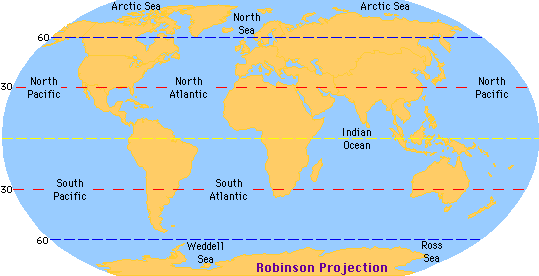
The distribution of ocean basins and continents is unevenly arranged
over the Earth's surface (Figure 8o-1).
In the Northern Hemisphere, the ratio of land to ocean is about 1 to 1.5. The
ratio of land to ocean in the Southern Hemisphere is 1 to 4. The greater
abundance of water in the Southern Hemisphere has some interesting effects on
the environment of this area. For example, climate tends to be more moderate in
the Southern Hemisphere because of the ocean's ability to release large amounts
of stored heat energy.
Humans have divided and named the interconnected oceans of the world
into three groups: the
The Pacific is the largest
ocean basin. It has an average depth of 4.3 kilometers and has few shallow
marginal seas, but many islands. Only a few rivers discharge into this ocean
basin. This lack of rivers is demonstrated by fact that the surface area of the
Pacific is about 1000 percent greater than the land area that drains into it.
The
The