Ice to Water
Extracted from http://resources.yesican.yorku.ca/lpdd/g07/lp/nelson/nel09.html
If
you leave an ice cube in a beaker at room temperature, heat from the
surrounding air will transfer to the ice, and the ice will become water. In
this investigation, you will investigate what happens to the temperature of ice
as heat is transferred to it from the surrounding air.
Materials
|
· Stirring
rod · 250 ml
beaker · 250 ml
crushed ice · Timing device · Thermometer
|
|

Procedure
|
|
|

|
|
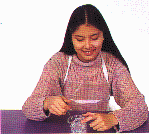
· Stir the ice
with a stirring rod. · Place the
thermometer in the breaker and record the temperature at 0 min. |
|
|
· At 1 min.,
insert the thermometer in the beaker and measure the temperature. · Continue
recording the temperature every 12-min, or until the ice has all melted. |




|
Investigation Questions |
|
|
Apply
Journal Entry Predict the melting temperature of each of the following substances:
wax, steel, sugar, asphalt, alcohol, cooking oil. Explain your thinking in each case. |

States Of Matter
Earlier,
you estimated the temperature of ice cream, hot tea, and the air inside a hot
oven. You know that ice cream is different from tea, and tea is different from
the air inside an oven. Ice cream is a solid, hot tea is a liquid, and the air
inside your oven is a gas. All substances can be grouped into one of these
states of matter-solid, liquid, or gas. Each state of matter
has certain characteristics,
or properties.
|
|
A gas fills any container it is in, and takes on the
shape of the container; a gas can flow and it is easy to compress. |
|
A liquid has a set volume, but it will take the same
shape as the container it is in; a liquid can flow, but it is difficult to
compress. |
|
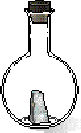
A solid has a set volume and a rigid shape; it
cannot flow like a gas or a liquid, and it is very hard to compress. |


Heat and States of Matter
If heat is added to or released from a substance, the
state of the substance can change. For example, if heat is added to ice cream,
it changes from a solid to a liquid. If heat is added to hot tea, the water
will boil, changing to a gas.

|
The six changes of state Melting is
the change from a solid to a liquid. Vaporization is
the change from a liquid to a gas. Slow vaporization is called evaporation.
Fast vapourization is called boiling. Condensation is
the change from a gas to a liquid. Solidification, or
freezing, is the change from a liquid to a solid. Sublimation is
either the change from a solid directly to a gas, or the change from a gas to
a solid. Notice that sublimation is the name for two possible changes of
state. |
|
Self Check |
|
|
Apply
Journal Entry During the course of the day, record any changes you see in states of
matter. List the place where the change happened, the initial state, and the
final state for each change. |
From Heat and
Temperature, ITP Nelson. © Copyright 1997
Copyright permission is hereby granted for educational purposes only, otherwise
this resource may not be reproduced, modified for re-sale or sold
"as-is" without explicit written permission from the
authors.
All educational reproductions of this document must include this copyright
notice.