Lesson 1: Basic
Terminology and Concepts
http://www.physicsclassroom.com/
Definition and Mathematics of Work
Until now, we utilized
In physics, work is defined as a force
acting upon an object to cause a displacement. There are three
key words in this definition - force, displacement, and cause. In order for a
force to qualify as having done work
on an object, there must be a displacement and the force must cause the displacement. There are
several good examples of work which can be observed in everyday life - a horse
pulling a plow through the fields, a father pushing a grocery cart down the
aisle of a grocery store, a freshman lifting a backpack full of books upon her
shoulder, a weightlifter lifting a barbell above her head, a shot-put launching
the shot, etc. In each case described here there is a force exerted upon an
object to cause that object to be displaced.
Read the following five statements and
determine whether or not they represent examples of work.
|
Statement |
Answer |
|
A teacher applies a force to a wall and
becomes exhausted. |
|
|
A book falls off a table and free falls to
the ground. |
|
|
A waiter carries a tray full of meals above
his head by one arm across the room. (Careful! This is a very difficult
question which will be discussed in more detail later.) |
|
|
A rocket accelerates through space. |
|
Mathematically, work can be expressed by the
following equation.

where F = force, d = displacement, and the
angle (theta) is defined as the angle between the force and the displacement
vector. Perhaps the most difficult aspect of the above equation is the angle
"theta." The angle is not just any
'ole angle, but rather a very specific angle. The angle measure is defined
as the angle between the force and the displacement. To gather an idea of its
meaning, consider the following three scenarios
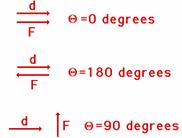
Scenario A: A force acts rightward upon an
object as it is displaced rightward. In such an instance, the force vector and
the displacement vector are in the same direction. Thus, the angle between F
and d is 0 degrees.
Scenario B: A force acts leftward upon an
object which is displaced rightward. In such an instance, the force vector and
the displacement vector are in the opposite direction. Thus, the angle between
F and d is 180 degrees.
Scenario C: A force acts upward upon an object
as it is displaced rightward. In such an instance, the force vector and the
displacement vector are at right angles to each other. Thus, the angle between
F and d is 90 degrees.
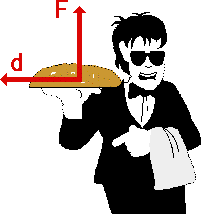 Let's consider Scenario C above in more
detail. Scenario C involves a situation similar to the waiter who carried a tray full of
meals above his head by one arm across the room. It was mentioned earlier that the waiter does
not do work upon the tray as he carries it across the room. The force
supplied by the waiter on the tray is an upward force and the displacement of
the tray is a horizontal displacement. As such, the angle between the force and
the displacement is 90 degrees. If the work done by the waiter on the tray were
to be calculated, then the results would be 0. Regardless of the magnitude of
the force and displacement, F*d*cosine 90 degrees is 0 (since the cosine of 90
degrees is 0). A vertical force can never cause a horizontal displacement;
thus, a vertical force does not do work on a horizontally displaced object!!
Let's consider Scenario C above in more
detail. Scenario C involves a situation similar to the waiter who carried a tray full of
meals above his head by one arm across the room. It was mentioned earlier that the waiter does
not do work upon the tray as he carries it across the room. The force
supplied by the waiter on the tray is an upward force and the displacement of
the tray is a horizontal displacement. As such, the angle between the force and
the displacement is 90 degrees. If the work done by the waiter on the tray were
to be calculated, then the results would be 0. Regardless of the magnitude of
the force and displacement, F*d*cosine 90 degrees is 0 (since the cosine of 90
degrees is 0). A vertical force can never cause a horizontal displacement;
thus, a vertical force does not do work on a horizontally displaced object!!
The equation for work lists three variables -
each variable is associated with the one of the three key words mentioned in
the definition
of work (force,
displacement, and cause). The angle theta in the equation is associated with
the amount of force which causes a displacement. As mentioned in
a previous unit,
when a force is exerted on an object at an angle to the horizontal, only a part
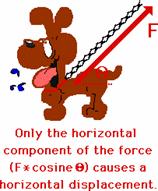
of the force contributes to (or causes) a horizontal displacement. Let's
consider the force of a chain pulling upwards and rightwards upon Fido in order
to drag Fido to the right. It is only the horizontal component of the tensional
force in the chain which causes Fido to be displaced to the right. The
horizontal component is found by multiplying the force F by the cosine of the
angle between F and d. In this sense, the cosine theta in the work equation
relates to the cause factor - it selects the portion of the force which
actually causes a displacement.
When determining the measure
of the angle in the work equation, it is important to recognize that the angle
has a precise definition - it is the angle between the force and the
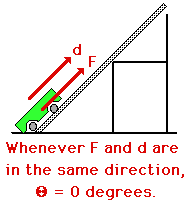
displacement vector. Be sure to avoid mindlessly using any 'ole angle in the equation. For instance, consider the activity
performed in the "It's All Uphill" lab. A force was applied to a cart
to pull it up an incline at constant speed. Several incline angles were used;
yet, the force was always applied parallel to the incline. The displacement of
the cart was also parallel to the incline. Since F and d were in the same
direction, the angle was 0 degrees. Nonetheless, most students experienced the
strong temptation to measure the angle of incline and use it in the equation.
Don't forget: the angle in the equation is not just any 'ole angle; it is defined as the angle between the force and
the displacement vector.
Whenever a new quantity is introduced in physics,
the standard metric units associated with that quantity are discussed. In the
case of work (and also energy), the standard metric unit is the Joule
(abbreviated "J"). One Joule is equivalent to one
The Joule is the unit of work.
1 Joule = 1 Newton * 1 meter
1J = 1 N * m
In fact, any unit of force times any unit of
displacement is equivalent to a unit of work. Some nonstandard units for work
are shown below. Notice that when analyzed, each set of units is equivalent to
a force unit times a displacement unit.
In summary, work is a force acting upon an
object to cause a displacement. When a force acts to cause an object to be
displaced, three quantities must be known in order to calculate the amount of
work. Those three quantities are force, displacement and the angle between the
force and the displacement.
Calculating the Amount of Work Done by Forces
In a previous part of Lesson 1, work was defined as a force acting
upon an object to cause a displacement. When a force acts to cause an object to
be displaced, three quantities must be known in order to calculate the work.
Those three quantities are force, displacement and the angle between the force
and the displacement. The work is subsequently calculated as
force*displacement*cosine(theta) where theta
is the angle between the force and the displacement vectors. In this part of
Lesson 1, the concepts and mathematics of work will be applied in order to analyze
a variety of physical situations.
Potential Energy
An object can store energy as the result of its
position. For example, the heavy ram of a pile driver is storing energy when it
is held at an elevated position. This stored energy of position is referred to
as potential energy. Similarly, a drawn bow is able to store energy as the
result of its position. When assuming its usual
position (i.e., when not drawn), there is no energy stored in the bow. Yet
when its position is altered from its usual equilibrium position, the bow is
able to store energy by virtue of its position. This stored energy of position
is referred to as potential energy. Potential energy is the stored energy of
position possessed by an object.

The two examples above
illustrate the two forms of potential energy to be discussed in this course -
gravitational potential energy and elastic potential energy. Gravitational potential energy is
the energy stored in an object as the result of its vertical position (i.e.,
height). The energy is stored as the result of the gravitational attraction of
the Earth for the object. The gravitational potential energy of the heavy ram
of a pile driver is dependent on two variables - the mass of the ram and the
height to which it is raised. There is a direct relation between gravitational
potential energy and the mass of an object; more massive objects have greater
gravitational potential energy. There is also a direct relation between
gravitational potential energy and the height of an object; the higher that an
object is elevated, the greater the gravitational potential energy. These
relationships are expressed by the following equation:
PEgrav = mass * g * height
PEgrav = m * g * h
In the above equation, m represents the mass of
the object, h represents the height of the object and g represents the
acceleration of gravity (approximately 10 m/s/s on Earth).
To determine the gravitational potential energy
of an object, a zero height position
must first be arbitrarily assigned. Typically, the ground is considered to be a
position of zero height. But this is merely an arbitrarily assigned position
which most people agree upon. Since many of our labs are done on tabletops, it
is often customary to assign the tabletop to be the zero height position; again
this is merely arbitrary. If the tabletop is the zero position, then the
potential energy of an object is based upon its height relative to the
tabletop. For example, a pendulum bob swinging to and from above the table top
has a potential energy which can be measured based on its height above the
tabletop. By measuring the mass of the bob and the height of the bob above the
tabletop, the potential energy of the bob can be determined.
Since the gravitational potential energy of an
object is directly proportional to its height above the zero position, a doubling of the height will result in a doubling of the gravitational potential
energy. A tripling of the height will
result in a tripling of the
gravitational potential energy. Use this principle to determine the blanks in
the following diagram. Knowing that the potential energy at the top of the tall
pillar is 30 J, what is the potential energy at the other positions shown on
the hill and the stairs.
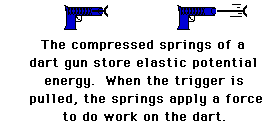

The second form of potential
energy which we will discuss in this course is elastic potential energy.
Elastic potential energy is the energy stored in elastic materials as the
result of their stretching or compressing. Elastic potential energy can be
stored in rubber bands, bungee chords, trampolines, springs, an arrow drawn
into a bow, etc. The amount of elastic potential energy stored in such a device
is related to the amount of stretch of the device - the more stretch, the more
stored energy.
Springs are a special instance of a device which
can store elastic potential energy due to either compression or stretching. A
force is required to compress a spring; the more compression there is, the more
force which is required to compress it further. For certain springs, the amount
of force is directly proportional to the amount of stretch or compression (x);
the constant of proportionality is known as the spring constant (k).
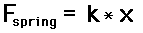
Such springs are said to
follow Hooke's Law. If a spring is not stretched or compressed, then there is no
elastic potential energy stored in it. The spring is said to be at its equilibrium position. The equilibrium
position is the position that the spring naturally assumes when there is no
force applied to it. In terms of potential energy, the equilibrium position
could be called the zero-potential energy position. There is a special equation
for springs which relates the amount of elastic potential energy to the amount
of stretch (or compression) and the spring constant. The equation is
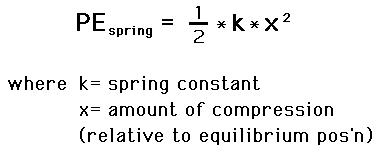
To summarize, potential energy
is the energy which an object has stored due to its position relative to some
zero position. An object possesses gravitational potential energy if it is
positioned at a height above (or below) the zero height position. An object
possesses elastic potential energy if it is at a position on an elastic medium
other than the equilibrium position.
Kinetic Energy
Kinetic energy is the energy of motion. An
object which has motion - whether it be vertical or horizontal motion - has kinetic
energy. There are many forms of kinetic energy - vibrational (the energy due to
vibrational motion), rotational (the energy due to rotational motion), and
translational (the energy due to motion from one location to another). To keep
matters simple, we will focus upon translational kinetic energy. The amount of
translational kinetic energy (from here on, the phrase kinetic energy will
refer to translational kinetic energy) which an object has depends upon two
variables: the mass (m) of the object and the speed (v) of the object. The
following equation is used to represent the kinetic energy (KE) of an object.
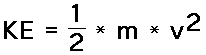
This equation reveals that the
kinetic energy of an object is directly proportional to the square of its
speed. That means that for a twofold increase in speed, the kinetic energy will
increase by a factor of four; for a threefold increase in speed, the kinetic
energy will increase by a factor of nine; and for a fourfold increase in speed,
the kinetic energy will increase by a factor of sixteen. The kinetic energy is
dependent upon the square of the speed. As it is often said, an equation is not
merely a recipe for algebraic problem-solving, but also a guide to thinking
about the relationship between quantities.
Kinetic energy is a scalar
quantity; it does
not have a direction. Unlike velocity, acceleration, force, and momentum,
the kinetic energy of an object is completely described by magnitude alone.
Like work and potential energy, the standard metric units of measurement for
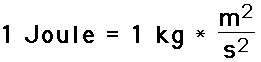
kinetic energy is the Joule. As might be implied by the above equation, 1 Joule
is equivalent to 1 kg*(m/s)^2.
Mechanical Energy
In a previous part of Lesson 1, it was said that work is done upon
an object whenever a force acts upon it to cause it to be displaced. Work is a
force acting upon an object to cause a displacement. In all instances in which
work is done, there is an object which supplies the force in order to do the
work. If a World Civilization book is lifted to the top shelf of a student
locker, then the student supplies the force to do the work on the book. If a
plow is displaced across a field, then some form of farm equipment (usually a
tractor or a horse) supplies the force to do the work on the plow. If a pitcher
winds up and accelerates a baseball towards home plate, then the pitcher
supplies the force to do the work on the baseball. If a roller coaster car is
displaced from ground level to the top of the first drop of the Shock Wave,
then a chain (driven by a motor) supplies the force to do the work on the car.
If a barbell is displaced from ground level to a height above a weightlifter's
head, then the weightlifter is supplying a force to do work on the barbell. In
all instances, an object which possesses some form of energy supplies the force
to do the work. In the instances described here, the objects doing the work (a
student, a tractor, a pitcher, a motor/chain) possess chemical potential energy stored in food or fuel which is
transformed into work. In the process of doing work, the objects doing the work
exchange energy in one form to do work on another object to give it energy. The
energy acquired by the objects upon which work is done is known as mechanical
energy.
Mechanical energy is the energy which is
possessed by an object due to its motion or its stored energy of
position. Mechanical energy can be either kinetic energy (energy of motion) or potential
energy (stored
energy of position). Objects have mechanical energy if they are in motion
and/or if they are at some position relative to a zero potential energy position (for example, a brick held at a
vertical position above the ground or zero height position). A moving car
possesses mechanical energy due to its motion (kinetic energy). A moving baseball possesses
mechanical energy due to both its high speed (kinetic energy) and its vertical position above
the ground (gravitational potential energy). A World Civilization book at rest on the top
shelf of a locker possesses mechanical energy due to its vertical position
above the ground (gravitational potential energy). A barbell lifted high above a
weightlifter's head possesses mechanical energy due to its vertical position
above the ground (gravitational potential energy). A drawn bow possesses mechanical
energy due to its stretched position (elastic potential energy).
An object which possesses mechanical energy is
able to do work. In fact, mechanical energy is often defined as the ability to
do work. Any object which possesses mechanical energy - whether it be in the
form of potential energy or kinetic energy
- is able to do work. That is, its mechanical energy enables that object to
apply a force to another object in order to cause it to be displaced.
Numerous examples can be given of how an object
with mechanical energy can harness that energy in order to apply a force to
cause another object to be displaced. A classic example involves the heavy ram
of a pile driver. A pile driver consists of a massive object which is elevated
to a high position and allowed to fall upon another object (called the pile) in
order to drive it downwards. Upon hitting the pile, the ram applies a force to
it in order to cause it to be displaced. The diagram below depicts the process
by which the mechanical energy of a pile driver can be used to do work.

A hammer is a miniature version of a pile
driver. The mechanical energy of a hammer gives the hammer its ability to apply
a force to a nail in order to cause it to be displaced. Because the hammer has
mechanical energy (in the form of kinetic energy), it is able to do work on the
nail. Mechanical energy is the ability to do work.
Another example which illustrates how
mechanical energy is the ability of an object to do work can be seen any
evening at your local bowling alley. The mechanical energy of a bowling ball
gives the ball the ability to apply a force to a bowling pin in order to cause
it to be displaced. Because the massive ball has mechanical energy (in the form
of kinetic energy),
it is able to do work on the pin. Mechanical energy is the ability to do work.
A dart gun is still another example of how
mechanical energy of an object can do work on another object. When a dart gun
is loaded and the springs are compressed, it possesses mechanical energy. The
mechanical energy of the compressed springs give the springs the ability to
apply a force to the dart in order to cause it to be displaced. Because of the
springs have mechanical energy (in the form of elastic potential
energy), it is able
to do work on the dart. Mechanical energy is the ability to do work.
A common scene in the western
As already mentioned, the mechanical energy of
an object can be the result of its motion (i.e., kinetic energy) and/or the result of its stored
energy of position (i.e., potential energy). The total amount of mechanical energy is
merely the sum of the potential energy and the kinetic energy. This sum is
simply referred to as the total mechanical energy (abbreviated TME).
TME = PE + KE
As discussed earlier, there are two forms of potential
energy discussed in
our course - gravitational potential energy and elastic potential energy. Given
this fact, the above equation can be rewritten:
TME = PEgrav + PEspring + KE
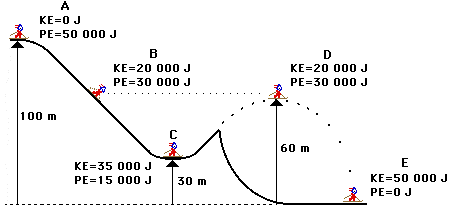
The diagram below depicts the motion of Li Ping
Phar (esteemed Chinese ski jumper) as she glides down the hill and makes one of
her record-setting jumps.
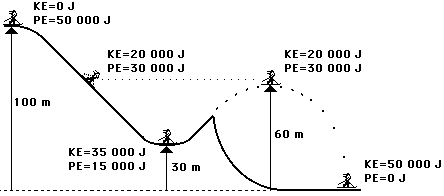
The total mechanical energy of Li Ping Phar is
the sum of the potential and kinetic energies. The two forms of energy sum up
to 50 000 Joules. Notice also that the total mechanical energy of Li Ping Phar
is a constant value throughout her motion. There are conditions under which the
total mechanical energy will be a constant value and conditions under which it
is a changing value. This is the subject of Lesson 2 - the work-energy theorem. For now, merely
remember that total mechanical energy is the energy possessed by an object due
to either its motion or its stored energy of position. The total
amount of mechanical energy is merely the sum of these two forms of energy. And
finally, an object with mechanical energy is able to do work on another object.
Power
The quantity work has to do with a force causing a displacement.
Work has nothing to do with the amount of time that this force acts to cause
the displacement. Sometimes, the work is done very quickly and other times the
work is done rather slowly. For example, a rock climber takes an abnormally
long time to elevate her body up a few meters along the side of a cliff. On the
other hand, a trail hiker (who selects the easier path up the mountain) might
elevate her body a few meters in a short amount of time. The two people might
do the same amount of work, yet the hiker does the work in considerably less
time than the rock climber. The quantity which has to do with the rate at which
a certain amount of work is done is known as the power. The hiker has a greater
power rating than the rock climber.
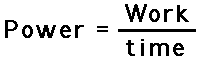
Power is the rate at which work is done. It is
the work/time ratio. Mathematically, it is computed using the following
equation.
The standard metric unit of power is the Watt.
As is implied by the equation for power, a unit of power is equivalent to a unit
of work divided by a unit of time. Thus, a Watt is equivalent to a
Joule/second. For historical reasons, the horsepower
is occasionally used to describe the power delivered by a machine. One
horsepower is equivalent to approximately 750 Watts.
Most machines are designed and built to do work
on objects. All machines are typically described by a power rating. The power
rating indicates the rate at which that machine can do work upon other objects.
Thus, the power of a machine is the work/time ratio for that particular
machine. A car engine is an example of a machine which is given a power rating.
The power rating relates to how rapidly the car can accelerate the car. Suppose
that a 40-horsepower engine could accelerate the car from 0 mi/hr to 60 mi/hr
in 16 seconds. If this were the case, then a car with four times the horsepower
could do the same amount of work in one-fourth the time. That is, a
160-horsepower engine could accelerate the same car from 0 mi/hr to 60 mi/hr in
4 seconds. The point is that for the same amount of work, power and time are
inversely proportional. Equations can be "guides to thinking" about
the relationships between quantities. The power equation suggests that a more
powerful engine can do the same amount of work in less time.
A person is also a machine which has a power rating. Some people are more
power-full than others; that is, they are capable of doing the same amount of
work in less time or more work in the same amount of time. In the Personal
Power lab, students determined their own personal power by doing work on their
bodies to elevate it up a flight of stairs. By measuring the force,
displacement and time, we were able to measure our personal power rating.
Suppose that Ben Pumpiniron elevates his 80-kg
body up the 2.0 meter stairwell in 1.8 seconds. If this were the case, then we
could calculate Ben's power rating.
It can be assumed that Ben must apply a 800-Newton downward force upon the
stairs to elevate his body. By so doing, the stairs would push upward on Ben's
body with just enough force to lift his body up the stairs. It can also be
assumed that the angle between the force of the stairs on Ben and Ben's
displacement is 0 degrees. With these two approximations, Ben's power rating
could be determined as shown below.
Ben's power rating is 889 Watts; what a
"horse."
The expression for power is work/time. Now
since the expression for work is force*displacement, the expression for power
can be rewritten as (force*displacement)/time. Yet since the expression for
velocity is displacement/time, the expression for power can be rewritten once
more as force*velocity. This is shown below.

This new expression for power reveals that a
powerful machine is both strong (big force) and fast (big velocity). The
powerful car engine is strong and fast. The powerful farm equipment is strong
and fast. The powerful weightlifters are strong and fast. The powerful linemen
on a football team are strong and fast. A machine
which is strong enough to apply a big force to cause a displacement in a small
mount of time (i.e., a big velocity) is a powerful machine.
Lesson 2: The
Work-Energy Theorem
Analysis of Situations in Which Mechanical Energy is
Conserved
It has previously been mentioned that there is a relationship
between work and mechanical energy change. Whenever work is done upon an object
by an external force,
there will be a change in the total mechanical energy of the object. If only internal
forces are doing
work (no work done by external forces), there is no change in total mechanical
energy; the total mechanical energy is said to be "conserved." In this part of Lesson 2, we will further
explore the quantitative relationship between work and mechanical energy
in situations in which there are no external forces doing work.
The quantitative relationship between work and
the two forms of mechanical energy is expressed by the following equation:
KEi + PEi + Wext = KEf
+ PEf
The equation illustrates that the total
mechanical energy (KE + PE) of the object is changed as a result of work done
by external forces. There are a host of other situations in which the only
forces doing work are internal forces. In such situations, the total mechanical
energy of the object is not changed. In such instances, it is sometimes
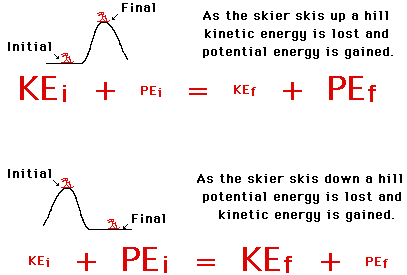
said that the mechanical energy is "conserved." The previous equation can be simplified to the following
form:
KEi + PEi = KEf + PEf
In these situations, the sum of the kinetic and
potential energy is everywhere the same. As kinetic energy is decreased (due to
the object slowing down), the potential energy is increased (due to the
stretch/compression of a spring or an increase in height above the earth). As
kinetic energy is increased (due to the object speeding up), the potential
energy is decreased (due to the return of a spring to its rest position or a
decrease in height above the earth). We would say that energy is transformed -
i.e., changes its form from kinetic energy to potential energy (or vice versa)
- yet the total amount present is conserved - i.e., always the same.
The tendency of an object to conserve its
mechanical energy is observed whenever external forces are not doing work. If the influence of friction and
air resistance can be ignored (or assumed to be negligible) and all other
external forces are absent or merely not doing work, then the object is often
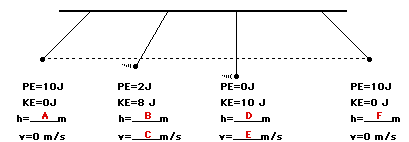
said to conserve its energy. Consider a pendulum bob swinging to and fro on the end of a string. There
are only two forces acting upon the pendulum bob. Gravity (an internal force)
acts downward and the tensional force (an external force) pulls upwards towards
the pivot point. The external force does not do work since at all times
it is directed at a 90-degree angle to the motion. (Review
a previous page to convince yourself that F*d*cosine angle = 0 J for the force of tension.)
As the pendulum bob swings to and fro, its height above the table top (and in turn its speed)
is constantly changing. As the height decreases, potential energy is lost; and simultaneously the kinetic
energy is gained.
Yet at all times, the sum of the potential and kinetic energies of the bob remains constant. The
total mechanical energy is 10 J. There is no loss or gain of mechanical energy;
only a transformation from kinetic energy to potential energy (and vice versa).
This is depicted in the diagram below.
The transformation (and conservation) of mechanical
energy was the
focus in the "Energy of a Pendulum" lab performed in class.
A 0.200-kg (200 gram) pendulum was released
from rest at location A, passed through a photogate at location B, and another
photogate at location C. The speed of the pendulum bob can be determined from
the width of the bob and the photogate times. The speed and mass can be used to
determine the kinetic energy
of the bob at each of the three locations. The heights of the bob above the
tabletop at each of the three locations were measured and can be used to
determine the potential energy of the bob. The data should reflect that the mechanical
energy changes its form
as the bob passes from location A to B to C. Yet the total mechanical
energy should
remain relativity constant. Sample data for the "Energy of a
Pendulum" lab are shown below.
|
Loc'n |
Height |
Speed |
PE |
KE |
TME |
|
A |
0.40 m |
0 m/s |
0.8 J |
0 J |
0.8 J |
|
B |
0.25 m |
1.70 m/s |
0.5 J |
0.29 J |
0.79 J |
|
C |
0.10 m |
2.47 m/s |
0.2 J |
0.61 J |
0.81 J |
The sample data show that the pendulum bob
loses potential energy as it drops from the more elevated location at A to the lower location
at B. As this loss of potential energy occurs, the pendulum bob gains kinetic
energy. Yet the
total mechanical energy remains approximately 0.8 Joules. We would say that
"total mechanical energy is conserved as the potential energy is
transformed into kinetic energy."
A roller coaster operates on this same
principle of energy transformation. Work is
initially done on a roller coaster car to lift to its initial summit. Once
lifted to the top of the summit, the roller coaster car has a large quantity of
potential
energy and
virtually no kinetic energy
(the car is almost at rest). If it can be assumed that no external
forces are doing work upon the car as it travels from the initial summit to the
end of the track (where finally an external braking system is employed), then
the total mechanical energy of the roller coaster car is conserved. As the car descends hills and
loops, its potential energy is transformed into kinetic energy (as the car
speeds up); as the car ascends hills and loops, its kinetic energy is
transformed into potential energy (as the car slows down). Yet in the absence
of external forces doing work, the total mechanical energy of the car is conserved.
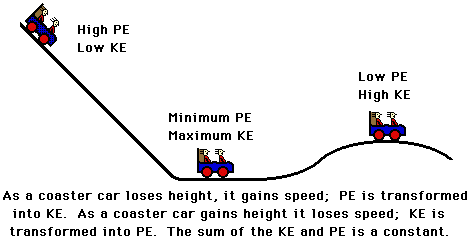
Conservation of energy on a roller coaster
ride means that the total amount of mechanical energy is the same at every
location along the track. The amount of kinetic energy and the amount of
potential energy is constantly changing; yet the sum of the kinetic and
potential energies is everywhere the same.
The motion of a ski jumper is also governed by
the transformation
of energy. As a ski
jumper glides down the hill towards the jump ramp and off the jump ramp towards
the ground, potential energy is transformed into kinetic energy. If it can be assumed that no external
forces are doing work upon the ski jumper as it travels from the top of the
hill to the completion of the jump, then the total mechanical energy of the ski jumper is conserved.
Consider Li Ping Phar, the esteemed Chinese ski jumper. She starts at rest on
top of a 100-meter hill, skis down the 45-degree incline and makes a
world-record setting jump. Assuming that friction and air resistance have a
negligible effect upon Li's motion and assuming that Li never uses her poles
for propulsion, her total mechanical energy would never change.

Of course it should be noted that the original
assumption that was made for both the roller coaster car and the ski jumper is
that there were no external forces doing work. In actuality, there are external
forces doing work. Both the roller coaster car and the ski jumper experience
the force of friction and the force of air resistance during the course of
their motion. Both friction and air resistance are external forces and both
would do work up on the moving object. In fact, the presence of friction and
air resistance would do negative work and cause the total mechanical energy to
decrease during the course of the motion. While assumption that mechanical
energy is conserved is an invalid assumption, it is a useful approximation
which assists in the analysis of an otherwise complex motion.
Check Your
Understanding
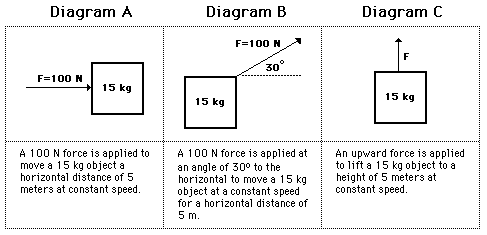
1. Apply the work equation to
determine the amount of work done by the applied force in each of the three
situations described below.
2.
Before
beginning its initial descent, a roller coaster car is always pulled up the
first hill to a high initial height. Work is done on the car (usually by a
chain) to achieve this initial height. A coaster designer is considering three
different incline angles at which to drag the 2000-kg car train to the top of
the 60-meter high hill. In each case, the force applied to the car will be
applied parallel to the hill. Her critical question is: which angle would
require the most work? Analyze the data, determine the work done in each
case, and answer this critical question.
3.

Ben Travlun carries a 200-N
suitcase up three flights of stairs (a height of 10.0 m) and then pushes it
with a horizontal force of 50.0 N at a constant speed of 0.5 m/s for a
horizontal distance of 35.0 meters. How much work does Ben do on his suitcase
during this entire motion?
4.
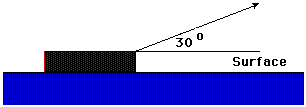
A force of 50 N acts on the
block at the angle shown in the diagram. The block moves a horizontal
distance of 3.0 m.
How much work is done by an applied
force to lift a 15-Newton block 3.0 meters vertically at a constant speed?
5. A student with a mass of 80.0 kg runs up three flights of stairs in 12.0 sec. The student has gone a vertical distance of 8.0 m. Determine the amount of work done by the student to elevate his body to this height. Assume that her speed is constant.
6.
Calculate
the work done by a 2.0-N force (directed at a 30° angle to the vertical) to
move a 500 gram box a horizontal distance of 400 cm across a rough floor at a
constant speed of 0.5 m/s. (HINT: Be cautious with the units.)
7.
A
tired squirrel (mass of 1 kg) does push-ups by applying a force to elevate its
center-of-mass by 5 cm. Determine the number of push-ups which a tired squirrel
must do in order to do a mere 5.0 Joules of work.
8.
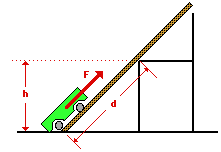 A cart is loaded with a brick and
pulled at constant speed along an inclined plane to the height of a seat-top.
If the mass of the loaded cart is 3.0 kg and the height of the seat top is 0.45
meters, then what is the potential energy of the loaded cart at the height of
the seat-top?
A cart is loaded with a brick and
pulled at constant speed along an inclined plane to the height of a seat-top.
If the mass of the loaded cart is 3.0 kg and the height of the seat top is 0.45
meters, then what is the potential energy of the loaded cart at the height of
the seat-top?
9.
If
a force of 15.0 N is used to drag the loaded cart (from previous question)
along the incline for a distance of 0.90 meters, then how much work is done on
the loaded cart?
10. Determine the kinetic energy of a 1000-kg
roller coaster car that is moving with a speed of 20.0 m/s.
11. If the roller coaster car in the
above problem were moving with twice the speed, then what would be its new
kinetic energy?
12. Missy Diwater, the former platform
diver for the Ringling Brother's Circus had a kinetic energy of 15 000 J just
prior to hitting the bucket of water. If Missy's mass is 50 kg, then what is
her speed?
13. A 750-kg compact car moving at 100
km/hr has approximately 290 000 Joules of kinetic energy. What is the kinetic
energy of the same car if it is moving at 50 km/hr? (HINT: use the kinetic
energy equation as a "guide to thinking.")
14. Two physics students, Will N. Andable and Ben Pumpiniron, are in the weightlifting room. Will lifts the 100-pound barbell over his head 10 times in one minute; Ben lifts the 100-pound barbell over his head 10 times in 10 seconds. Which student does the most work? Which student delivers the most power? Explain your answers.
15. During the Personal Power lab, Jack and Jill ran up the hill. Jack is twice as massive as Jill; yet Jill ascended the same distance in half the time. Who did the most work? Who delivered the most power? Explain your answers.
16. A tired squirrel (mass of 1 kg) does
push-ups by applying a force to elevate its center-of-mass by 5 cm. Determine
the number of push-ups which a tired squirrel must do in order to do a mere 1.0
Joule of work. If the tired squirrel does all this work in 4 seconds, then
determine its power.
17. If little Nellie Newton lifts her
40-kg body a distance of 0.25 meters in 2 seconds, then what is the power
delivered by little Nellie's biceps?
18. Your monthly electric bill is
expressed in kilowatt-hours, a unit of energy delivered by the flow of l
kilowatt of electricity for one hour. Use conversion factors to show how many
joules of energy you get when you buy 1 kilowatt-hour of electricity.
19. An escalator is used to move 20
passengers every minute from the first floor of a department store to the
second. The second floor is located 5-meters above the first floor. The average
passenger's mass is 60 kg. Determine the power requirement of the escalator in
order to move this number of passengers in this amount of time.
20.
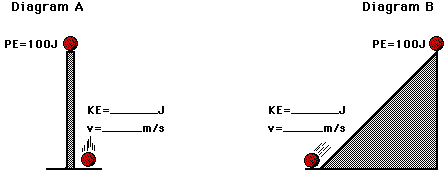
Consider the falling motion of
the ball in the following two frictionless situations. For each situation,
indicate what type of forces are doing work upon the ball. Indicate whether the
energy of the ball is conserved and explain why. Finally, indicate the kinetic
energy and the velocity of the 2-kg ball just prior to striking the ground.
21. If frictional forces and air
resistance were acting upon the falling ball in #1 would the kinetic energy of
the ball just prior to striking the ground be more, less, or equal to the value
predicted in #21?
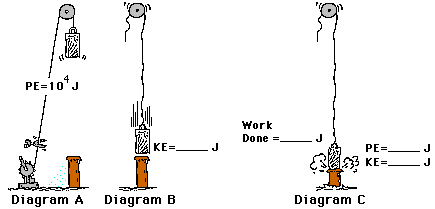
22. The cartoon strip below depicts a pile-driver falling from a high elevation (diagram A) to a low elevation (diagram B) before it encounters the force of a spike which ultimately brings it to rest (diagram C). Assume that there is no air resistance and that the spike moves only slightly. Fill in the blanks in the cartoon strip.
23. A worker pushes a 50.0-kg cylinder
up a frictionless incline at constant speed to a height of 3-meters. A diagram
of the situation and a free-body diagram is shown below. Note that the force of
gravity has two components (parallel and perpendicular component); the parallel
component balances the applied force and the perpendicular component balances
the normal force.
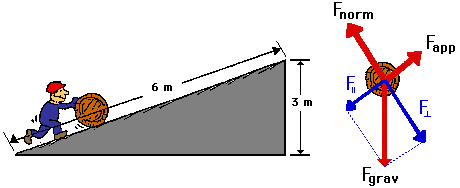
Of the forces acting upon the cylinder, which
one(s) do work upon it?
Based upon the types of forces acting upon the
system and their classification as internal or external forces, is energy
conserved? Explain.
Calculate the amount of work which the man does
upon the cylinder.
25. Use the following diagram to answer the
next questions . Neglect the effect of friction and air resistance.
As the
object moves from point A to point D across the frictionless surface, the sum
of its gravitational potential and kinetic energies
a. decreases, only.
b. decreases and then increases.
c. increases and then decreases.
d. remains the same.
The object will have a minimum gravitational
potential energy at point
a. A.
b. B.
c. C.
d. D.
e. E.
The object's kinetic energy at point C is less
than its kinetic energy at point
a. A only.
b. A, D, and E.
c. B only.
d. D and E.

26. Many drivers education
books provide tables which relate a car's braking distance to the speed of the
car (see table below). Utilize what you have learned about the stopping
distance-velocity relationship to complete the table.
27. Some driver's license exams have the
following question.
A car moving 50 km/hr skids 15 meters with
locked brakes. How far will the car skid with locked brakes if it is moving at
150 km/hr?
28. Two arrows are fired into a bale of hay. If
one has twice the speed of the other, how much farther does the faster arrow
penetrate? (Assume that the force of the haystack on the arrows are constant).
29. Use the law of conservation of energy
(assume no friction) to fill in the blanks at the various marked positions for
a 1000-kg roller coaster car.

30. If the angle of the
initial drop in the roller coaster diagram above were 60 degrees (and all other
factors were kept constant), would the speed at the bottom of the hill be any
different? Explain.
31. Determine Li Ping Phar's (m=50 kg) speed at
locations B, C, D and E.
32. An object which weighs 10
N is dropped from rest from a height of 4 meters above the ground. When it has
free-fallen 1 meter its total mechanical energy with respect to the ground is
a. 2.5 J
b. 10 J c.
c. 30 J
d. 40 J
33. During a certain time interval, a 20-N
object free-falls 10 meters. The object gains _____ Joules of kinetic energy
during this interval.
a. 10
b. 20
c. 200
d. 2000