GALICIAN “BIRLOS” (Celtic Skittles)
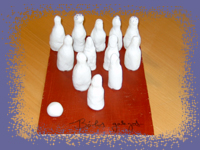
This game is played with 16 wooden barrel shaped skittles. Depending on the region, they can be 15 cm. high and 7/8 cm. in diameter or 8 cm. high and 2’5 cm. in diameter. Players use 3 wooden balls, each one weighing 1.800 g. It can be played individually, in pairs or in groups of 3 or 4. It is played on a flat clay court (whose width and length are shown in the model). The goal of the game consists in knocking down pins and scoring points. The winner is the first one to score 150 points. The player must remain stationary in the throwing platform when throwing the balls. Each turn starts with all the skittles standing and consists of three balls being rolled down the alley (called also “birlo”) If all the pins are knocked down, then they are reset, so the maximum score in one turn is 48. There are many different ways of playing this game depending on the region.
OS XOGOS DA CHAPA ( similar to “Hopscotch”)
It is played worldwide and it is known in Galicia by many different names: rollo, mariola, cotelo, truco, peletre, roleta, etc. There can be any number of players and a flat stone is the only object you need in order to play. The models show just a few of the many different boards of this game. It consists in throwing a flat stone or “marker” into a grid previously painted on the ground with a piece of chalk. The playground can be made of stone, concrete, slate or even clay. It is a game of accuracy, balance and speed.
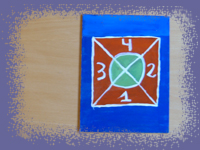
Here are some examples:O CASTRO
The first player throws the stone into section 1 and hops into this section. He must push the marker with his toe to section 2, then 3 and 4 and again into section 1. Finally, he must push it into any of the parts of the central circle. In the second turn he must throw the stone into section 2 and follow the above directions. The game finishes when all sections are done.
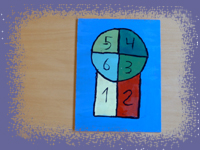
"O PADRÓN"
The player throws the stone into section 1. Then he hops into the other squares, leaving the marker in its place. In section 6 he can have a rest, placing both feet on the ground. Then he has to hop back to section 1 and there he must push the stone out of the grid with his toe. After that, he must throw the stone into section 2 and then proceed to repeat the above directions. The winner is the one who first does all the sections.
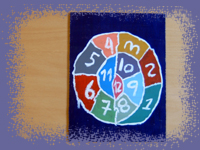
“O CARACOL” (The Snail)
The player must throw the stone into square 1 and hop into this square. Then he has to push the marker to square 2 and following, till square 12. There, he can have a rest and then he has to hop back to the start, pushing the stone with his toe until it gets out of the board from square 1. In the second turn he must throw the marker in square 2, skipping square 1 and jumping over it. The rest of the squares are done in the same way. The winner is the one who first finishes the twelve rounds.
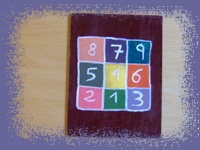
“A CHAPA DE NOVE”
The boardd consists of a big square divided into 9 squares, each of them of the same size. The player has to jump forwards and backwards. He must throw the stone in square 1 and then he has to follow this sequence:
- Jump over square 1.
- Jumping again, he opens his legs and puts his right foot in square 3 and his left foot in square 2.
- Then he puts both feet back in square 1.
- He picks the stone and jumps out of the square.
- He throws the stone in square 2 and he jumps in with both feet.
- He repeats the sequence with the other squares, until all of them are done.
"A CHAPA CHINESA" (The Chinese Marker)
The player must throw the stone into square 1. Then he hops into this square and takes two steps forward into squares 2 and 3. Then he has to come back to square 1, turn around and push the stone out of the square, always standing on one foot. Once this mission is successfully completed, he must throw the stone into square 2 and hop forward into squares 1, 2, 3 and 4. Then he has to come back to squares 3 and 2, turn around again and push the stone into square 1 and out of the grid. He must proceed in the same way until all the squares are done.
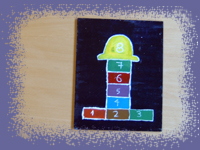
"A MARIOLA"
The first player is placed in the semicircle “Earth” (Terra) and he must throw the stone into square 1 (that is, they essentially drop it). After that, he must hop with his right foot all the way to the end of the grid. When he arrives at the semicircle “Heaven” (Ceo)he must turn around, and hop back with his left foot to square 1. They must skip the square with the marker inside of it, may not hop on any lines and may not skip any squares. Single squares must be hopped with one foot. Double squares must be straddled with one foot in each square simultaneously. When arriving back to square 1, the player must push the marker out of the square with his toe. Once this mission is successfully completed, he or she throws the marker into square 2, and then proceeds to repeat the above directions, but skipping over square 2 this time since it holds the marker. Player 1’s turn continues until he or she makes an error.
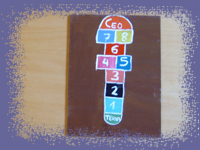
"O AVIÓN" (The Plane)
It is very similar to “Mariola” but adding one more square to the board.
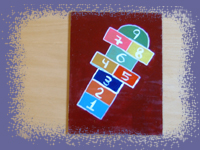
"O BONECO E A BONECA"
(The Boy Doll and The Doll)
They are the same game but the grids are slightly different. The stone is thrown into square 1. The player has to jump over this square into square 2 and following, and then he has to come back and push the stone out of square 1.The second turn is made without moving the foot from where you stick it and without moving the stone (that has to be pushed out in just one kick).
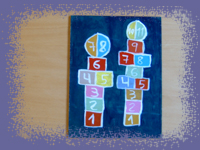
"OS MESES DO ANO" (The Months of the Year)
The player must throw the stone into square 6 (January) staying behind the squares 1 and 7 (June and December) If the stone falls in without touching any line, then he can go on playing. If not, it is another player’s time. Then he hops, following the path shown in the model, till square 6 (January). Once there, he has to push the stone with his toe from square to square till December and then push it out of the grid. The player has to do the same with the other months. When he finishes the first turn, he can do it again, but this time remaining twice as much in each square keeping balance in just one foot. Finally, in the third turn he can do it the other way round, beginning by square 1 (June).
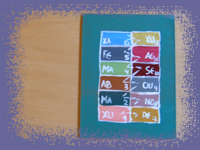
"AS CORES" (Colours)
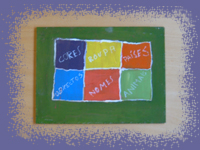
Fanse seis cadros no chan nos que se escribe, nesta orde, cores, roupa, países, obxectos, nomes e animais.
Sáltase cos pés xuntos, casa a casa, comezando pola casa cores. Sáltase dando en cada unha dous pulos cos pés xuntos, ao tempo que se di a cada pulo o nome dunha cor e salta de seguido fóra da casa. Faise o mesmo comezando por cada unha das outras casas e por orde, dicindo nomes referentes ao tema.
Ao rematar o circuito, repítese de novo, introducindo novas dificultades: á pata coxa, cruzando as pernas facendo tesoira, cos ollos pechados, etc.
"A CHAVE"
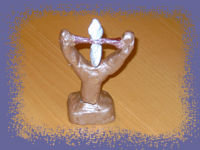
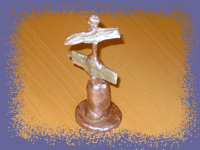
There are many different types of “Chave” and many different ways of playing, depending on the region. Here we show two different models.
It is played by teams of 3 players. In each turn, the player throws 5 “pellos” (cylindrical iron disks that have 8 cm. in diameter and 2 cm. thick, each one weighing 750 g.)
The playground must be a flat clay alley of at least 10 m. long for 3 m. wide. The “chave” is placed at the end of this alley, stuck in the ground. Behind it there must be a parapet in order to stop the disks that don’t hit the “chave”.
A PORCA
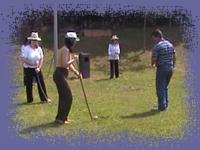
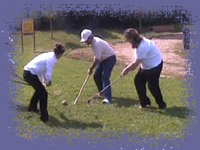
The “Porca” (also called “Pino” or “Cachoa” in certain areas) is a widely known game, similar to hockey or golf. These sports became popular long time after the existence of the “Porca” game.
It is a children’s game, mostly played during winter in a wide, open field, usually while watching over the cattle.
A BILLARDA
The “Billarda” (also known as “Estornela”, “Tala”, “Toña” or “Lipilape”) is one of the most popular games in Galicia. The rules are different depending on the region. That is the reason why it is so difficult to find a common way to play this game.
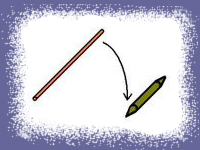
It is essentially played with a big wooden stick. The player has to hit a small piece of wood (called “billarda”) in order to throw it as far as possible.