The Celts in Bavaria. An historical overview.
Whoever reads the word "Celt" today will think of Ireland, Scotland, Wales or maybe Brittany. These are the countries where Celtic languages have been spoken up to the present day and where Celtic culture has enjoyed a long and extensive flowering.
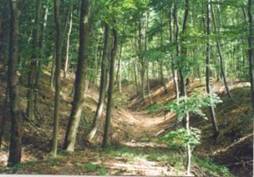
But there was a time when the Celts were spread over almost all of Europe. For example, a wanderer strolling today through the forests south of Munich, Bavaria, will see intact Celtic monuments, earth walls, ditches, and burial mounds every now and then. Often hidden in the dim light of dense forest, these monuments are silent witnesses of a time when Celtic Druids held the rituals of their tribes in these places. In burial mound cemeteries, Celtic princes, noblemen and warriors have been found in their graves, often with rich equipment, a fact that allows us today to acknowledge how highly developed Celtic arts and craftsmanship already were. There were even Celtic cities on Bavarian soil!
The Celts were originators of the first culture in European history to show the characteristic signs of a high developed, supra-regional civilization. Probably moving in from Eastern Europe, they initially settled in Central Europe.
"Through its geographical situation in Southern Germany, Bavaria belongs to the original Celtic heartland, to the area where Celts already were present before the start of the Celtic expansion from the end of the 5th century AD." (Schussmann)
From that time onwards the Celts expanded, especially to the British Isles and Ireland, but they also reached countries as far apart as Turkey (Galatians) and Spain (Ibero-Celts).
The time frame for Celtic Bavaria looks like this:
Hallstatt Era 750-450 BCE
La Tène Era 450-100 BCE
Late Celtic Era 100-15 BCE
The Hallstatt Era has been named after the village of Hallstatt in Austria, where Celtic salt mines and approximately 2,000 Celtic graves have been discovered to date. "Hall" is actually a mainland Celtic word meaning "salt." It is repeated in place names along the Alps like Hallein, Hall, Bad Reichenhall. Salt was a most important source of wealth for the Celts in alpine regions and a sought-after trading good.
The La Tène Era has been named after a town in the French speaking part of Switzerland. The findings at both archaeological sites have been considered so typical for the eras they represent, that the eras were named after them.
Celtic remains on Bavarian soil can be roughly separated into three groups:
1. So called "Late Celtic Viereckschanzen"2. Graves: single burial mounds, burial mound cemeteries,and flat grave cemeteries
3. Settlements: cities, citadels of the aristocracy, and fortified hilltop settlements
| 1. "Viereckschanzen" |
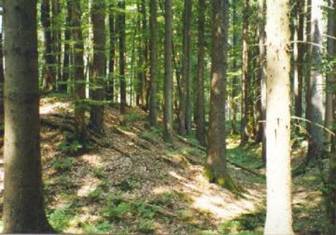
The corner of a Viereckschanze in the forest. |
|||
|
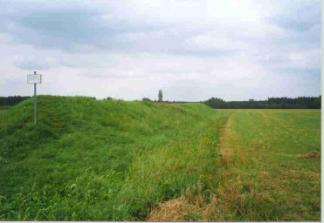
A "Viereckschanze" is basically a quadrangular enclosure. "Viereck" is German for "four corner", which hints at the rectangular shape of the monument. The enclosure or temenos is formed by an earth wall and a ditch running along the outside of the wall. The length of the walls is 80 - 150 meters (270 - 500 feet). The wall and ditch had no defensive purpose, but were built to separate the sacred space inside from the profane outside. There is an entrance that can lead to all directions, but never to the North. One reason for this might be that the sun never stands in the North (northern hemisphere). The entrance was usually gated by a wooden building or gatehouse in Celtic times. Of this type of monument, we know of approximately 200 in Bavaria today. A high concentration of them is found south of Munich. Their state of repair varies. In continental Europe "Viereckschanzen" exist from central France to Bohemia. They are called "Late Celtic" because they originate from the Late Celtic Era 100-15 BCE. |
||||
|
The purpose of the "Viereckschanzen" is still discussed among
archaeologists, but more and more evicence points in the
direction of a religious use. In the 1950s one of these
monuments in the village of Holzhausen near Munich was
excavated. |
||||
|
||||
| 2. Celtic graves. | |
In Celtic Bavaria, the following burial customs
were observed:
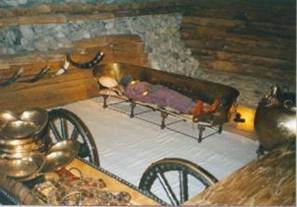
Most of today's archaeological findings come from pieces of equipment that were buried with the deceased. These are most notably weapons, jewelery, pottery, and parts of clothing like belt ornaments, needles etc. Most of the Bavarian findings are today in the Archaeological State Museum of Bavaria in Munich. (See end of article.) The number of known burial mounds in neighbouring Wuerttemberg alone was estimated to be 6,700 in 1961. The number is continually rising because of the growing use of aerial photography in the search for ground monuments. |
|
|
One of the most important and best documented excavations of a Celtic burial mound is "The Prince of Hochdorf." It is situated in Baden-Wuerttemberg, the German state west of Bavaria, but can stand representative for all burial mounds of that era. (See end of article.) |
|
| 3. Celtic settlements | |
|
The Celts had full blown cities in Bavaria. They are called "oppida,"
from the Latin word oppidum = city. These cities were commercial
centers with shops, craftsmen and artisans, merchants, workers,
farmers, etc. |
|
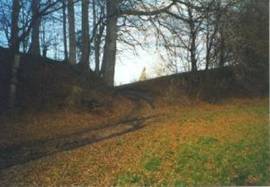 Original entrance to the Celtic city of Fentbach, near Weyarn, Upper Bavaria |
Besides cities we also know of Celtic hill fortifications or
hill forts. During the Hallstatt era these are mostly fortified
castles or citadels of the local aristocracy. |
| Conclusion | |||
|
The invasion and occupation of Bavaria by the Romans in 15 BCE
set an end to almost 800 years of Celtic culture. Scientists today don't believe that all of the Celts were killed or driven out of the country by the Romans. They rather suggest that the Celts took on more and more Roman habits and were "Romanized" that way. The following 400 years in Bavaria were therefore determined by Romans and Romanized Celts. It is as late as the beginning of the migration age around 400 CE that Germanic tribes begin to shape the future destiny of Bavaria. They will become decisive in the creation of the Bavarian tribe around 550 CE. |
|||
|
Does the Bavarian culture of today still contain Celtic
elements? This question is still debated among scientists. One fact is that the traditional holidays and festivals of Bavaria show surprising similarities with the Celtic Wheel of the Year as we know it. Another, that Celtic sacred places were Christianized in many locations and therefore survived as places of worship to the present day. Bavaria even remembers Christianized versions of Celtic myths and legends and there still is the one or other place name in use that can be traced back to Celtic times. The Celtic element in Bavarian culture may be not as obvious as it is in today's "Celtic" countries, but it is certainly there and an inseparable part of its history. |
|
||
|
|||