DYNAMICS: FORCES AND MOTION
http://www.physicsclassroom.com/
Newton's First Law of Motion
In Kinematics,
the variety of ways by which motion can be described (words,
graphs, diagrams, numbers, etc.) was discussed. In Dynamics (Newton's Laws of Motion),
the ways in which motion can be explained will be discussed. Isaac
Newton (a 17th century scientist) put forth a variety of laws which explain why
objects move (or don't move) as they do. These three laws have become known as Newton's three laws of
motion.
Newton's First
Law
The Newton's first law of
motion is sometimes referred to as the
"law of inertia."
Newton's first law of motion
is often stated as
"An
object at rest tends to stay at rest and an object in motion tends to stay in
motion with the same speed and in the same direction unless acted upon by an
unbalanced force"
There are two parts to this statement - one which predicts the behavior
of stationary objects and the other which predicts the behavior of moving
objects. The two parts are summarized in the following diagram.
The
behavior of all objects can be described by saying that objects tend to "keep
on doing what they're doing" (unless acted upon by an unbalanced
force).
-
If at rest, they will
continue in this same state of rest.
-
If in motion with an
eastward velocity of 5 m/s, they will continue in this same state of motion (5
m/s, East). If in motion with a leftward velocity of 2 m/s, they will continue
in this same state of motion (2 m/s, left). The state of motion of an object is
maintained as long as the object is not acted upon by an unbalanced
force.
All objects resist changes in their state of
motion - they tend to "keep on
doing what they're doing."
Inertia and
Mass
Newton's first law of motion states that "An object at rest tends to stay at rest and an object
in motion tends to stay in motion with the same speed and in the same direction
unless acted upon by an unbalanced force." Objects "tend to keep on
doing what they're doing." In fact, it is the natural tendency of objects
to resist changes in their state of motion. This tendency to resist changes in
their state of motion is described as inertia.
Inertia
= the resistance an object has to a change in its state
of motion.
Newton's conception of
inertia stood in direct opposition to more popular conceptions about motion.
The dominant thought prior to Newton's day was that it was the natural tendency of objects to come to a rest
position. Moving objects, so it was believed, would eventually stop moving; a
force was necessary to keep an object moving. But if left to itself, a moving
object would eventually come to rest and an object at rest would stay at rest;
thus, the idea which dominated people's thinking for nearly 2000 years prior to
Newton was that it was the natural tendency of all objects to assume a rest
position.
 Galileo, the premier scientist of the seventeenth century, developed the
concept of inertia. Galileo reasoned that moving objects eventually stop
because of a force called friction. In experiments? using a pair of inclined
planes facing each other, Galileo observed that a ball will roll down one plane
and up the opposite plane to approximately the same height. If smoother planes
were used, the ball would roll up the opposite plane even closer to the
original height. Galileo reasoned that any difference between initial and final
heights was due to the presence of friction. Galileo postulated that if
friction could be entirely eliminated, then the ball would reach exactly the
same height.
Galileo, the premier scientist of the seventeenth century, developed the
concept of inertia. Galileo reasoned that moving objects eventually stop
because of a force called friction. In experiments? using a pair of inclined
planes facing each other, Galileo observed that a ball will roll down one plane
and up the opposite plane to approximately the same height. If smoother planes
were used, the ball would roll up the opposite plane even closer to the
original height. Galileo reasoned that any difference between initial and final
heights was due to the presence of friction. Galileo postulated that if
friction could be entirely eliminated, then the ball would reach exactly the
same height.
Galileo
further observed that regardless of the angle at which the planes were
oriented, the final height was almost always equal to the initial height. If
the slope of the opposite incline was reduced, then the ball would roll a
further distance in order to reach that original height.
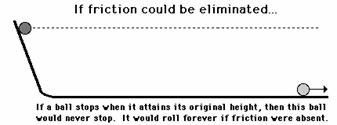
Galileo's
reasoning continued - if the opposite incline was elevated at nearly a 0-degree
angle, then the ball would roll almost forever in an effort to reach the
original height. And if the opposing incline was not even inclined at all (that
is, if it were oriented along the horizontal) , then ... an object in motion
would continue in motion... .
 Isaac Newton built on Galileo's thoughts about motion. Newton's first law of motion
declares that a force is not needed to keep an object in motion. Slide a
book across a table and watch it slide to a rest position. The book in motion
on the table top does not come to a rest position because of the absence of a force; rather it is the presence of a force - that force being
the force of friction - which brings the book to a rest position. In the
absence of a force of friction, the book would continue in motion with the same
speed and direction - forever! (Or at least to the end of the table top.) A
force is not required to keep a moving book in motion; in
actuality, it is a force which brings the book to rest.
Isaac Newton built on Galileo's thoughts about motion. Newton's first law of motion
declares that a force is not needed to keep an object in motion. Slide a
book across a table and watch it slide to a rest position. The book in motion
on the table top does not come to a rest position because of the absence of a force; rather it is the presence of a force - that force being
the force of friction - which brings the book to a rest position. In the
absence of a force of friction, the book would continue in motion with the same
speed and direction - forever! (Or at least to the end of the table top.) A
force is not required to keep a moving book in motion; in
actuality, it is a force which brings the book to rest.
 All objects resist changes in their state of motion. All objects have this
tendency - they have inertia. But do some objects have more of a tendency to
resist changes than others? Absolutely yes! The tendency of an object to resist
changes in its state of motion is dependent upon mass. Inertia is that quantity
which is solely dependent upon mass. The more mass which an object has,
the more inertia it has - the more tendency it has to resist changes in its
state of motion.
All objects resist changes in their state of motion. All objects have this
tendency - they have inertia. But do some objects have more of a tendency to
resist changes than others? Absolutely yes! The tendency of an object to resist
changes in its state of motion is dependent upon mass. Inertia is that quantity
which is solely dependent upon mass. The more mass which an object has,
the more inertia it has - the more tendency it has to resist changes in its
state of motion.
State of Motion
Inertia is
the tendency of an object to resist changes in its state of motion. But what is
meant by the phrase "state of motion?" The state of motion of an
object is defined by its velocity - the speed with a
direction. Thus, inertia could be redefined as follows:
Inertia = tendency of an object to resist
changes in its velocity.
An
object at rest has zero velocity - and (in the absence of an unbalanced force)
will remain with a zero velocity; it will not change its state of motion (i.e., velocity). An object in motion with a
velocity of 2 m/s, East will (in the absence of an unbalanced force) remain in
motion with a velocity of 2 m/s, East; it will not change its state of motion (i.e., velocity).
Objects resist changes in their velocity.
As
learned in
an earlier unit, an object which is not
changing its velocity is said to have an acceleration of 0 m/s/s. Thus, we
could provide an alternative means of defining inertia:
Inertia = tendency of an object to resist
accelerations.
Balanced and
Unbalanced Forces
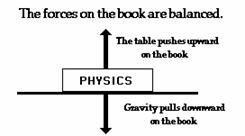
But
what exactly is meant by the phrase unbalanced force? What is an unbalanced force?
In pursuit of an answer, we will first consider a physics book at rest on a
table top. There are two forces acting upon the book. One force - the Earth's
gravitational pull - exerts a downward force. The other force - the push of the
table on the book (sometimes referred to as a normal force) - pushes upward on the book.
Since
these two forces are of equal magnitude and in opposite directions, they
balance each other. The book is said to be at equilibrium. There is no
unbalanced force acting upon the book and thus the book maintains its state of motion. When all the forces acting upon an object balance each other, the
object will be at equilibrium; it will not accelerated.
Forces and Its Representation
The Meaning of
Force
A force
is a push or pull upon an object resulting from the object's interaction with another object.
Whenever there is an interaction
between two objects, there is a force upon each of the objects. When the interaction ceases, the two objects no
longer experience the force. Forces only exist as a result of an
interaction.
For
simplicity sake, all forces (interactions) between objects can be placed into
two broad categories:
·
Contact forces are
types of forces in which the two interacting objects are physically contacting
each other. Examples of contact forces include frictional forces, tensional
forces, normal forces, air resistance forces, and applied forces.
·
Action-at-a-distance forces are types of forces in which the two interacting objects are not in
physical contact with each other, yet are able to exert a push or pull despite
a physical separation. Examples of action-at-a-distance forces include
gravitational forces (e.g., the sun and planets exert a gravitational
pull on each other despite their large spatial
separation; even when your feet leave the earth and you are no longer in contact
with the earth, there is a gravitational pull between you and the Earth),
electric forces (e.g., the protons in the nucleus of an atom and the electrons
outside the nucleus experience an electrical pull towards each other despite
their small spatial separation), and magnetic forces (e.g., two magnets can
exert a magnetic pull on each other even when separated by a distance of a few
centimeters).
|
Contact
Forces
|
Action-at-a-Distance
Forces
|
|
Frictional
Force
|
Gravitational
Force
|
|
Tensional
Force
|
Electrical
Force
|
|
Normal
Force
|
Magnetic
Force
|
|
Air
Resistance Force
|
|
|
Applied
Force
|
|
|
Spring
Force
|
|
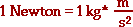
Force is a quantity which is measured using the standard metric unit
known as the Newton.
One Newton is the amount of force required to give a 1-kg mass an acceleration
of 1 m/s/s. A Newton is abbreviated by a "N." To say "10.0
N" means 10.0 Newtons of force. Thus, the following unit equivalency can
be stated:
A
force is a vector
quantity. As learned in an earlier unit, a
vector quantity is a quantity which has both magnitude and direction. To fully
describe the force acting upon an object, you must describe both the magnitude (size) and the direction.
 Thus, 10 Newtons is not a full description of the force acting upon an
object. In contrast, 10 Newtons, downwards is a complete description of the
force acting upon an object; both the magnitude (10 Newtons) and the direction
(downwards) are given.
Thus, 10 Newtons is not a full description of the force acting upon an
object. In contrast, 10 Newtons, downwards is a complete description of the
force acting upon an object; both the magnitude (10 Newtons) and the direction
(downwards) are given.
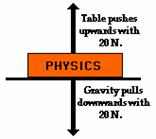
 Because a force is a vector which has a direction, it is common to
represent forces using diagrams in which a force is represented by an arrow.
Such vector diagrams were introduced in an earlier unit and will be used throughout your study of physics. The size of the
arrow is reflective of the magnitude of the force and the direction of the
arrow reveals the direction which the force is acting. Furthermore, because
forces are vectors, the influence of an individual force upon an object is
often canceled by the influence of another force. For example, the influence of
a 20-Newton upward force acting upon a book is canceled by the influence of a 20-Newton downward force acting upon
the book. In such instances, it is said that the two individual forces
"balance each other"; there would be no unbalanced
force acting upon the book.
Because a force is a vector which has a direction, it is common to
represent forces using diagrams in which a force is represented by an arrow.
Such vector diagrams were introduced in an earlier unit and will be used throughout your study of physics. The size of the
arrow is reflective of the magnitude of the force and the direction of the
arrow reveals the direction which the force is acting. Furthermore, because
forces are vectors, the influence of an individual force upon an object is
often canceled by the influence of another force. For example, the influence of
a 20-Newton upward force acting upon a book is canceled by the influence of a 20-Newton downward force acting upon
the book. In such instances, it is said that the two individual forces
"balance each other"; there would be no unbalanced
force acting upon the book.
Other
situations could be imagined in which two of the individual vector forces
cancel each other ("balance"), yet a third individual force exists
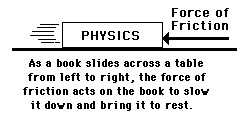
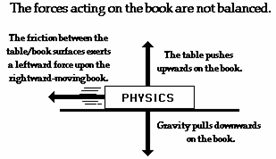
that is not balanced by another force. For example, imagine a book sliding
across the rough surface of a table from left to right. The downward force of
gravity and the upward force of the table supporting the book act in opposite
directions and thus balance each other. However, the force of friction acts
leftwards, and there is no rightward force to balance it. In this case, an unbalanced
force acts upon the book to change its state of motion.
Types of Forces
A force is a push or pull acting upon an object as a result of its interaction
with another object. There are a variety of types of forces. Previously
in this lesson, a variety of force types
were placed into two broad category headings on the basis of whether the force
resulted from the contact or non-contact of the two interacting objects. These
types of individual forces will now be discussed in more detail.
|
Type of Force
(and
Symbol)
|
Description of Force
|
|
Applied
Force Fapp
|
An
applied force is a force which is applied to an object by a person or another
object. If a person is pushing a desk across the room, then there is an
applied force acting upon the object. The applied force is the force exerted
on the desk by the person.
|
|
Gravity
Force
(Weight)
Fgrav
|
The
force of gravity is the force at which the earth, moon, or other massively
large object attracts another object towards itself. By definition, this is
the weight of the object. All objects upon earth experience a force of
gravity which is directed "downward" towards the center of the
earth. The force of gravity on earth is always equal to the weight of the
object as found by the equation:
Fgrav = m * g
where g = 9.8 m/s2 (on Earth) and m = mass (in
kg)
|
|
Normal
Force
Fnorm
|
The
normal force is the support force exerted upon an object which is in contact
with another stable object. For example, if a book is resting upon a surface,
then the surface is exerting an upward force upon the book in order to
support the weight of the book. On occasions, a normal force is exerted
horizontally between two objects which are in contact with each other.
|
|
Friction
Force
Ffrict
|
The
friction force is the force exerted by a surface as an object moves across it
or makes an effort to move across it. The friction force opposes the motion
of the object. For example, if a book moves across the surface of a desk,
then the desk exerts a friction force in the opposite direction of its
motion. Friction results from the two surfaces being pressed together
closely, causing intermolecular attractive forces between molecules of
different surfaces. As such, friction depends upon the nature of the two
surfaces and upon the degree to which they are pressed together. The friction
force can be calculated using the equation:
|
|
Air
Resistance Force
Fair
|
The
air resistance is a special type of frictional force which acts upon objects
as they travel through the air. Like all frictional forces, the force of air
resistance always opposes the motion of the object. This force will
frequently be neglected due to its negligible magnitude. It is most
noticeable for objects which travel at high speeds (e.g., a skydiver or a
downhill skier) or for objects with large surface areas.
|
|
Tensional
Force
Ftens
|
The
tension is the force which is transmitted through a string, rope, or wire
when it is pulled tight by forces acting from each end. The tensional force
is directed along the wire and pulls equally on the objects on either end of
the wire.
|
|
Spring
Force
Fspring
|
The
spring force is the force exerted by a compressed or stretched spring upon
any object which is attached to it. An object which compresses or stretches a
spring is always acted upon by a force which restores the object to its rest
or equilibrium position. For most springs (specifically, for those which are
said to obey "Hooke's Law"), the magnitude of the force is directly
proportional to the amount of stretch or compression.
|
A few
further comments should be added about the single force which is a source of
much confusion to many students of physics - the force of gravity.
As mentioned above, the force of gravity
acting upon an object is sometimes referred to as the weight of an object. Many
students of physics confuse weight with mass.
The mass
of an object refers to the amount of matter that is contained by the object;
the weight of an object is the force of gravity acting upon that object. Mass
is related to "how much stuff is
there" and weight is related to the pull of the Earth (or any other
planet) upon that stuff. The mass of
an object (measured in kg) will be the same no matter where in the universe
that object is located. Mass is never altered by location, the pull of gravity,
speed or even the existence of other forces. For example, a 2-kg object will
have a mass of 2 kg whether it is located on Earth, the moon, or Jupiter; its
mass will be 2 kg whether it is moving or not (at least for purposes of our
study); and its mass will be 2 kg whether it is being pushed or not.
On
the other hand, the weight of an object (measured in Newtons)
will vary according to where in the universe the object is. Weight depends upon
which planet is exerting the force and the distance the object is from the
planet. Weight, being equivalent to the force of gravity, is dependent upon the
value of g.
On earth's surface g is 9.8 m/s2 (often approximated as
10 m/s2). On the moon's surface, g is 1.7 m/s2. Go to
another planet, and there will be another g value. Furthermore, the g value is inversely
proportional to the distance from the center of the planet. So if we were to
measure g
at a distance of 400 km above the earth's surface, then we would find the g
value to be less than 9.8 m/s2.
The
meaning of each of these forces will have to be thoroughly understood to
successfully proceed through this unit. Ultimately, you must be capable of reading
a verbal description of a physical situation and know enough about these forces
to recognize their presence (or absence) and to construct a free-body diagram
which illustrates their relative magnitude and direction.
Newton's Second Law of Motion
Newton's Second
Law
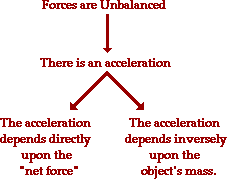
Newton's second law of
motion pertains to the behavior of objects for which all existing forces are not
balanced. The second law states that the acceleration of an object is dependent
upon two variables - the net
force acting upon the object and the mass of the
object. As learned in the "The Rocket Simulation" Lab, the
acceleration of an object depends directly upon the net force acting upon the
object, and inversely upon the mass of the object. As the force of propulsion
acting upon the rocket-chair increased, the acceleration of the rocket-chair
increased. As the mass of the rocket-chair increased, the acceleration of the
rocket-chair decreased.
Newton's second law of
motion can be formally stated as follows:
The
acceleration of an object as produced by a net force is directly proportional
to the magnitude of the net force, in the same direction as the net force, and
inversely proportional to the mass of the object.
In
terms of an equation, the net force is equated to the product of the mass times
the acceleration.
 Fnet = m * a
In
this entire discussion, the emphasis has been on the "net force." The
acceleration is directly proportional to the "net force;" the
"net force" equals mass times acceleration; the acceleration in the
same direction as the "net force;" an acceleration is produced by a
"net force." The NET FORCE. It is important to remember this
distinction. Do not use the value of merely "any 'ole force" in the
above equation; it is the net force which is related to acceleration. As discussed in an earlier lesson, the net force is the vector sum of all the forces. If all the
individual forces acting upon an object are known, then the net force can be determined..
The above equation also indicates that a unit of force is equal to a
unit of mass times a unit of acceleration. By substituting standard metric
units for force, mass, and acceleration into the above equation, the following
unit equivalency can be written.
The
definition of the standard metric unit of force is stated by the above
equation. One Newton is defined as the amount of force required to give a 1-kg mass an
acceleration of 1 m/s/s.
Newton's second law provides
the explanation for the behavior of objects upon which the forces do not
balance. The law states that unbalanced forces cause objects to accelerate with
an acceleration which is directly proportional to the net force and inversely
proportional to the mass.
Newton's Third Law of Motion
Newton's Third
Law
A
force is a push or a pull upon an object which results from its interaction
with another object. Forces result from interactions! As discussed in a
previous section some forces result from contact
interactions (normal, frictional, tensional, and applied forces are
examples of contact forces) and other forces are the result of
action-at-a-distance interactions (gravitational, electrical, and magnetic
forces). According to Newton, whenever objects A and B interact with each other, they exert forces
upon each other. When you sit in your chair, your body exerts a downward force
on the chair and the chair exerts an upward force on your body. There are two
forces resulting from this interaction - a force on the chair and a force on your
body. These two forces are called action
and reaction forces and are the
subject of Newton's third law of motion. Formally stated, Newton's third law is:
"For
every action, there is an equal and opposite reaction."
The statement
means that in every interaction, there is a pair of forces acting on the two
interacting objects. The size of the forces on the first object equals
the size of the force on the second object. The direction of the force on the
first object is opposite to the direction of the force on the second
object. Forces always come in pairs - equal and opposite action-reaction
force pairs.
A
variety of action-reaction force pairs are evident in nature. Consider the
propulsion of a fish through the water. A fish uses its fins to push water
backwards. But a push on the water will only serve to accelerate the water. In
turn, the water reacts by pushing the
fish forwards, propelling the fish through the water. The size of the force on
the water equals the size of the force on the fish; the direction of the force
on the water (backwards) is opposite the direction of the force on the fish
(forwards). For every action, there is an equal (in size) and opposite (in
direction) reaction force. Action-reaction force pairs make it possible for
fish to swim.
Consider
the flying motion of birds. A bird flies by use of its wings. The wings of a
bird push air downwards. In turn, the air reacts by pushing the bird upwards.
The size of the force on the air equals the size of the force on the bird; the
direction of the force on the air (downwards) is opposite the direction of the
force on the bird (upwards). For every action, there is an equal (in size) and
opposite (in direction) reaction. Action-reaction force pairs make it possible
for birds to fly.
Consider
the motion of your automobile to school. An automobile is equipped with wheels
which spin backwards. As the wheels spin backwards, they push the road
backwards. In turn, the road reacts by pushing the wheels forward. The size of
the force on the road equals the size of the force on the wheels (or
automobile); the direction of the force on the road (downwards) is opposite the
direction of the force on the wheels (upwards). For every action, there is an
equal (in size) and opposite (in direction) reaction. Action-reaction force
pairs make it possible for automobiles to move.
Check Your
Understanding
Read
the following questions and predict the answer.
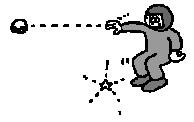
1. Imagine
a place in the cosmos far from all
gravitational and frictional influences. Suppose that an astronaut in that
place throws a rock. The rock will
a.
gradually stop.
b.
continue in motion in the
same direction at constant speed.
2. An 2-kg object is moving horizontally with a speed of 4 m/s. How much
net force is required to keep the object moving at this speed and in this
direction?
3.
Carls and Berg are arguing in the cafeteria. Carls says that if he flings the
jello with a greater speed it will have a greater inertia. Berg argues that
inertia does not depend upon speed, but rather upon mass. Who do you agree
with? Explain why.
4. If
you were in space in a weightless
environment, would it require a force to set an object in motion?
5.
Mr. Wegley spends most Sunday afternoons at rest on the sofa, watching pro
football games and consuming large quantities of food. What effect (if any)
does this practice have upon his inertia? Explain.
6. Ben Tooclose is being chased through the woods by a bull moose which he was
attempting to photograph. The enormous mass of the bull moose is extremely
intimidating. Yet, if Ben makes a zigzag pattern through the woods, he will be
able to use the large mass of the moose to his own advantage. Explain this in
terms of inertia and Newton's first law of motion.
 7. Two bricks are resting on edge of the lab table. Shirley Sheshort
stands on her toes and spots the two bricks. She acquires an intense desire to
know which of the two bricks are most massive. Since Shirley is vertically
challenged, she is unable to reach high enough and lift the bricks; she can
however reach high enough to give the bricks a push. Discuss how the process of
pushing the bricks will allow Shirley to determine which of the two bricks is
most massive. What difference will Shirley observe and how can this observation
lead to the necessary conclusion?
7. Two bricks are resting on edge of the lab table. Shirley Sheshort
stands on her toes and spots the two bricks. She acquires an intense desire to
know which of the two bricks are most massive. Since Shirley is vertically
challenged, she is unable to reach high enough and lift the bricks; she can
however reach high enough to give the bricks a push. Discuss how the process of
pushing the bricks will allow Shirley to determine which of the two bricks is
most massive. What difference will Shirley observe and how can this observation
lead to the necessary conclusion?
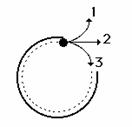
8.
The physics teachers are taking some time off for a little putt-putt golf. The
15th hole at the Hole-In-One Putt-Putt Golf Course has a large metal rim which
putters must use to guide their ball towards the hole. Mr. Schmidgall guides a
golf ball around the metal rim When the ball leaves the rim, which path (1, 2,
or 3) will the golf ball follow?
9. A
4.0-kg object is moving across a friction-free surface with a constant velocity
of 2 m/s. Which one of the following horizontal forces is necessary to maintain
this state of motion?
|
a.
0 N
|
b.
0.5 N
|
c.
2.0 N
|
d.
8.0 N
|
|
e.
depends on the speed.
|
10
Luke Autbeloe drops a 5.0 kg box of shingles (weight = ~50.0 N) off the barn
house roof into a haystack below. Upon encountering the haystack, the box of
shingles encounters a 50.0 N upward restraining force. Use this description to
answer the following questions..
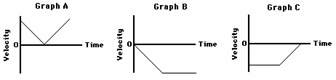
a.
Which one of the
velocity-time graphs best describes the motion of the shingles? Support your
answer with sound reasoning.
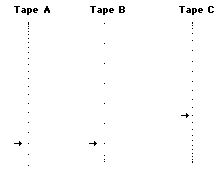
b. Which one of the following ticker tapes best
describes the motion of the falling shingles from the time that they are
dropped to the time that they hit the ground? The arrows on the diagram
represent the point at which the shingles hit the haystack. Support your answer
with sound reasoning.
c. Several of Luke's friends were watching the motion of the falling
shingles. Being "physics types", they began discussing the motion and
made the following comments. Indicate whether each of the comments are correct
or incorrect? Support your answers.
c.
Once the shingles hit the
haystack, the forces are balanced and the shingles will stop.
d.
Upon hitting the haystack,
the shingles will accelerate upwards because the haystack applies an upward
force.
e.
Upon hitting the haystack,
the shingles will bounce upwards due to the upwards force.
11.
If the forces acting upon an object are balanced, then the object
f.
must not be moving.
g.
must be moving with a
constant velocity.
h.
must not be accelerating.
i.
none of these
12.
Complete the following table showing the relationship between mass and weight.
|
Object
|
Mass
(kg)
|
Weight
(N)
|
|
Melon
|
1
kg
|
|
|
Apple
|
|
0.98
N
|
|
Pat
Eatladee
|
25
kg
|
|
|
Fred
|
|
980
N
|
13.
Different masses are hung on a spring scale calibrated in Newtons.
j.
The force exerted by gravity
on 1 kg = 9.8 N.
k.
The force exerted by gravity
on 5 kg = ______ N.
l.
The force exerted by gravity
on _______ kg = 98 N.
m.
The force exerted by gravity
on 70 kg = ________ N.
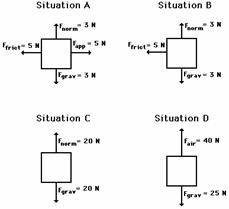
14. Free-body diagrams for four situations are
shown below. The net force is known for each situation. However, the magnitudes
of a few of the individual forces are not known. Analyze each situation individually
and determine the magnitude of the unknown forces. Then depress the mouse on
the pop-up menu to view the answers.
 15. Free-body diagrams for four situations are shown below. For each
situation, determine the net force acting upon the object.
15. Free-body diagrams for four situations are shown below. For each
situation, determine the net force acting upon the object.
16.
What acceleration will result when a 12-N net force applied to a 3-kg object? A
6-kg object?
17. A
net force of 16 N causes a mass to accelerate at a rate of 5 m/s2.
Determine the mass.
18.
An object is accelerating at 2 m/s2. If the net force is tripled and
the mass is doubled, then what is the new acceleration?
19.
An object is accelerating at 2 m/s2. If the net force is tripled and
the mass is halved, then what is the new acceleration?
20.
While driving down the road, Anna Litical observed a bug striking the
windshield of her car. Quite obviously, a case of Newton's third law of
motion. The bug hit the windshield and the windshield hit the bug. Which of the
two forces is greater: the force on the bug or the force on the windshield?
21.
Rockets are unable to accelerate in space because ...
n.
there is no air in space for
the rockets to push off of.
o.
there is no gravity is in
space.
p.
there is no air resistance
in space.
q.
... nonsense! Rockets do
accelerate in space.
22. A
gun recoils when it is fired. The recoil is the result of action-reaction force
pairs. As the gases from the gunpowder explosion expand, the gun pushes the bullet forwards and the bullet
pushes the gun backwards. The
acceleration of the recoiling gun is ...
r.
greater than the
acceleration of the bullet.
s.
smaller than the
acceleration of the bullet.
t.
the same size as the
acceleration of the bullet.
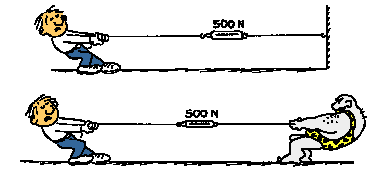
23. In the top picture, a physics student is pulling upon a rope which
is attached to a wall. In the bottom picture, the physics student is pulling
upon a rope which is held by the Strongman. In each case, the force scale reads
500 Newtons. The physics student is pulling
a.
with more force when the
rope is attached to the wall.
b.
with more force when the
rope is attached to the Strongman.
c.
the same force in each case.