VECTORS
http://www.physics.uoguelph.ca/tutorials/vectors/vectors.html
The reason
for this introduction to vectors is that many concepts in science, for example,
displacement, velocity, force, acceleration, have a size or magnitude, but also
they have associated with them the idea of a direction. And it is obviously
more convenient to represent both quantities by just one symbol. That is the vector.
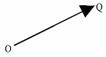 Graphically, a vector is represented
by an arrow, defining the direction, and the length of the arrow defines the
vector's magnitude..
Graphically, a vector is represented
by an arrow, defining the direction, and the length of the arrow defines the
vector's magnitude..
If we
denote one end of the arrow by the origin O and the tip of the arrow by Q. Then
the vector may be represented algebraically by OQ.
This is
often simplified to just Q or Q.
The line
and arrow above the Q are there to indicate that the symbol represents a
vector. Another notation is boldface type as:Q.
The
magnitude of a vector is denoted by absolute value signs around the vector
symbol: magnitude of Q = |Q|.
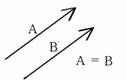 The operation of addition,
subtraction and multiplication of ordinary algebra can be extended to vectors
with some new definitions and a few new rules. There are two fundamental
definitions.
The operation of addition,
subtraction and multiplication of ordinary algebra can be extended to vectors
with some new definitions and a few new rules. There are two fundamental
definitions.
1) Two vectors,A and B are equal if they have the same magnitude and direction,
regardless of whether they have the same initial points.
 2)
A vector having the same magnitude as A
but in the opposite direction to A
is denoted by -A ,
2)
A vector having the same magnitude as A
but in the opposite direction to A
is denoted by -A ,
ADDITION
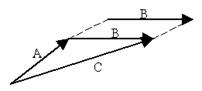
The sum of two vectors, A and B, is a vector C, which
is obtained by placing the initial point of B on the final point of A,
and then drawing a line from the initial point of A to the final point of B
.
The operation of vector addition as described
here can be written as C = A + B
SUBTRACTION
Vector
subtraction is defined in the following way. The difference of two vectors, A - B , is a vector C , C = A - B
or C = A + (-B).Thus vector
subtraction can be represented as a vector addition.
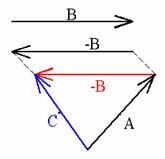
The graphical representation
is shown below. Inspection of the graphical representation shows that we place
the initial point of the vector -B
on the final point the vector A ,
and then draw a line from the initial point of A to the final point of -B.
MULTIPLICATION BY A SCALAR
Any
quantity which has a magnitude but no direction associated with it is called a "scalar". For example, speed,
mass and temperature.
The product
of a scalar, m say, times a vector A
, is another vector, B, where B has the same direction as A but
|B| = m|A|.
UNIT VECTOR
Vectors can
be related to the basic coordinate systems which we use by the introduction of
what we call unit vectors.
 A unit vector is one which has a
magnitude of 1 and is often indicated by putting a hat on top of the vector
symbol, for example UNIT VECTOR = a
is read as "a hat" or "a unit".
A unit vector is one which has a
magnitude of 1 and is often indicated by putting a hat on top of the vector
symbol, for example UNIT VECTOR = a
is read as "a hat" or "a unit".
COMPONENTS OF AVECTOR
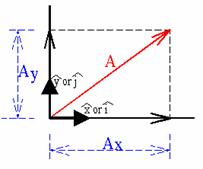
Let us consider
the two-dimensional Cartesian Coordinate System. We can define a unit vector in
the x-direction by i; Similarly in
the y-direction we use j. Any
two-dimensional vector can now be represented by employing multiples of the
unit vectors,
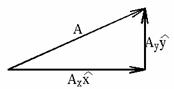 The vector A can be represented algebraically by A = Ax + Ay. Where Ax and Ay
are vectors in the x and y directions. If Ax and Ay are
the magnitudes of Ax and Ay, then Axi and Ayj are the vector components of A
in the x and y directions respectively
The vector A can be represented algebraically by A = Ax + Ay. Where Ax and Ay
are vectors in the x and y directions. If Ax and Ay are
the magnitudes of Ax and Ay, then Axi and Ayj are the vector components of A
in the x and y directions respectively
RESOLVING A VECTOR
The
breaking up of a vector into its component parts is known as resolving a vector. Notice that the
representation of A by it's
components is not unique. Depending on the orientation of the coordinate system
with respect to the vector in question, it is possible to have more than one
set of components.
 It is perhaps easier to understand
this by having a look at an example.
It is perhaps easier to understand
this by having a look at an example.
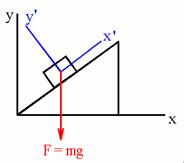
Consider an object of mass, M, placed on a
smooth inclined plane, as shown in Panel 10 . The gravitational force acting on
the object is
F = mg where g is the
acceleration due to gravity.
In the unprimed coordinate system, the vector F can be written as
F= - Fy.j
but in the primed coordinate system : F= -Fxi - Fyj
Which representation to use will depend on the
particular problem that you are faced with.
MULTIPLICATION OF VECTORS
 The multiplication of two vectors,
is not uniquely defined, in the sense that there is a question as to whether
the product will be a vector or not. For this reason there are two types of vector
multiplication.
The multiplication of two vectors,
is not uniquely defined, in the sense that there is a question as to whether
the product will be a vector or not. For this reason there are two types of vector
multiplication.
- First, the scalar or dot product of
two vectors, which results in a scalar.
- And secondly, the vector or cross product
of two vectors, which results in a vector.
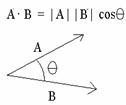
The scalar
product of two vectors, A and B denoted by A·B, is defined as the product of the magnitudes of the vectors
times the cosine of the angle between them.
Note that
the result of a dot product is a scalar, not a vector.
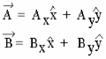
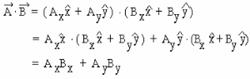
The definition of the scalar
product given earlier, required a knowledge of the magnitude of A and B , as well as the angle of the two vectors. If we are given the
vectors in terms of a Cartesian representation, that is, in terms of i and j we
can use the information to work out the scalar product, without having to
determine the angle between the vectors.
Check, by your own, the next web sites:
http://www.physics.uoguelph.ca/applets/Intro_physics/Vector_Add/vectortest.htm
http://www.pa.uky.edu/~phy211/VecArith/index.html
http://www.glenbrook.k12.il.us/gbssci/phys/Class/vectors/u3l1b.html
ACTIVITIES
Determine
the magnitude and direction of the following vectors . Use the indicated scale
and a scale conversion to determine the magnitude.
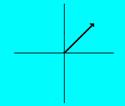 1.
Given the SCALE: 1 cm = 10 m/s, determine the magnitude and direction of this
vector.
1.
Given the SCALE: 1 cm = 10 m/s, determine the magnitude and direction of this
vector.
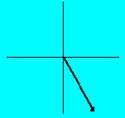 2.
Given the SCALE: 1 cm = 50 km/hr, determine the magnitude and direction of this
vector.
2.
Given the SCALE: 1 cm = 50 km/hr, determine the magnitude and direction of this
vector.
3. Given the
SCALE: 1 cm = 10 m/s, determine the magnitude and direction of this vector.
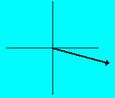
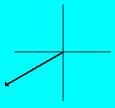 4. Given the SCALE: 1 cm = 50 km/hr,
determine the magnitude and direction of this vector.
4. Given the SCALE: 1 cm = 50 km/hr,
determine the magnitude and direction of this vector.
Do the next
exercises:
1. Add the following vectors and determine the resultant:
3.0 m/s, 45 deg and 5.0 m/s, 135 deg
2. Add the following vectors and determine the resultant.:
5.0 m/s, 45 deg and 2.0 m/s, 180 deg
3. Add the following vectors and determine the resultant.:
6.0 m/s, 225 deg and 2.0 m/s, 90 deg
4. Add the following vectors and determine the resultant:
4.0 m/s, 135 deg and 4.0 m/s, 315 deg
5. Add the following vectors and determine the resultant.:
5.0 m/s, 45 deg and 2.5 m/s, 135 deg
6. Add the following vectors and determine the resultant.: 7.0
m/s, 0 deg and 2.0 m/s, 90 deg
7. Add the following vectors and determine the resultant.:
8.0 m/s, 330 deg and 4.0 m/s, 45 deg
8. Add the
following vectors and determine the resultant.: 2.0 m/s, 150 deg and 4.0 m/s,
225 deg
9. Add the
following vectors and determine the resultant.: 3.0 m/s, 45 deg and 5.0 m/s,
135 deg and 2.0 m/s, 60 deg
10. Add the
following vectors and determine the resultant.: 2.0 m/s, 315 deg and 5.0 m/s,
180 deg and 2.0 m/s, 60 deg
11. Add the
following vectors and determine the resultant.: 4.0 m/s, 90 deg and 2.0 m/s, 0
deg and 2.0 m/s, 210 deg
12. Add the
following vectors and determine the resultant.: 2.5 m/s, 45 deg and 5.0 m/s,
270 deg and 5.0 m/s, 330 deg