Waves. Introduction
http://www.physicsclassroom.com/Class/waves/U10L1a.html
http://hyperphysics.phy-astr.gsu.edu/hbase/hph.html
Waves are everywhere in
nature. Our understanding of the physical world is not complete until we
understand the nature, properties and behaviours of waves.
Waves are small amplitude perturbations which
propagate through continuous media: e.g., gases, liquids, solids, or--in
the special case of electromagnetic waves--a vacuum. Wave motion is a
combination of oscillatory and translational motion. Waves are important
because they are the means through which virtually all information regarding
the outside world is transmitted to us. For instance, we hear things via sound
waves propagating through the air, and we see things via light waves. Now, the
physical mechanisms which underlie sound and light wave propagation are
completely different. Nevertheless, sound and light waves possesses a number of
common properties which are intrinsic to wave motion itself. In this section,
we shall concentrate on the common properties of waves, rather than
those properties which are peculiar to particular wave types.
Waves transport
energy and momentum through space without transporting matter.
Wave motion involves the
transfer of energy. The behaviour of this energy transfer varies with the
particular medium of transport and energy form. In general, vibrations
propagate in the form of waves. Mechanical waves travel in a material medium,
such as a string or a membrane. Acoustic waves travel in fluids, such as air or
water.
General Wave Properties
- Wave motion is initiated
by an energetic disturbance which subsequently travels through a medium
with a fixed velocity (for homogeneous media). This moving disturbance is
referred to as a traveling wave.
(SIMPLE HARMONIC MOTION: Click
here to find out more information about this type of motion)
Travelling Waves
Elasticity
and a source of energy are the preconditions for periodic
motion, and when the elastic object is an extended body, then the periodic
motion takes the form of traveling waves.
|
|
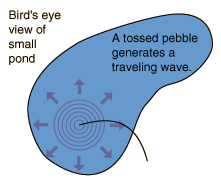
A pond
has an equilibrium level, and gravity serves as a restoring force. When work
is done on the surface to disturb its level, a transverse
wave is produced. |
|
|
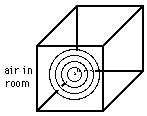
A disturbance of the air pressure produces a spherical traveling
pressure wave (sound).
A sound wave in air is a longitudinal
wave. |
- A wave propagates through
a medium via internal cohesive forces, though the medium itself is not
transported.

- A simple sinusoidal
disturbance of frequency f will produce periodic motion
with a wavelength given by l= v/f, where v is the wave speed of propagation. The
wavelength l represents the distance between
successive, periodic movements of a medium.
- The wave speed is
determined by the mass (or mass density) and elastic modulus (or tension)
of the medium in which it travels. A more ``massy'' material will have a
lower propagation speed. A ``stiffer'' material will have a higher speed
of propagation.
- Longitudinal Wave Motion: vibration of
particles in the medium is along the same direction as the wave motion.
Longitudinal
Waves
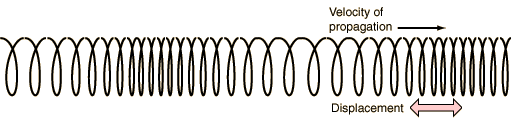
In longitudinal waves the displacement of the medium is parallel to the
propagation of the wave. A wave in a "slinky" is a good
visualization.
Sound
waves in air are longitudinal waves. A single-frequency sound wave
traveling through air will cause a sinusoidal pressure variation in the air.
The air motion which accompanies the passage of the sound wave will be back and
forth in the direction of the propagation of the sound, a characteristic of longitudinal
waves.

- Transverse Wave Motion: vibration of
particles in the medium is perpendicular to the direction of wave motion.
Transverse Waves
For transverse
waves the displacement of the medium is perpendicular to the direction of
propagation of the wave. A ripple
on a pond and a wave on
a string are easily visualized transverse waves.
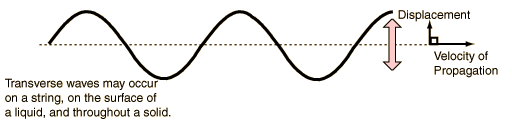
Transverse waves cannot propagate in a gas or a liquid because there is no mechanism for driving motion perpendicular to the propagation of the wave.
- Sound waves are
longitudinal disturbances that travel in a solid, liquid, or gas.
- The speed of sound in air
is approximately given by v = 331.3 + 0.6 t
(meters / second), where t is the
temperature of the air in degrees Celsius. A value of 345 meters / second
is a good estimate at room temperature.
The speed
of a wave is determined by the medium. In general the speed of the wave can be
thought of as being dependent on two properties of the medium
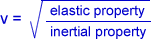
For a
string the speed is given by

where T is
the tension in the string and m is the mass/ lengyh of the
string.
The speed
of sound waves in a medium depends on the compressibility and mass density of
the medium. The speed of sound can be calculated from the bulk modulus, B, and
the density r. (The bulk modulus is a measure of resistance to
change in volume of a solid or liquid.

The speed
of sound in air is about 343 at 20 degrees C and 1 atm pressure. As the
temperature increases the speed of sound in air tends to increase according to
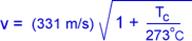
Periodic waves
bohr.physics.hku.hk/academic/
courses/phys2222/Chap2c.ppt
If one end
of a long taut string is shaken back and forth in periodic motion, then a periodic
wave is generated. If a periodic wave is travelling along a taut string or any
other medium, each point along the medium oscillates with the same period.
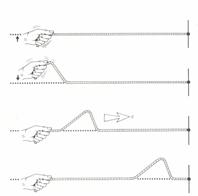 One-dimensional waves
The essential aspect of a
propagating wave is that it is a self-sustaining disturbance of the medium
through which it travels. For example, a pulse travels along a stretched
string, as shown in figure.
 Wave
is a function of both position and time, and thus it can be written,
Wave
is a function of both position and time, and thus it can be written,

 Represents the shape or profile of the wave at
t=0.
Represents the shape or profile of the wave at
t=0.
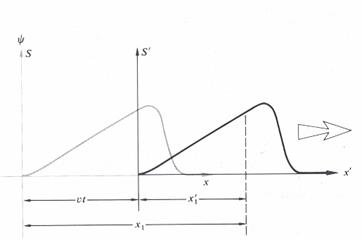
Figure at
right is a “double exposure” of a
disturbance taken at the beginning and at time t.
Introduce
a coordinate system S’, which travels along with the pulse at the speed v. In this system, Y is no longer a function of
time. As we move along with S’ we see a
stationary profile with the same functional form as previous equation. Here the
coordinate is x’, so that
Y= f (x´); with x´= x- vt
 Y = f(x-vt)
It represents
the most general form of the one-dimensional wave function, traveling in the
positive x direction.
Similarly,
if the wave were traveling in the negative x-direction, the equation would
become Y =
f(x+vt)
We may
conclude therefore that, regardless of the shape of the disturbance, the
variables x and t must appear in the function as a unit, i.e., as a single
variable in the form Y =
f(x±vt)
Harmonic waves
The
simplest wave form is a sine or cosine wave, that is called harmonic wave. The profile is
Y(x,t)t=o=Y(x)= A sin kx = f(x)
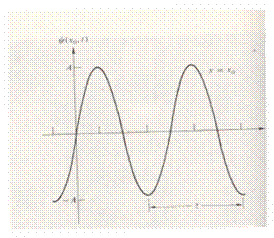 Where k is a
positive constant known as the propagation number or
wave numbrr. A is known
as the amplitude of the wave
Replace x with x-vt, we have a progressive wave traveling to the
positive x-direction with a speed of v: Y(x,t) =A sin k(x- vt)
Where k is a
positive constant known as the propagation number or
wave numbrr. A is known
as the amplitude of the wave
Replace x with x-vt, we have a progressive wave traveling to the
positive x-direction with a speed of v: Y(x,t) =A sin k(x- vt)
Holding
either x or t fixed results in a sinusoidal disturbance, so the wave is
periodic in both space and time. The spatial period is the wave length and is denoted by l . The temporal period is the
amount of time it takes for one complete wave to pass a stationary observer and
is denoted as T .
From the
definition of T and l we have:

 The inverse of the period is called the frequency f, which is the number of cycles per unit of
time. Thus
The inverse of the period is called the frequency f, which is the number of cycles per unit of
time. Thus
 Angular frequency, w, is defined as the number of radians per unit
of time. Thus
Angular frequency, w, is defined as the number of radians per unit
of time. Thus

The harmonic wave can also be
written as
The most general harmonic wave
equation is

The whole quantity in the bracket
is called the phase, f,
with e the initial phase.
The wavelength and the period
describe aspects of the repetitive nature of a wave in space and time. These concepts are equally well applied to waves
that are not harmonic, as long as each wave profile is made up of a regularly
repeating pattern.
The harmonic wave function is doubly periodic
Equation
describes a pattern of motion
which is periodic in both space and time
TIME
PERIODICITY
The
wave pattern is periodic in time, y(x,t
+nT)= y(x,t) with period T= 2p/w
The
wave period is the oscillation period of the wave disturbance at a given point
in space. The wave frequency (i.e., the number of
cycles per second the wave pattern executes at a given point in space) is
written f= 1/T= w/2p
The quantity w is termed the angular
frequency of the wave. Finally, at any given point in space, the
displacement y oscillates between + y0
and - y0 (since the
maximal values of sin q are ±). Hence, y0 corresponds to the wave amplitude.
The particle vibrates with the
same equation at the instants t, t+T, t+2T……
SPACE
PERIODICITY
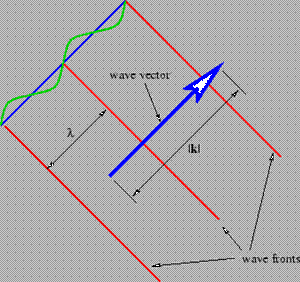 The wave pattern is periodic in space, y(x+ nl,t)= y(x,t) with
periodicity length l= 2p/k
The wave pattern is periodic in space, y(x+ nl,t)= y(x,t) with
periodicity length l= 2p/k
Here, l is known as the wavelength,
whereas k is known as the wavenumber.
The vibration´s state for the
particles at x, x+ l, x+2 l,... is the same.
Consequences:
-
Two points on a wave separated by nl are in phase.Two points on a wave with the same phase
have the same ...
o
quantity of disturbance (displacement, etc.)
o
rate of change of disturbance (velocity, etc.).
-
The wave fronts are constant phase surfaces separated by
one wavelength. The wave vector is normal to the wave fronts and its length is
the wavenumber.
When you throw a
pebble in a pond, it makes waves on the surface that move out from the place
where the pebble entered the water. The waves are largest where they are formed
and gradually get smaller as they move away. This decrease in size, or amplitude, of
the waves is called attenuation. Seismic waves also become attenuated as
they move away from the earthquake source.
The energy of a
wave is related to its amplitude : Em= ½ kA2= ½ mw2A2= ½ m4p2f2A2=2mp2f2A2
So that, E µ A2
E is the energy of
the wave.
A is the amplitude of the wave.
Intensity is defined as the rate of flow of
energy through unit area perpendicular to the direction of travel of the wave
at the place in question. It can be thought of as an energy flux. For
the intensity at a point A due to a source of spherical waves,
|
I = |
E s.t |
= |
P 4 pr2 |
µ |
A02 r2 |
I is the intensity
at point A.; and P is the power emanated by the source.
r is the distance between the source and point A.
A0 is the amplitude of waves that have just been emitted
from the source. (A.r= cte)
A consequence of the above relations is that as waves
spread out from a source, their amplitude naturally decreases.
Absorption
So far we have tacitly assumed that wave energy remains as wave energy, and
is not converted to any other form. If this was true, then the world would
become more and more full of sound waves, which could never escape into the
vacuum of outer space. In reality, any mechanical wave consists of a travelling
pattern of vibrations of some physical medium, and vibrations of matter always
produce heat, as when you bend a coat hangar back and forth and it becomes hot.
We can thus expect that in mechanical waves such as water waves, sound waves,
or waves on a string, the wave energy will gradually be converted into heat.
This is referred to as absorption.
The wave suffers a decrease in amplitude, as shown in figure. The
decrease in amplitude amounts to the same fractional change for each unit of
distance covered. That is, the reduction in amplitude is exponential.
Intensity decreases, exponentially, with the distance : I = I0e-br
Waves propagation:
Huygens´Principle
 Christian Huygen (1629-1695) is said to
have gained most of his insights into wave motion by observing waves in a
canal. Huygens was the first major proponent of the wave theory of
light. Huygens had a very important insight into the nature of wave propagation
which is nowadays called Huygens'
principle. When applied to the propagation of light waves, this
principle states that:
Christian Huygen (1629-1695) is said to
have gained most of his insights into wave motion by observing waves in a
canal. Huygens was the first major proponent of the wave theory of
light. Huygens had a very important insight into the nature of wave propagation
which is nowadays called Huygens'
principle. When applied to the propagation of light waves, this
principle states that:
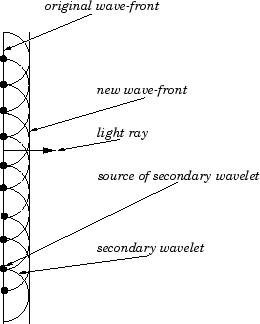
Every point on a wave front can be thought of as a new point source for
waves generated in the direction the wave is travelling or being propagated.
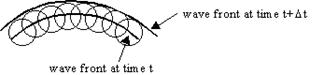
Every point on a wave-front may
be considered a source of secondary spherical wavelets which spread out in the
forward direction at the speed of light. The new wave-front is the tangential
surface to all of these secondary wavelets.
According to Huygens'
principle, a plane light wave propagates though free space at the speed of
light,  . The light rays
associated with this wave-front propagate in straight lines, as shown in the diagram
below. It is also fairly straightforward to account for the laws of reflection
and refraction using Huygens' principle.
. The light rays
associated with this wave-front propagate in straight lines, as shown in the diagram
below. It is also fairly straightforward to account for the laws of reflection
and refraction using Huygens' principle.
REFLECTION AND REFRACTION
Waves travel at a constant speed in a uniform
medium. A change in medium, or a change in the condition of a medium, will
usually result in a change in the speed of the wave.
A change in the speed of a wave results in a
corresponding change in wavelength. The frequency of the wave remains constant
once the wave has been generated. The
wavelength of a wave varies directly with the speed for any given frequency in
the same medium. l= v/f
Reflection of Sound
The process of wave reflection may be defined as the
return of all or part of a sound beam when it encounters the boundary between
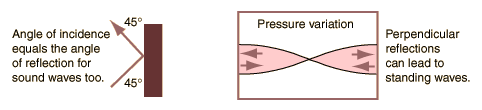
two media. The most important rule of reflection is that the angle of incidence is equal to the angle of reflection.
The reflection of sound follows the law "angle of
incidence equals angle of reflection", sometimes called the law of reflection. The same behavior
is observed with light and other waves, and by the bounce of a billiard ball
off the bank of a table. The reflected waves can interfere with incident waves,
producing patterns of constructive and destructive interference. This can lead
to resonances called standing waves in rooms. It also
means that the sound intensity near a hard surface is enhanced because the
reflected wave adds to the incident wave, giving a pressure amplitude that is
twice as great in a thin "pressure zone" near the
surface. This is used in pressure zone microphones to increase sensitivity. The
doubling of pressure gives a 6 decibel increase in the signal picked up by the
microphone. Reflection of waves in strings and air columns are essential to the
production of resonant standing waves in those systems.
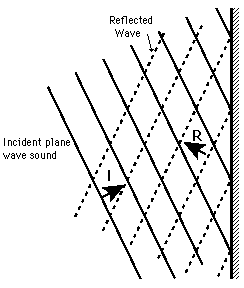
Plane
Wave Reflection
|
|
"The angle of incidence is equal to the angle
of reflection" is one way
of stating the law of reflection for light in a
plane mirror. Sound obeys the same law
of reflection . |
Point source of sound reflecting from a plane
surface.
|
|
When sound waves from a point source strike a plane
wall, they produce reflected circular wavefronts as if there were an
"image" of the sound source at the same distance on the other side
of the wall. If something obstructs the direct sound from the source from
reaching your ear, then it may sound as if the entire sound is coming from
the position of the "image" behind the wall. This kind of sound imaging
follows the same law of reflection as your image in
a plane mirror. |

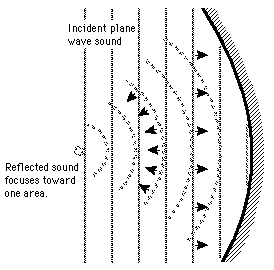
Reflection
from Concave Surface
|
Any concave surface will tend to focus the sound waves
which reflect from it. This is generally undesirable in auditorium acoustics
because it produces a "hot spot" and takes sound energy away from
surrounding areas. Even dispersion of sound is desirable in auditorium
design, and a surface which spreads sound is preferable to one which focuses
it. |
|
Refraction of Sound
Refraction is the change in direction of
a wave due to a change in velocity. It happens when
waves travel from a medium with a given refractive
index to a medium with another. At the boundary between the media the wave
changes direction, its wavelength increases or
decreases but frequency remains constant.
For example, a light ray will refract as it passes
through glass; understanding of this
concept led to the invention of the refracting
telescope.
The law of
refraction states: v2senai=v1senar
Refraction is the bending of waves when they enter a
medium where their speed is different. Refraction is not so important a
phenomena with sound as it is with light where it is responsible for image formation by lenses, the eye, cameras, etc. But bending of sound waves does occur
and is an interesting phenomena in sound

These visualizations may help in understanding the
nature of refraction. A column of troops approaching a medium where their speed
is slower as shown will turn toward the right because the right side of the
column hits the slow medium first and is therefore slowed down. The marchers on
the left, perhaps oblivious to the plight of their companions, continue to
march ahead full speed until they hit the slow medium.
Not only does the direction of march change, the
separation of the marchers is decreased. When applied to waves, this implies
that the direction of propagation of the wave is deflected toward the right and
that the wavelength of the wave is decreased. From the basic wave relationship, v=fl, it is clear that a slower
speed must shorten the wavelength since the frequency of the wave is determined
by its source and does not change.
Another visualization of refraction can come from the
steering of various types of tractors, construction equipment, tanks and other
tracked vehicle. If you apply the right brake, the vehicle turns right because
you have slowed down one side of the vehicle without slowing down the other.
Diffraction of Sound
 Diffraction: the
bending of waves around small* obstacles and the spreading out of waves beyond
small* openings.
Diffraction: the
bending of waves around small* obstacles and the spreading out of waves beyond
small* openings.
(* small compared to the
wavelength)
Diffraction is a wave phenomenon: the
apparent bending and spreading of waves when they meet an obstruction.
Diffraction occurs with electromagnetic waves, such as light and radio
waves, and also in sound waves and water waves. Diffraction
also occurs when any group of waves of a finite size is propagating; for
example, a narrow beam of light waves from a laser must, because of
diffraction of the beam, eventually diverge into a wider beam at a sufficient
distance from the laser. It is the diffraction of "particles", such
as electrons, which stood as one of the powerful arguments in favor of quantum
mechanics.
It is
mathematically easier to consider the case of far-field or Fraunhofer
diffraction, where the diffracting obstruction is many
wavelengths distant from the point at which the wave is measured. The more
general case is known as near-field or Fresnel
diffraction, and involves more complex mathematics. As the
observation distance in increased the results predicted by the Fresnel theory
converge towards those predicted by the simpler Fraunhofer theory.
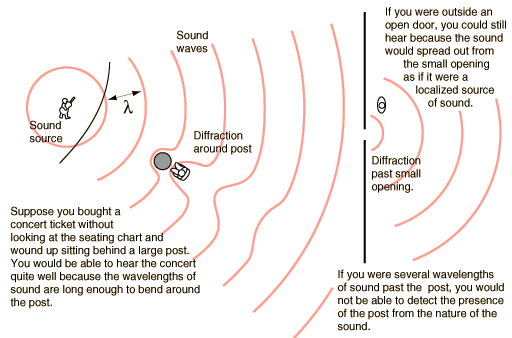
Important parts of our experience with sound involve
diffraction. The fact that you can hear sounds around corners and around
barriers involves both diffraction and reflection of sound. Diffraction in such
cases helps the sound to "bend around" the obstacles. The fact that
diffraction is more pronounced with longer wavelengths implies that you can
hear low frequencies around obstacles better than high frequencies, as
illustrated by the example of a marching band on the street.
Another common example of diffraction is the contrast in sound from a close
lightning strike and a distant one. The thunder from a close bolt of lightning
will be experienced as a sharp crack, indicating the presence of a lot of high
frequency sound. The thunder from a distant strike will be experienced as a low
rumble since it is the long wavelengths which can bend around obstacles to get
to you. There are other factors such as the higher air absorption of high
frequencies involved, but diffraction plays a part in the experience.
You may perceive diffraction to have a dual nature,
since the same phenomenon which causes waves to bend around obstacles causes
them to spread out past small openings. This aspect of diffraction also has
many implications. Besides being able to hear the sound when you are outside
the door as in the illustration above, this spreading out of sound waves has
consequences when you are trying to soundproof a room. Good soundproofing
requires that a room be well sealed, because any openings will allow sound from
the outside to spread out in the room - it is surprising how much sound can get
in through a small opening. Good sealing of loudspeaker cabinets is required
for similar reasons.
Another implication of diffraction is the fact that a
wave which is much longer than the size of an obstacle, like the post in the
auditorium above, cannot give you information about that obstacle. A
fundamental principle of imaging is that you cannot see an object which is
smaller than the wavelength of the wave with which you view it. You cannot see
a virus with a light microscope because the virus is smaller than the
wavelength of visible light. The reason for that limitation can be visualized
with the auditorium example: the sound waves bend in and reconstruct the
wavefront past the post. When you are several sound wavelengths past the post,
nothing about the wave gives you information about the post. So your experience
with sound can give you insights into the limitations of all kinds of imaging
processes.
Interference of
waves
In contrast to refraction, interference can only be naturally explained
by thinking of light as waves. Consider two waves meeting as shown in the
Figure below:
|
Interference of waves |
|
|


For constructive
interference, the waves meet in phase,
i.e. so that the crests of each wave coincide.
In destructive interference, the
waves meet out of phase, so that the crest of one wave coincides with a trough
of the other wave, and they cancel each other out.
This
readily explains the double slit interference pattern of Figure. The two light
rays start off in phase since they come from the same source. By the time they
reach the screen after having been diffracted through the slits, they have
travelled different distances, so that the crests of the ray that travels
further (the bottom ray in Figure lag a little behind those of the top ray. If
they lag behind by a half a wave length, the crest of one ray will meet the
trough of the other at the screen, and destructive interference will naturally
result.
On the other hand if one ray lags behind by a full
wavelength (or two or three full wavelengths, etc.) a crest will still meet
a crest at the screen, and a bright spot will appear due to constructive
interference.
Principle of superposition
When two
or more waves overlap, the resultant wave is the algebraic sum of the
individual waves
Mathematically,
when there are two pulses on the string, the total wave function is the
algebraic sum of the individual functions.
Superposition
is a characteristic and unique property of wave motion. There is no analogous
situation in Newtonian particle motion; that is, two Newtonian particles never
overlap or add together in this way.
Interference of two pulses


 ;
; 
Consequences:
-
Constructive
interference: same phase
o

-
Destructive
interference: opposite phase
o

Interference of two harmonic waves (same A, same frequency and same wavelength)
The
phenomenon of two or more waves of the same, or almost the same, frequency
superposing to produce an observable pattern in the intensity is called interference.
The
result of the superposition of two harmonic waves of the same frequency depends
on the phase difference between the waves.
If the
two waves are in phase, then the amplitude of the resultant wave is 2A. The
interference of two waves in phase is called constructive interference.
If the
two waves are 180º out of phase, then the amplitude of the resultant wave is 0.
This interference is called destructive interference.
A common
cause of a phase difference between two waves is different path lengths between
the sources of the waves and the point of interference.


Consequences:
-
Constructive
interference: MAXIMUM VALUES
o

-
Destructive
interference: NODES
o

Standing waves
If waves are confined in space, like the waves on a
piano string, sound waves in an organ pipe, or light waves in a laser, reflections
at both ends cause the waves to travel in both directions. These superposing
waves (same A, same frequency and opposite direction) interfere in accordance
with the principle of superposition. For a given string or pipe, there are
certain frequencies for which superposition results in a stationary vibration
pattern called a standing wave.
The necessary conditions for standing waves on a
string are:
-
Each point on the string either remains at rest or oscillates
with simple harmonic motion. (Those points remaining at rest are nodes).
-
The motions of any two points on the string that are
not nodes oscillate either in phase or 1780º out of phase.


Nodes: 
Distance between two nodes: l/2
Antinodes: 
Distance between
two antinodes: l/2
The distance
between a node and an adjacent antinode is l/4.
The Doppler Effect
If a wave source and a receiver are moving relative to
each other, the received frequency is not the same as the frequency of the
source. If they are moving closer together, the received frequency is greater
than the source frequency; and if they are moving farther apart, the received
frequency is less than the source frequency. This is called the Doppler Effect.
In the following discussion, all motions are relative
to the medium. Consider the source moving with speed us, shown in
the figure and a stationary receiver. The source has frequency fs
(and period Ts). The received frequency fr is: fr=
v/l (stationary receiver).
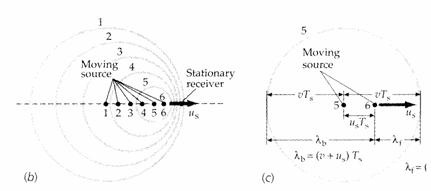
But to
find fr we need to find l. l= (v±us)Ts=
(v±us)/fs
When the receiver moves relative to the medium, the
received frequency is different simply because the receiver moves past more or fewer
wave crest in a given time. For a receiver moving with speed ur, let
Tr denote the time between arrivals of successive crests. Then, during the time
between the arrivals or two successive crest, each crest will have travelled a
distance v.Tr, and a during the same time, the receive have
travelled a distance ur.Tr.
We have fr= 1/Tr= (v±ur)/l
The correct choices for the plus or minus signs are
most easily determined by remembering that the frequency tends to increase both
when the source moves toward the receiver and when the receiver moves toward
the source. For example, if the receiver is moving toward the source the plus
sign is selected in the numerator, which tends to increase the received
frequency, and if the source is moving away from the receiver the plus sign is
selected in the denominator, which tends to decreased the received frequency.

Resonance
The amplitude, and therefore, the energy, of a system in
the steady state depends not only on the amplitude of the driving force, but
also on its frequency. The natural frequency of an oscillator w0, is itrs frequency
when non driving or damping forces are present. (In the case of a spring, w0= (k/m)1/2).
If the driving frequency is approximately equal to the natural frequency of the
system, the system will oscillate with a relatively large amplitude. This
phenomenon is called resonance. When
the driving frequency equals the natural frequency of the oscillator, the energy per cycle
transferred to the oscillator is maxium. The natural frequency of the system is
thus called the resonance frequency.
Summary
http://hypertextbook.com/physics/waves/periodic/
- Fundamentals
- A wave is a disturbance that propagates.
- A cycle is a sequence of events that repeats.
- A cycle is periodic if it repeats with a characteristic time.
- Characteristics
- Amplitude (A) is the maximum absolute value of a
periodically varying quantity.
- Amplitude
has the unit of the quantity that is changing (displacement, pressure,
field strength, etc.)
- Period (T) is the time between successive
cycles of a repeating sequence of events.
 (time
per number of cycles)
(time
per number of cycles) - The SI unit
of period is the second [s].
- Frequency (f) is the number of cycles of a
repeating sequence of events in a unit interval of time.
 (number
of cycles per time)
(number
of cycles per time) - Frequency
and period are reciprocals (or inverses) of one another:
 .
. - The SI unit
of frequency is the hertz
[Hz = 1/s = s-1].
- Phase (φ) is the stage of development of a
periodic process.
- Two points
on a wave with the same phase have the same ...
- quantity of
disturbance (displacement, etc.) and
- rate of
change of disturbance (velocity, etc.).
- Phase is an
angular quantity.
- Adjacent
points in phase are separated by one
complete cycle.
- Adjacent
points out of phase are separated by half a
cycle.
- The SI unit
of phase is the radian, which is itself a
unitless ratio
[rad = m/m = Pa/Pa = (V/m)/(V/m) = etc.].
- Wavelength (λ) is the distance between any point on a
periodic wave and the next point corresponding to the same portion of the
wave measured along the path of propagation.
- Wavelength
is measured between adjacent points in phase.
- The SI unit
of wavelength is the meter [m].
- Speed (v) is ...
 the
rate of change of distance with time by definition and
the
rate of change of distance with time by definition and  the
product of wavelength and frequency for periodic waves.
the
product of wavelength and frequency for periodic waves. - Frequency
and wavelength are inversely proportional.
- Lower frequency
waves have longer wavelengths.
- Higher frequency
waves have shorter wavelengths.
- The speed of
a wave is sometimes known as its wave speed
- The SI unit
of speed is the meter per second [m/s].
- One-Dimensional
Wave Equation

- A, amplitude
- f, frequency
- λ,
wavelength
- φ,
phase

- A, amplitude
- ω,
angular frequency

- k, wave
number

- φ,
phase
Where to find more information
http://farside.ph.utexas.edu/teaching/301/lectures/
http://hypertextbook.com/physics/waves/periodic/
http://www.physics.nmt.edu/~raymond/classes/ph13xbook/
http://www.wordiq.com/definition/Wave
http://www3.interscience.wiley.com:8100/legacy/college/cutnell/0471151831/concepts/cs/sim25.htm
http://www3.interscience.wiley.com:8100/legacy/college/cutnell/0471151831/concepts/