Physical Units
Mechanics is the branch of physics in which the basic
physical units are developed. The logical sequence is from the description of
motion to the causes of motion (forces and torques) and then to the action of
forces and torques. The basic mechanical
units are those of

All mechanical quantities can be expressed in terms of
these three quantities. The standard units are the Systeme Internationale or SI
units. The primary SI units for mechanics are the kilogram (mass), the meter
(length) and the second (time). However if the units for these quantities in
any consistent set of units are denoted by M, L, and T, then the scheme of
mechanical relationships can be sketched out.
Dimensional Analysis
Having the same units on both sides of an equation
does not guarantee that the equation is correct, but having different
units on the two sides of an equation certainly guarantees that it is wrong!
So it is good practice to reconcile units in problem solving as one check on
the consistency of the work. Units obey the same algebraic rules as numbers, so
they can serve as one diagnostic tool to check your problem solutions.
For example, in the solution for distance in constant acceleration motion, the distance is
set equal to an expression involving combinations of distance, time, velocity and acceleration. But the
combination of the units in each of the terms must yield just the unit of
distance, since the left hand side of the equation has the dimension of
distance.

Combinations of units pervade all of physics, and
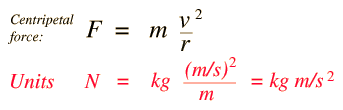
doing some analysis of the units is common practice. For example, in the case
of centripetal force, it is not immediately
evident that the quantity on the right has the dimensions of force, but it must. Checking it out:
Often the use of dimensional analysis can be helpful
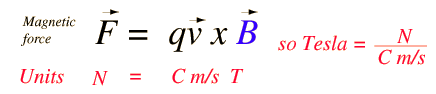
as a reminder of what specialized units contain. In the case of the magnetic force on a moving charge, the magnetic field unit is a Tesla.
But what is a Tesla? Checking out the force equation can remind you of the
combination of basic units that is contained in the unit named a Tesla.
A Comment on Significant Digits
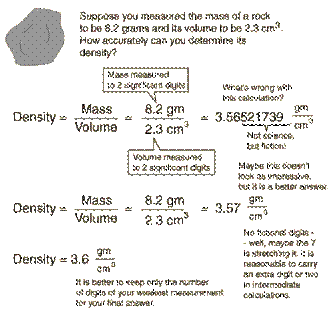
No measurements are exact, and it is important to
state experimental results with a number of significant digits which give a
reasonable impression of the accuracy of the measurement. Consider the following example of a measured density.
Relative Motion
The laws of physics which apply when you are at rest
on the earth also apply when you are in any reference frame which is moving at
a constant velocity with respect to the earth. For example, you can toss and
catch a ball in a moving bus if the motion is in a straight line at constant
speed.
The motion may have a different appearance as viewed
from a different reference frame, but this can be explained by including the relative velocity of the reference
frame in the description of the motion.
Position
Specifying the position of an object is essential in describing motion. In one dimension
some typical ways are

In two dimensions, either cartesian or polar
coordinates may be used, and the use of unit vectors is common. A
position vector r may be expressed in terms of the unit vectors.

In three dimensions, cartesian or spherical polar coordinates are
used, as well as other coordinate systems for specific
geometries.

The
vector change in position associated with a motion is called the displacement.
Displacement
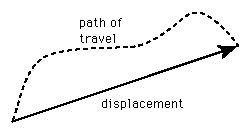
The displacement of an object
is defined as the vector distance from some
initial point to a final point. It is therefore distinctly different from the
distance travelled except in the case of straight line motion. The distance
travelled divided by the time is called the speed, while the displacement
divided by the time defines the average velocity.
|
|
If the positions of the initial
and final points are known, then the distance relationship can be used to
find the displacement. |
Velocity
The average speed of an object is defined as the
distance travelled divided by the time elapsed. Velocity is a vector quantity, and
average velocity can be defined as the displacement divided by the
time. For the special case of straight line motion in the x direction, the
average velocity takes the form:

The units for velocity can
be implied from the definition to be meters/second or in general any distance
unit over any time unit.
You can approach an expression for the instantaneous velocity
at any point on the path by taking the limit as the time interval gets smaller
and smaller. Such a limiting process is called a derivative and the
instantaneous velocity can be defined as

Average Velocity,
Straight Line
The average speed of an object is defined as the
distance travelled divided by the time elapsed. Velocity is a vector quantity, and
average velocity can be defined as the displacement divided by the
time. For the special case of straight line motion in the x direction, the
average velocity takes the form:

If the beginning and ending velocities for this motion are known, and the acceleration is constant, the average
velocity can also be expressed as

For this special case, these expressions give the same result.
Average Velocity,
General
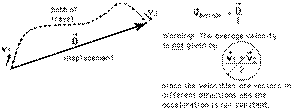 The average speed
of an object is defined as the distance travelled divided by the time elapsed.
Velocity is a vector quantity, and
average velocity can be defined as the displacement divided by the time.
For general cases involving non-constant acceleration, this definition must be
applied directly because the straight line average velocity expressions do not
work.
The average speed
of an object is defined as the distance travelled divided by the time elapsed.
Velocity is a vector quantity, and
average velocity can be defined as the displacement divided by the time.
For general cases involving non-constant acceleration, this definition must be
applied directly because the straight line average velocity expressions do not
work.
If
the positions of the initial and final points are
known, then the distance
relationship can be
used to find the displacement.
Instantaneous velocity
Now the idea of
average velocity is something that is fairly straightforward, but the idea of instantaneous
velocity is a little trickier. It really requires calculus to fully
appreciate, but hopefully you already know what a derivative is, so this
shouldn't be too hard.
Suppose the
velocity of the car is varying, because for example, you're in a traffic jam.
You look at the speedometer and it's varying a lot, all the way from zero to 60
mph. What is the instantaneous velocity? It is, more or less, what you read on
the speedometer. I'm assuming you've got a good speedometer that isn't too
sluggish and can change its reading quite quickly. Your speedometer is
measuring the the average velocity but one measured over quite a short time, to
ensure that you're getting an up to date reading of your velocity.
So if you
measure the displacement of the car  over a time
  ,
you can use that to determine the average velocity of the car. What we want is
to take the limit as goes
to zero. More formally, the instantaneous velocity v is defined as
,
you can use that to determine the average velocity of the car. What we want is
to take the limit as goes
to zero. More formally, the instantaneous velocity v is defined as

Most of the time
we'll be working with instantaneous velocity, so we'll just drop the instantaneous,
and call the above v the velocity.
To justify that
such a limit exists is something that you've hopefully had to grapple with
already. For physics problems, this limit does indeed exist and gives the
derivative:

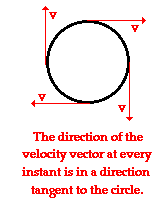 Velocity, being a
vector, has both a magnitude and a direction. The magnitude of the velocity
vector is merely the instantaneous speed of the object; the direction of the
velocity vector is directed in the same direction which the object moves. Since
an object is moving in a circle, its direction is continuously changing. At one
moment, the object is moving northward such that the velocity vector is
directed northward. One quarter of a cycle later, the object would be moving
eastward such that the velocity vector is directed eastward. As the object rounds
the circle, the direction of the velocity vector is different than it was the
instant before. So while the magnitude of the velocity vector may be constant,
the direction of the velocity vector is changing. The best word that can be
used to describe the direction of the velocity vector is the word tangential. The direction of the velocity
vector at any instant is in the direction of a tangent line drawn to the circle
at the object's location. (A tangent line is a line which touches the circle at
one point but does not intersect it.) The diagram at the right shows the
direction of the velocity vector at four different point for an object moving
in a clockwise direction around a circle. While the actual direction of the
object (and thus, of the velocity vector) is changing, it's direction is always
tangent to the circle.
Velocity, being a
vector, has both a magnitude and a direction. The magnitude of the velocity
vector is merely the instantaneous speed of the object; the direction of the
velocity vector is directed in the same direction which the object moves. Since
an object is moving in a circle, its direction is continuously changing. At one
moment, the object is moving northward such that the velocity vector is
directed northward. One quarter of a cycle later, the object would be moving
eastward such that the velocity vector is directed eastward. As the object rounds
the circle, the direction of the velocity vector is different than it was the
instant before. So while the magnitude of the velocity vector may be constant,
the direction of the velocity vector is changing. The best word that can be
used to describe the direction of the velocity vector is the word tangential. The direction of the velocity
vector at any instant is in the direction of a tangent line drawn to the circle
at the object's location. (A tangent line is a line which touches the circle at
one point but does not intersect it.) The diagram at the right shows the
direction of the velocity vector at four different point for an object moving
in a clockwise direction around a circle. While the actual direction of the
object (and thus, of the velocity vector) is changing, it's direction is always
tangent to the circle.
Tangential
acceleration:
A
vector tangent to the circular path whose magnitude is the rate of change of
tangential speed.
Centripetal Acceleration: Consider an object moving in a
circle of radius r with constant angular velocity. The tangential speed is constant, but the direction of
the tangential velocity vector
changes as the object rotates. Centripetal
acceleration is the rate of change of tangential velocity:
- The direction of the
centripital acceleration is always inwards along the radius vector of the
circular motion.
- The magnitude of the
centripetal acceleration is related to the tangential speed and angular
velocity as follows: ac= v2/R
In general, a particle moving in a circle experiences both angular
acceleration and centripetal accelaration. Since the two are always
perpendicular, by definition, the magnitude of the net acceleration a
total is: 
Relative Velocity
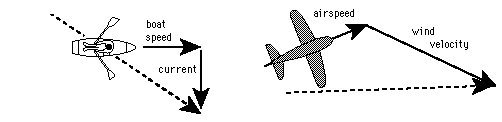
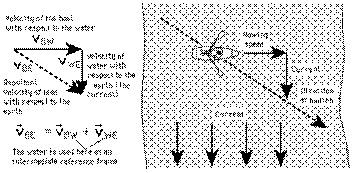
One must take into account relative velocities to
describe the motion of an airplane in the wind or a boat in a current.
Assessing velocities involves vector addition and a useful
approach to such relative velocity problems is to think of one reference frame
as an "intermediate" reference frame in the form:

Put into words, the velocity of A with respect to C is equal to the velocity of
A with respect to B plus the velocity of B with respect to C. Reference frame B
is the intermediate reference frame. This approach can be used with the airplane or boat examples.
Boat in Current
A boat in
current is a good example of relative velocity.
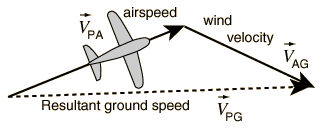
Airplane in Wind
The cross-country navigation
of an aircraft involves the vector addition of relative velocities since the
resultant ground speed is the vector sum of the airspeed and the wind velocity.
Using the air as the intermediate reference frame, ground speed can be
expressed as:
|
|
|

Acceleration
Acceleration is defined as the rate of change of velocity. Acceleration is
inherently a vector quantity, and an
object will have non-zero acceleration if its speed and/or direction is
changing. The average acceleration is given by

where the small arrows indicate the vector quantities. The operation of
subtracting the initial from the final velocity must be done by vector addition since they are
inherently vectors.
The units for acceleration
can be implied from the definition to be meters/second divided by seconds,
usually written m/s2.
The instantaneous acceleration at any time may be
obtained by taking the limit of the average acceleration as the time interval
approaches zero. This is the derivative of the velocity
with respect to time:

Description of
Motion in One Dimension
Motion is described in terms
of displacement (x), time (t), velocity (v), and acceleration (a). Velocity is
the rate of change of displacement and the acceleration is the rate of change
of velocity. The average velocity and average acceleration are defined by the
relationships:

|
|
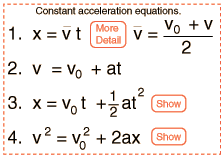
A bar above any quantity indicates that it is the
average value of that quantity. If the acceleration is constant, then
equations 1,2 and 3 represent a complete description of the motion. Equation
4 is obtained by a combination of the others. Click on any of the equations
for an example. |
Motion Graphs
Constant acceleration motion can be characterized by motion equations and by motion
graphs. The graphs of distance, velocity and acceleration as functions of time
below were calculated for one-dimensional motion using the motion equations in
a spreadsheet. The acceleration does change, but it is constant within a given
time segment so that the constant acceleration equations can be used. For
variable acceleration (i.e., continuously changing), then calculus methods must be used to
calculate the motion graphs.

A considerable amount of information about the motion can
be obtained by examining the slope of the various graphs. The slope of the
graph of position as a function of time is equal to the velocity at that time,
and the slope of the graph of velocity as a function of time is equal to the
acceleration.
The Slopes of
Motion Graphs
A considerable amount of information about the motion
can be obtained by examining the slope of the various motion graphs. The slope of the
graph of position as a function of time is equal to the velocity at that time,
and the slope of the graph of velocity as a function of time is equal to the
acceleration.

In this example where the initial position and
velocity were zero, the height of the position curve is a measure of the area
under the velocity curve. The height of the position curve will increase so
long as the velocity is constant. As the velocity becomes negative, the
position curve drops as the net positive area under the velocity curve
decreases. Likewise the height of the velocity curve is a measure of the area
under the acceleration curve. The fact that the final velocity is zero is an
indication that the positive and negative contributions were equal.
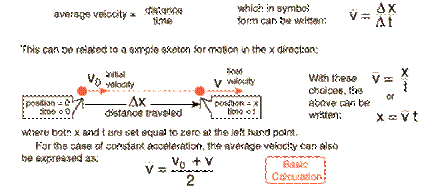
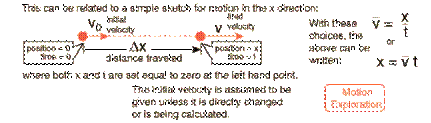
Distance, Average Velocity and Time
The case of motion in one
dimension (one direction) is a good starting point for the description of
motion. Perhaps the most intuitive relationship is that average velocity is
equal to distance divided by time:
Forms of Motion Equations

Calculus Application for Constant Acceleration
The motion equations for the case of constant acceleration can be developed by integration of the acceleration. The process can be reversed by taking successive derivatives.

On the left hand side above, the constant acceleration
is integrated to obtain the velocity. For this indefinite integral, there is a
constant of integration. But in this physical case, the constant of integration
has a very definite meaning and can be determined as an intial condition on the
movement. Note that if you set t=0, then v = v0, the initial value
of the velocity. Likewise the further integration of the velocity to get an
expression for the position gives a constant of integration. Checking the case
where t=0 shows us that the constant of integration is the initial position x0.
It is true as a general property that when you integrate a second derivative of
a quantity to get an expression for the quantity, you will have to provide the
values of two constants of integration. In this case their specific meanings
are the initial conditions on the distance and velocity.
Time Dependent
Acceleration
If the acceleration of an object is
time dependent, then calculus methods are required for motion analysis. The
relationships between position, velocity and acceleration
can be expressed in terms of derivatives or integrals.

Forms of Motion Equations

 Freefall
In the
absence of frictional drag, an object near the surface of the earth will fall
with the constant acceleration of gravity g. Position and speed at any time can
be calculated from the motion equations.
Illustrated
here is the situation where an object is released from rest. It's position and speed
can be predicted for any time after that. Since all the quantities are directed
downward, that direction is chosen as the positive direction in this case.