
Verán / Summer
|
||
|
Galego |
English |
|
|
O verán é unha época adicada a recoller as primeiras colleitas do ano. Faise a seitura e malla do cereal, cóllese a herba para conservala para o inverno e cóllense as patacas e os productos de horta. Tamén hai que mirar polo millo que xa está crecido e os animais. |
Summer is the time of the first harvests. It is the time for reaping and threshing cereal, harvesting hay for winter, picking potatoes and vegetables. It is also the time to look after the corn that is growing and the animals too. |
|
|
AA seitura |
The reaping | |
 |
Foto 1.
Segador.
A seitura é a sega do trigo
ou do centeo. Tiña lugar arredor do mes de xullo, cando o cereal
estaba maduro. Era un traballo colectivo, no que se podían empregar veciños ou
xornaleiros que formaban cuadrillas. Esta actividade consistía na corta
do cereal, o atado dos monllos e o transporte nun carro á eira.
Nesta fotografía podemos ver
a un dos segadores que corta o centeo cunha gadaña.
|
Picture 1. Reaper. The reaping of wheat or rye took place around July when the grain was ripe. It was a collectice work for neighbours and day labourers who formed groups. They had to real the cereal, tie the sheaves and the transport it in carts to the yard. In this picture we can see a reaper using a scythe. |
 |
Foto 2. Segador.
Nesta fotografía vemos a outro segador cun pano na cabeza para protexerse do sol. A seitura tiña lugar nunha soa xornada, de sol a sol, cando o tempo era seco para evitar que o cereal cortado podrecera coa humidade. |
Picture 2. Reaper. In this picture we can see another reaper with a handkerchief on his head to protect himself from the sun. The reaping took place in just one day, from sunrise to sunset, when the weather was dry so the cereal did not rot with humidity. |
 |
Foto 3. Segador.
Nesta fotografía vemos a outro segador que protexe a cabeza cun sombreiro de palla. Na man leva un feixe de centeo ou monllo. Ó rematar de segar, os monllos xúntanse e colócanse en medoucas ou montóns de forma cónica. As espigas colócanse cara o centro para protexelas da chuvia. |
Picture 3. Reaper. in this picture we can see another reaper protecting his head with a straw hat. He is carrying a sheave or "monllo" of rye. When they finished reaping, the sheaves were put together in "medoucas" or small conical heaps. The ears were placed to the inside so they were protected from the rain. |
 |
Foto 4. Mulleres levando cestos. |
Picture 4. Women carrying baskets. Apart from reaping, women were in charge of taking food and drink to the workers. In this picture we can see women carrying big baskets with the food. |
|
A malla |
The threshing | |
 |
Foto 5. Eira con horreo. A malla consistía na separación do gran da palla do cereal. Tiña lugar xusto despois da seitura, nos meses de xullo e agosto. A malla era tamén un traballo colectivo no que se xuntaban todos os veciños. A malla tiña lugar na eira, un espacio aberto preto da casa. A eira podía estar enlousada pero tamén podía ser de terra. Neste caso, había que preparala botándolle unha capa de bosta e auga para facer unha superficie compacta. |
Picture 5.Yard and granary. The threshing consisted of separating the grain from the straw. It happened right after the reaping, in July and August. The threshing was also a collective work that involved all the neighbours. The threshing took place in the house yard, an open space near the house. The yard could be paved but it could be also soil. In this case, it had to be prepared spreading a layer of cowpat and water to form a compact surface to work on. |
 |
Foto 6. A malla. Uns días antes da malla facíase a meda na eira. Os monllos colocábanse nun montón piramidal, coas espigas para dentro. Esto chamábase meda. Nesta fotografía podemos ver á xente na eira e ao fondo, a meda. |
Picture 6. The threshing. Some days before the threshing the sheaves were piled on the yard. This heap was called "meda". It was pyramidal and the ears were place in the inside. In this picture we can see two people making a "meda". |
 |
Foto 7. A malladora.
1962. Antigamente a malla facíase manualmente golpeando os monllos cuns bastóns ou mallos. Dende hai tempo xa se vén introducinto a malladora, unha máquina que fai o traballo de separar o gran da palla. Nesta imaxe vemos aos rapaces subidos á meda, dende alí, lanzaban os monllos abaixo para que pasasen pola malladora. |
Picture 7. The threshing machine. 1962. In the old times the threshing was made manually, hitting the sheaves with a flail or "mallos". Since long ago, the thresing machine was introduced. In this picture we can see two children on top of the "meda". From there, they sent the sheaves down so they could be passed through the thresher machine. |
 |
Foto 8. Mallando.
Nesta fotografía podemos ver como eran as mulleres as que xeralmente desataban os monllos e os colocaban na prancha que tiña a malladora na parte de atrás. |
Picture 8. Threshing. In this picture we can see how women undo the sheaves and place them on the mouth of the threshing machine at the back. |
 |
Foto 9. Mallando.
Nesta imaxe vemos como dous homes se encargaban de facer pasar o cereal pola malladora. O gran caía por uns buratos na base da malladora e era recollido en cestos polas mulleres. Polo outro lado saía a palla, xa limpa que se ataba en feixes ou se amoreaba para facer o palleiro. |
Picture 9. Threshing. in this image we can see how two men were in charge of feeding the threshing machine with the cereal. The grain fell down through the holes and was gathered in baskets by the women. Clean straw came out through the other side, it was tied in bunches or was piled in a hayrick. |
 |
Foto 10. A colleitadora. No últimos tempos fixeron a súa aparición as colleitadoras mecánicas, que fan a sega e a malla ao mesmo tempo e no campo, polo que xa é difícil poder ver unha malla na eira coma antes. |
Picture 10. The combine harvester. In the last decades the combine harvesters have been introduced. They do the reaping and threshing at the same time in the very field so it is rare to see a traditional threshing nowadays. |
|
O palleiro |
The hayrick | |
 |
Foto 11. O palleiro. O palleiro era a forma natural de conservar a palla e a herba seca protexida da choiva. Era normal que en todas as eiras das casas houbera un ou dous palleiros. Esta herba usábase para alimentar aos animais polo inverno. |
Picture 11. The hayrick. A hayrick was the natural way of preserving the hay and straw away from the rain. There usually were one or two hayricks in every houseyard. This way was used to feed tha animals during winter. |
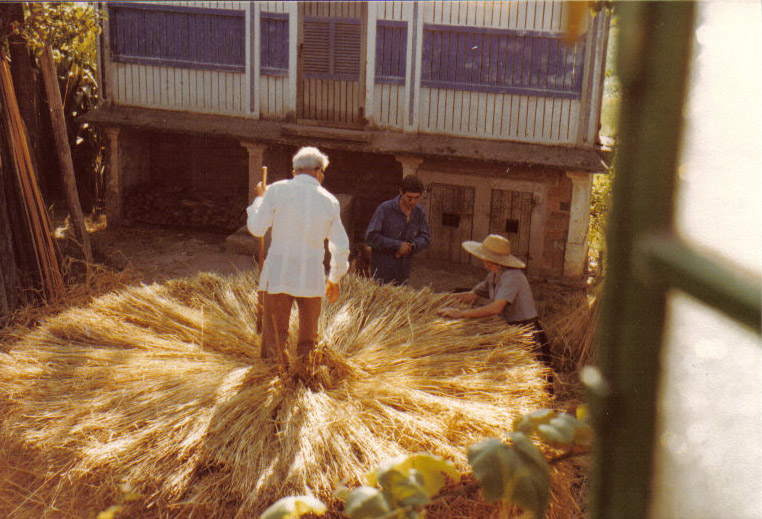 |
Foto 12. A base do palleiro. |
Picture 12. The base of the hayrick. To make the hayrick, the hay was placed in a circle. A person went up with a hay fork to arrange the straw that some other people threw up from beneath or from a cart. |
 |
Foto 13. Metade do palleiro. Nesta imaxe vemos como a persoa que está encima do palleiro vai colocando a palla de xeito circular coa forcada, en capas superpostas. |
Picture 13. The middle of the hayrick. In this image we can see how the person on the hayrick is arranging the straw in a circle with the fork in different layers. |
 |
Foto 14. Cumio do palleiro.
A medida que se vai facendo o palleiro se vai rematando
en forma de cono ata rematalo cun cucurucho feito de palla que se chama
carapucha. |
Picture 14. The top of the hayrick. As the hayrick grows the top is given a conical shape and a hood made of straw is placed on the top. This is called "carapucha". The hayrick was made hay or straw but the outside cover was made of rye straw to protect it from the rain. A straw ring was placed on the surface so the straw layer didn´t fly away. |
 |
Foto 15. Tipos de palleiros. |
Picture
15. Types of hayricks. In this picture we can see two hayricks. The one on the left is made of hay and the one on the right of wheat straw. Both of them are covered with rye straw. In between there is a small "maragota", a small hayrick which contains the strings to tie the sheaves. |
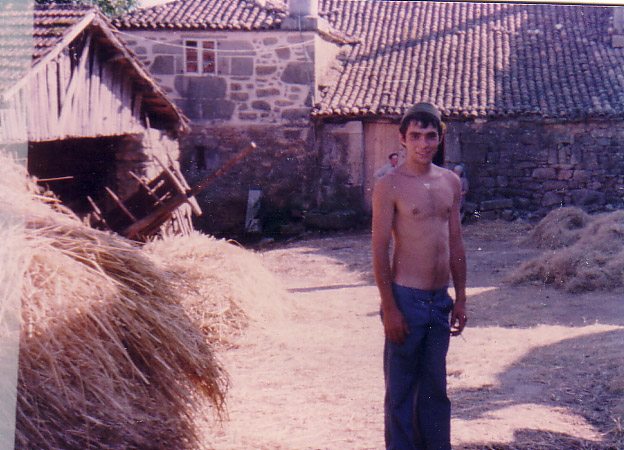 |
Foto 16. Posando co palleiro.
Ao acabar o palleiro era frecuente que a persoa que mais traballou nel se retratase ao seu lado. |
Picture 16. In front of the hayrick. When the hayrick was finished, the people who worked on it used to take pictures of it. |
| O empacado | The packing | |
 |
Foto 17. Carros de herba. |
Picture 17. Carts with
hay. In the old days the grass was reaped and left to dry and then it was carried by cart to the yard to make the hayrick so it was preserved for winter. |
 |
Foto 18.
Empacando. |
Picture 18. Packing. Nowadays hayricks are not necessary anymore thanks to technique. Packing machines pack the hay into bales that are stored in the barn or covered with plastic to use in winter. |
 |
Foto 19. Rolos. |
Picture 19. Bales. The grass is cut with the reaper and is arranged into lines. It is left to dry for a few days. Then the baler collects the hay, packs it and expells it as bales. At he beginning bales were rectangular, nowadays they are like rolls. |
| Apañar as patacas | Picking potatoes. | |
 |
Foto 20. Apañando
patacas. |
Picture 20. Picking potatoes. |
 |
Foto 21. Apañando patacas co tractor. |
Picture 21. Picking potatoes with
the tractor. |
| Recollida das hortalizas | Harvesting vegetables. | |
 |
Foto 22. Na horta. Durante todo o veran é posible desfrutar dos productos da horta. A finais da temporada, é necesario recollelos e almacenalos para a súa conservación. |
Picture 21. In the vegetable garden. |
|
|
Foto 23. Remolacha. |
Picture 23. Beetroot. |
 |
Foto 24. Pementos. |
Picture 24. Peppers. |
| Mallar as fabas | Threshing beans | |
 |
Foto 25.
Mallando. |
Picture 25. Threshing. |
| Sachar e regar o millo | Weeding the corn | |
 |
Foto 26. Sachando. |
Picture 26. Digging. |
 |
Foto 27. A rega. |
Picture 27. Watering. |
| Sacar as vacas a pacer | Taking the cows to graze | |
 |
Foto 28. Vacas á corda. |
Picture 28. Cows á corda |
 |
Foto 29. Rapaz coas vacas. |
Picture 29. Boy with cows. |
 |
Foto 30. Vacas na leira. As vacas podíanse levar a un prado ou a unha leira. Neste caso había que telas ben controladas para que non fosen á horta. |
Picture 30. Cows in the yard. |
 |
Foto 31. Vacas no prado. Nesta fotografía podemos ver ás vacas nun prado ao coidado dunha persoa. |
Picture 31. Cows on a field. |
 |
Foto 32. Devesa. Ás veces as vacas levábanse a zonas onde a vexetación mesturaba prados e árbores autóctonas. Estas eran as devesas. |
Picture 32. "Devesas". |
 |
Foto 33. Pastor eléctrico. Hoxe en día coa proliferación dos pastores eléctricos xa non é necesario que unha persoa estea ao coidado das vacas polo que se gaña tempo e recursos. As vacas quedan soas no prado cerradas por un cercado eléctrico que as mantén alí. |
Picture 33. Electric fencing. |